

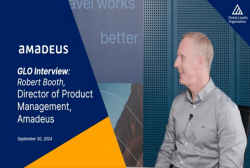
00:00 On key focus in Amadeus • 00:50 On Altea’s evolution to Nevio • 01:57 On Key Nevio features and use cases • 03:20 On state of digital transformation • 04:55 On implementation of Nevio 06:03 On 3 airlines pioneering Nevio and different use cases of Nevio • 08:34 On Nevio launch timeframe • 10:04 On costs and business case of Nevio’s implementation • 11:13 On future launches • 13:06 On hyper-contextualization • 14:57 On sustainability initiatives at Amadeus
 GLO
GLO- 00:00 On key focus in Amadeus
- 00:50 On Altea’s evolution to Nevio
- 01:57 On Key Nevio features and use cases
- 03:20 On the state of digital transformation
- 04:55 On implementation of Nevio
- 06:03 On 3 airlines pioneering Nevio and different use cases of Nevio
- 08:34 On Nevio launch timeframe
- 10:04 On costs and business case of Nevio’s implementation
- 11:13 On future launches
- 13:06 On hyper-contextualization
- 14:57 On sustainability initiatives at Amadeus
Full interview transcript:
00:00
GLO: Dear Robert, absolute pleasure to meet you here in Nice, at Amadeus offices and absolute pleasure to interview you. Robert, can you start by introducing yourself to our GLO members and tell us a little bit about your role at Amadeus.
Robert Booth: Hi, my name is Robert Booth and I’m a Director of Product Management here in Amadeus. My area of focus is our airline business and I’ve spent the last 20 years helping to evolve airline systems to make them more customer-centric and revenue-producing for our airlines. My current focus these days is NDC (new distribution capability) and Nevio, which is the new portfolio that we’ve launched.
00:50
GLO: Can you tell us a little bit more in detail about Nevio?
Robert Booth: Absolutely, in order to talk about Nevio we need to go back in time.
In 2000 Amadeus entered the airline IT space and we entered with a portfolio that was called Altea, which is a passenger services system that is based on the state-of-the-art industry standards and technology of 20 years ago. However, now in the mid 2020s we feel that we’ve reached a pivotal moment in terms of customer trends and us at Amadeus, as digital natives on what customer experience we expect from our airlines. In addition, technology has involved considerably in terms of Cloud native solutions, OpenAI, using data and data intelligence. Finally, the industry standards, which had been quite static for the last 30 or 40 years, have undertaken a revolution focusing on new distribution protocols such as NDC and also the change to one order.
01:57
GLO: So if we look at Nevio how would you say is it a step up or a change from Altea which you offered to your clients previously? How does it help your clients?
Robert Booth: In many respects Nevio is both an evolution and a revolution. The reason why I say it is an evolution is because airlines have been moving into the area of modern retailing over the last number of years. In that, they’ve looked to become more customer-centric in terms of collating and harmonizing data to provide more personalized offers. Also they’ve become more dynamic in terms of their offers with dynamic pricing and certain elements of bundling. Finally, they’ve also tried to move to more self-service.
However we’ve reached the limits of what are possible with today’s standards and legacy technology. So this is why I also say it’s a revolution because moving to one order and having a single order record in terms of removing legacy artifacts such as tickets, EMDs, static fare filing, RBDs or booking classes means that we need to transform the technology underneath. So both an evolution in terms of a better customer experience and a revolution in terms of the technology underpinnings of our industry.
03:20
GLO: You said that you have to transform the underlying technologies in order for your clients to achieve those changes. What challenges do you face when you work with your clients? What are the challenges they’re dealing with?
Robert Booth: I would say the challenges are in a number of areas.The first challenge is in the cost of the transformation. Our industry over the last 3-4 years had very reduced revenues because of COVID and our airlines were focused on getting their operations up and running. Doing a transformation program like this is quite costly so they need to have the available revenues to be able to invest in these kind of projects.
Secondly it is business continuity. Changing your core IT systems can be disruptive to your airline. Airlines need to operate 24/7. They can never stop operating. So how do you do a massive technology change while running your airline and not stopping even for a minute?
The third, these systems are not there yet. The standards have been defined and revolving but the systems are not yet complete. So how as an airline do you do a transformation into solutions that are being built while not shutting down your airline operation and also finding a way to invest in this technology and not having to wait three or four years until the project is live? These are a few of the challenges.
04:55
GLO: These are quite big challenges. Are there any real-life examples of implementation you can tell us about?
Robert Booth: Absolutely. I’ve talked about the challenges. But you wouldn’t be doing this unless there were benefits available. So let’s talk about a few of the benefits to some of the early adopters.
One of the areas that airlines are focusing is on dynamic and continuous pricing. This is moving from a world where you have fixed price points and quite large jumps between the different price points to continuous and dynamic pricing. By that we mean any price point and also, we mean a price that can react dynamically based on the customer context and also the competitive situation and also where that airline places themselves. If you are a full-service carrier and you’re being compared to a low-cost carrier and your product is better and richer, you would want to position your price probably higher than the low-cost carrier. We see airlines who move to dynamic and continuous pricing getting anywhere between 3-6% revenue increment on that.
06:03
GLO: Who are the movers? Who are the first movers? Can you share with us?
Robert Booth: So in terms of the first movers who have committed to a world of offer and order management within Amadeus, we have the privilege of working with 3 airlines. Those airlines are Finnair, Saudi Airlines and British Airways. They are going to be the pilots of moving from Altea, which is our current PSS, to Nevio, which is our future-proof offer and order management.
06:34
GLO: Three very different airlines and in different regions. So what are the different use cases?
Robert Booth: The 3 airlines that I mentioned are the airlines who historically have always been at the forefront of our industry trying new standards and new ways of working.
If you look at the sort of use cases that they’re looking to unlock, the first is in the area of being much more dynamic and reactive with their products. Today if an airline would like to release a new product, they need to go through quite a long and complicated process of filing the product. They need to get alignment on maybe 10 or 20 or 30 different systems.There can be impacts from their website, through to their booking engine, to their PSS, down to accounting. What that means is they can’t be very agile with their product offering. So one of the big areas of innovation that these airlines would like is to move to a much more dynamic product offering, where they can actually have business agility to try a new product configuration on potentially one market, gather data on the performance on that, and then roll that out to all the other markets. That’s one area that they’re focusing on.
Another area is around continuous and dynamic pricing of their products and services.
A third angle is actually a very customer-centric angle, and that’s around moving to 100% self-servicing. Today when there is a change to your flight, either because there’s been a change of schedule or else you as a customer would like to request a change, that process can be quite full of friction, it can be quite manual, it can require sometimes that you need to call the call center and you need to sit on hold. How can we move to a world where the end traveler is 100% empowered and can actually make those changes 100% themselves on their mobile device? So I would say these are a couple of the angles that our leading airlines are looking at.
08:34
GLO: You mentioned that for these three airlines at the moment it’s a pilot program. When can we expect it to go fully live? What is your time frame you’re working with?
Robert Booth: With the three airlines I mentioned, I wouldn’t actually call it a pilot, these are committed projects moving forward. Though what we see is two things. One is that they’re focusing on what I call early deliverables. Airlines can not wait 2-3 years to get ROI (return on investment). So with each of these airlines, they are focusing on their early deliverables and those early deliverables can be around bringing continuous and dynamic pricing to their current air products today. It also can be the area of continuous and dynamic pricing around their ancillary products today.
Another area of focus is on personalization and actually building the customer knowledge and the segmentation in order to apply that through their booking and servicing processes.
The last area is changing distribution. Each of these airlines are on a journey of moving from the current edifact-based distribution to XML driven NDC and each of those airlines are looking at moving their distribution more and more towards the new distribution capability.
10:04
GLO: Listening to you how the airlines transition from their current status to the new program, it sounds like there is a lot of change involved. There’s a lot of costs involved as well. So how do airlines actually justify this expense?
Robert Booth: In terms of the cost of change, there are a number of different things. The first is that airlines need to build a business case to say that the cost is worth the benefits.
The second thing is because this will take some time, you need to be able to handle the fact that you’re going to be running two systems in parallel for a while. The airline needs to have a way that they can control the total cost of ownership of running their existing passenger services system and then their new offer and order. And there are different ways to manage that.
The third thing is around, like I said, those early deliverables – not waiting 2-3 years until the new system is live, but releasing new capabilities 1-by-1 when they’re released. That is really focusing on more agile ways of project management and software delivery.
11:13
GLO: What’s in store in the next 18 months? What are you focusing on?
Robert Booth: In the next 18 months, I mean, we’re focusing on many things. I would say one of the first things is supporting what we call the prime booking flow. The prime booking flow is the first flow that a passenger goes through when they’re booking a flight, be that through either the airline’s digital or their NDC channels. That is a clear focus for us.
Then after that, we’re going to be looking at how can we build out the product catalogue with bundling capabilities, to allow an airline to create product bundles more than what they can today with static fare filing.
We’re also looking in the area of new commercial partnerships. This is the transformation of interline and codeshare. We’re looking at two different use cases. One is how can we help full service carriers interline with low cost carriers, which today is quite challenging because a lot of low cost carriers do not have tickets. Also we’re looking at supporting airlines upsell and cross-sell ancillary services between different full service carriers because that is actually quite challenging today.
The last area I’d look at is around servicing and the simplification of servicing based on the order management system. That’s sort of what’s happening over the next 18 to 24 months.
Then if we look further beyond that, we’re going to be focusing further down into the airline value chain. So looking at settlement and the way that we can simplify the accounting and the recognition of that revenue. Finally, in terms of the area of delivery. This is how we’re going to be transforming what is departure control into a more logistics delivery system where it has the customer at the heart rather than the flight.
13:06
GLO: Robert, you mentioned customer centricity. One topic we keep hearing about again and again in the last 12 months is the customer being at the centre of focus, the seamless travel and personalisation. So when you’re working with your clients, what trends are they talking about?
Robert Booth: Absolutely. Personalisation is a very broad category. What I would like to do is focus more on what I call hyper-contextualisation. The reason why I talk about hyper-contextualisation is that our industry can unlock a lot of value that has nothing to do with personalised data, i.e. what my name is, is actually not that important. What’s really important is the context that I’m travelling in. Let me give a concrete example. Imagine I’m travelling by myself. I’m flying on a Monday and I’m coming back on a Thursday. My context is most probably business and the sort of experience that I want to have and the sort of products and services that are relevant for me are very different than, for instance, I’m travelling in a party of four with two adults, two children. We’re travelling for three weeks and maybe it’s a long haul trip to a sunny destination. Now, that is just contextual and it’s nothing personal. What I would say is that there is so much value yet to be unlocked, even just leveraging contextual data in order to be more relevant in terms of your product offering and the way that you’re servicing your customers. So, I would say, hesitate a little bit on personalisation and really move to how can we get contextualisation right and be more relevant to those customers in front of us.
14:57
GLO: I think you hit the nail on the head there because personalisation is such a word which is so frequently used. But the question is, how do you use the data? What kind of data you’re using and what are you doing with it? And so that discussion could go on for another day.So, I’m going to stop here. And let’s move on to sustainability. You are part of your role is sustainability at Amadeus. Could you tell us about your initiatives?
Robert Booth: At Amadeus, we understand where we sit in the entire travel ecosystem. We do not make planes. We do not make engines. And we do not manufacture fuel. We are a technology company very much focused on the travel ecosystem. Our sustainability, and when I talk about sustainability, I’m really referring to environmental sustainability, is in 3main pillars.
The first one is, as a corporation, how are we being as sustainable as possible in terms of, be that offsetting our own travel or be that in terms of moving to different types of green IT. We need to move to green IT because of the volume of data and transactions that go through our system. And to ensure that we’re being as efficient as possible in terms of storage of data and transactions.
The second area is around what I’m going to call operational efficiency. A number of the systems we operate actually impact the operational efficiency of our airline customers. These are in the areas of, for instance, our sequence management at the airport, in terms of weight and load balancing for our aircraft. Everything we can do to optimize the amount of fuel burn is only beneficial.
Then the third area is in what I’m going to call true environmental sustainability options. What I mean here is not necessarily improving operational efficiency, but bringing new features and functions that have a pure sustainability angle. Now, one example of that is in terms of disclosure. One of the things that we’re working on is when a traveler is searching for flights, that we can be transparent in terms of the disclosure of the CO2 that is burned during that flight.
The next area is around the action that the traveler can take to offset that flight. So, we are bringing solutions to allow the passenger to either offset that flight or potentially to purchase SAF in order to make the environmental impact of that flight lesser than what it would be otherwise.
17:36
GLO: Robert, how retail transformation can help loyalty and also the airlines. Looking at the next 12 to 18 months, what would your one prediction be?
Robert Booth: My one prediction is that we’ve moved the conversation on from if the modern retailing transformation will happen, moving away from legacy standards to offer an order base to when. I predict that over the next 12 to 18 months, we’re going to see a certain number of airlines publicly declare their commitment to move to this new retail transformation.
18:22
GLO: Thank you very much. Absolute pleasure to talk to you and hope to catch you again next year. The pleasure is all mine.
Robert Booth: The pleasure is all mine.Thank you very much.
Source: GLO
Disclaimer: Press release
© Press Release 2025
Send us your press releases to news@globalloyalty.org
Press releases originate from external third-party providers. This website does not have responsibility or control over its content, which is presented as is, without any alterations. Neither this website nor its affiliates guarantee the accuracy of the views or opinions expressed in the press release.
The press release is intended solely for informational purposes and does not offer tax, legal, or investment advice, nor does it express any opinion regarding the suitability, value, or profitability of specific securities, portfolios, or investment strategies. Neither this website nor its affiliates are liable for any errors or inaccuracies in the content, nor for any actions taken based on it. By using the information provided in this article, you agree to do so at your own risk.
To the maximum extent permitted by applicable law, this website, its parent company, subsidiaries, affiliates, shareholders, directors, officers, employees, agents, advertisers, content providers, and licensors shall not be liable to you for any direct, indirect, consequential, special, incidental, punitive, or exemplary damages, including but not limited to lost profits, savings, and revenues, whether in negligence, tort, contract, or any other theory of liability, even if the possibility of such damages was known or foreseeable.
The images used in press releases and articles provided by 3rd party sources belong to the respective source provider and are used for illustrative purposes in accordance with the original press releases and publications.
Disclaimer: Content
While we strive to maintain accurate and up-to-date content, Global Loyalty Organisation Ltd. makes no representations or warranties of any kind, express or implied, about the correctness accuracy, completeness, adequacy, or reliability of the information or the results derived from its use, not that the content will meet your requirements or expectations. The content is provided “as is” and “as available”. You agree that your use of the content is at your own risk. Global Loyalty Organisation Ltd. disclaims all warranties related to the content, including implied warranties of merchantability, fitness for a particular purpose, non-infringement, and title, and is not liable for a particular purpose, non-infringement, and title, and is not liable for any interruptions. Some jurisdictions do not allow the exclusion of certain warranties, so these jurisdictions may not apply to you. Global Loyalty Organisation Ltd. Reserves the right to modify, interrupt, or discontinue the content without notice and is not liable for doing so.
Global Loyalty Organisation Ltd. shall not be liable for any damages, including special, indirect, consequential, or incidental damages, or damages for lost profits, revenue, or use, arising out of or related to the content, whether in contract, negligence, tort, statute, equity, law, or otherwise, even if advised of such damages. Some jurisdictions do not allow limitations on liability for incidental or consequential damages, so this limitation may not apply to you. These disclaimers and limitations apply to Global Loyalty Organisation Ltd. and its parent, affiliates, related companies, contractors, sponsors, and their respective directors, officers, members, employees, agents, content providers, licensors, and advisors.
The content and its compilation, created by Global Loyalty Organisation Ltd, are the property of Global Loyalty Organisation Ltd. and cannot be reproduced without prior written permission.
