

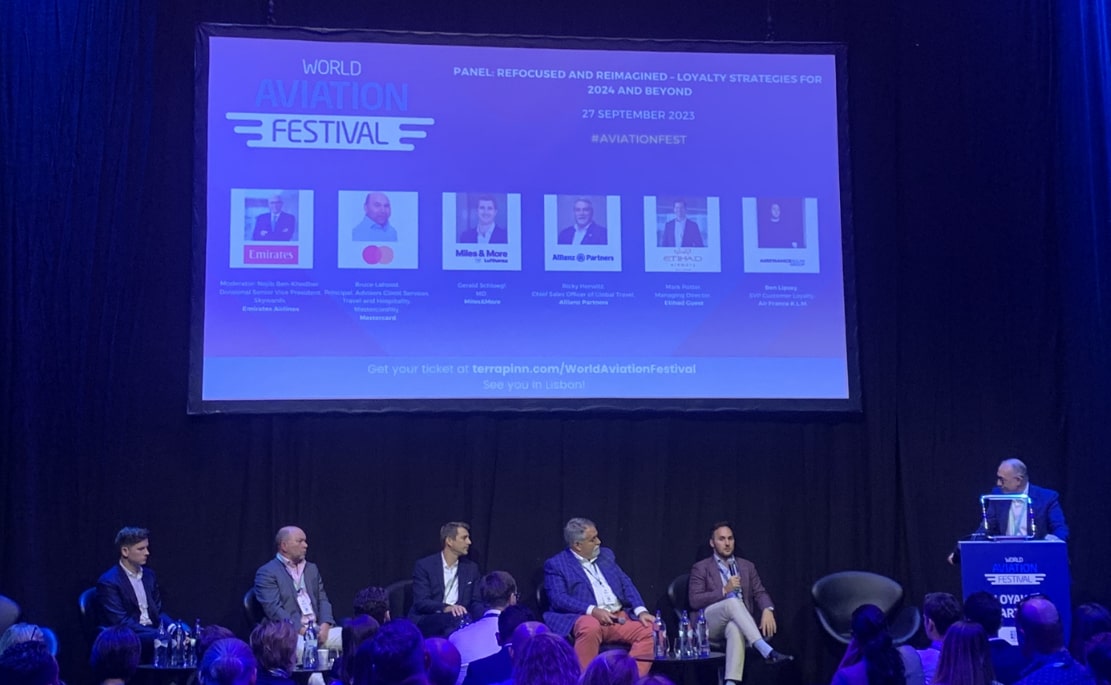
Key takeaways from GLO-hosted Loyalty session with Dr. Nejib Ben Khedher, Emirates, Ben Lipsey Air France - KLM, Gerald Schloegl of Lufthansa Miles & More, Bruce Lahood from Mastercard, Mark Potter from Etihad and Ricky Horwitz of Allianz Insurance discussing loyalty strategies in 2024 and beyond.
 GLO
GLOKey takeaways from GLO-hosted loyalty session with Dr. Nejib Ben-Khedher, Emirates, Ben Lipsey of Air France – KLM, Gerald Schloegl of Lufthansa/Miles & More, Bruce Lahood from Mastercard, Mark Potter from Etihad and Ricky Horwitz of Allianz Insurance discussing loyalty strategies in 2024 and beyond.
Day 2 of WAF presented a GLO-hosted loyalty session: “Refocused and Reimagined – Loyalty strategies for 2024 and beyond” with Dr. Nejib Ben-Khedher, Emirates as Moderator, and Ben Lipsey of Air France – KLM, Gerald Schloegl of Lufthansa/Miles & More, Bruce Lahood from Mastercard, Mark Potter from Etihad and Ricky Horwitz of Allianz Insurance discussing loyalty strategies in 2024 and beyond.
Nejib Ben-Khedher, Emirates / Skywards: My dear colleagues, we are here on an invitation from Global Loyalty Organisation, a global loyalty and CX professional association. Emirates is a member of GLO and I believe Air France is also a member there are large members from other industries like Accor, Deloitte, and Visa who are also part of the network and it’s a great platform for us to regularly exchange opinions and views.
Let’s talk about some of the trends and I would like to address the “elephant in the room”. I believe that my colleagues would agree with me that the pandemic has put us in the spotlight. During the pandemic, loyalty was the only division that was bringing contributions to the bottom line and kept on generating revenue. Post-pandemic, we have a different picture with the boom in travel, not enough seats available for FFP members to redeem, which posed a big challenge. We’ve seen instances of what I would call program devaluation. All the programs have approached it in different ways, but we need to call a spade a spade and it is somewhat of a program devaluation. How you guys are weathering the storm and change from pandemic to post-pandemic?
Ben Lipsey, Air France- KLM, Flying Blue: During the pandemic and I think now even more so, it’s clear that the loyalty organization is the one responsible for a lot of the more resilient revenues that come in. I think we’ve recently seen some significant changes in the industry, both in Europe with British Airways and in the U.S. with Delta, and how even a small change can have an outsized impact on those who are most loyal. But at the same time, I think, when we look at America, for example, when they followed the change to kind of more total revenue-based accumulation for status – we see that the spending on their co-branded credit cards went up, the number of applications went up, the spend on their partners went up and by extension, their commission. So I think and the reason I’m mentioning the U.S. in particular is because I think there you have a true understanding or rather a different understanding of the importance of loyalty towards the bottom line. Having worked in the North American market, and now working in Europe, I can tell you that it’s a different ballgame, so to speak. The reliance that we have on our co-brand credit cards is a lot less due to the regulated interchange fees in Europe. Heads of loyalty programs are all familiar with the challenges we face.
That being said we have a strong business in credit card conversions – primarily Americans have been transferring their points from Amex Chase or Citi into our program and then redeeming them. To your point about the limited availability, one of the strengths of our own Flying Blue program in our case is we have a dynamic inventory. We were one of the first ones to move towards this about 10 years ago and that was done at the request of our members, which allowed them to redeem for any seat on the plane. So, of course, when the plane is full to help us get rid of distressed inventory, you have the cheapest seats available, the saver inventory, or the limited seats for lower prices. But of course, if you want to go on a particular date on a particular flight, you can use more miles to buy that seat. So, for us, that has helped kind of shield the members a little bit from these kinds of devaluations. But it doesn’t make kind of the commercial value of the seats, which does, again, keep our revenue management team and our members.
Gerald Schloegl, Lufthansa / Miles & More: First of all, I think loyalty has a commercial impact. The thing is we are not able to show it today, but loyalty is changing customer behavior. This I would say is often not rational; it is very emotional. This is why we at Lufthansa are working on what we call the “customer lifetime value” concept because we would like to show the commercial impact. So what is the real commercial impact of the loyalty program on the bottom line of the airlines? Because what we know, for instance, is a customer who booked a business class redemption flight for the first time, and never booked full-fare business class tickets before. But after the experience of flying business class, he or she can start booking business class. And that’s what I mean by loyalty changing customer behavior. You’re giving them a perk, an experience, and then you’re changing their buying behavior. But we need to make it transparent. That’s the key aspect of it. That’s why we’re working on the master concept.
Nejib Ben-Khedher, Emirates / Skywards: Bruce, you have recently published a per on loyalty, talking about 3 major trends that you have seen in the change of customer behavior. These trends are lifestyle loyalty, recognition and 3rd is simplicity and accessibility of programs. Can you take us to the details of this research?
Bruce Lahood, Mastercard: As my colleagues have already mentioned, there’s quite a different marketplace that’s come back post-pandemic. I think the mix of customers, the heavy dominant leisure market, maybe less of the “road warriors”, sort of changed the makeup of the market. I think that’s a bearing going forward with this construct of loyalty programs.
The other one is the monetization. I think there’s a realization now that loyalty is a highly valuable asset and needs to be monetized and quantified in ways that contribute to the overall business. So the first one sits around lifestyle. And really if you go with the notion that there’s a different marketplace out there – there’s a lot of people traveling, but the frequency on average has probably come down a little.
So the question becomes how do you stay relevant with an audience when they’re not traveling on your aircraft or staying in your hotels or whatever space across the loyalty and travel aspect of your play? It speaks to being part of their everyday lives rather than just their travel lives. I think that’s where lifestyle kicks in and that’s where partner ecosystems and the ability to stay relevant when people aren’t in your brand so that when they do come back to the travel world, your brand is top of mind. This can be done through things like co-brands, but partnerships of any sort can play a role in doing that. So that’s what lifestyle speaks to.
When I talk about relevance and recognition, this is something we observe, as we work with a lot of brands around the world in travel and hospitality. Often, they go back to the program to say, I need to reboot as this is not working, I need to look at the value proposition – when in fact often it’s the marketing that brings it to life that is not performing against the backdrop of a program that’s probably quite robust. It’s just not being communicated well.
Just to give you some quick stats: the return of travelers that come into loyalty programs, is quite significant in terms of the repeat travel behavior and the ability to have marketing to onboard and educate people into a program is super important and all brands do that very well. It’s a big area of relevance and the recognition speaks to a deprived market that’s come back into the marketplace two years on. It’s looking for those small touches. And these aren’t just necessarily status benefits, these are just the small recognition touches such as simplicity and access.
For simplicity and accessibility, it is literally about dumbing down programs. These legacy programs have been around for a long time and become quite elaborate for consumers to understand.
So taking a 40,000-foot view of a program, it’s quite a labyrinth of complexity. But consumers see it like a tunnel, traversing from one door to the next, and the ability to be able to simplify and make accessibility into that program and drive incrementally is super important.
Nejib Ben-Khedher, Emirates / Skywards: How is the Etihad Guest loyalty program adapting to these 3 trends?
Mark Potter, Etihad / Etihad Guest: I think on the everyday side, three years ago we launched the “Miles on the Go” product. It allowed the currency to be surfaced in an ecosystem of a thousand-plus merchants. That was kind of the beginning of the narrative of how we can get the currency to be prevalent in non-air space.
I think what is evolving now is we still drive the members to come to our ecosystem to transact. I think our currency needs to be serviced in that ecosystem instead, so it becomes part of their life rather than forcing the members into our lives. So, there’s an evolution of that space.
I think simplicity is important, but I think also what’s going to happen is we need to put some of the choice back in the members’ hands. So at the moment, to your point, Bruce, I think we have a legacy product that is a tier benefit structure which is the same for everybody, irrespective of whether you’re a corporate or family leisure flier, whether you fly once a year or 25,000 times a year, there is always the same tier benefits. I think the member needs to take some ownership of that and be given the choice of what they want to do when they’re flying for that certain kind of transaction.
On the recognition side, I think Sky does a great job of recognizing the members through your experiential product – you have a great asset suite of sponsorships. We’re in the beginning of doing that. What we’re seeing is members are enjoying the ability to engage with us in a non-kind of transactional sense, e.g. taking them to football games, or taking them on flights and normal services in meetings that we can talk to them in an informal sense. And that emotional connection is not just a narrative in an email, it’s an analogy to having face-to-face or 1 to 1. I think as we come out of COVID, members are still expecting that emotional connection so we can find ways to recognize them by taking them on trips, but also engaging them more frequently, understand what they like.
Ben Lipsey, Air France-KLM / Flying Blue: I think, yeah, I would echo what Mark said because, I think the emotional aspect leads to what we call it, what I call kind of the, you know, aspirational rewards and irrational behavior to achieve those. When I say irrational behavior, I don’t mean that in a negative sense. What I mean is you go out of your way to take a flight that might have an extra connection or be less convenient or more expensive, which of course is the goal, because you’re loyal to the airline hotel chain, or car rental company.
We see our partners, Accor, in the hotel space, have done very similarly the experiential aspect where, you know, because they sponsor the Paris Olympics and Paris soccer team, members can use miles to train on the pitch with the players, which is something so unique. People are extremely loyal because of this and they don’t end up using their points for hotel rooms, but they use them for these kinds of experiences.
So at Flying Blue, Air France-KLM we’re similarly attempting to offer such experiences. We are in the early stages of developing that, especially in light of the Olympics coming to Paris next year as well. We have two Michelin-star chefs that we have based at the event with culinary expertise from France.
We also see that that when emotion drives customer behavior, there’s a lot of there’s a lot of real attachment to the program, which means that you have your own ambassadors talking to their own, their own friends and families and colleagues, which can help drive business. So that’s for me a big reason to treat your customers with respect.
I think gone are the days when you can try to spin a negative change, which is going to happen into a positive one because people talk and people feel insulted if you try to do that. We’re looking at how we change our communication to make sure that it is transparent.
Gerald Schloegl, Lufthansa / Miles & More: A couple of weeks ago I learned a sentence that I really like “Experiences over things”. What does it mean? We see that customers are spending more on experiences like restaurants, and traveling, and less on things in the classical sense, e.g. retail stuff. I think this is a new phase that we are entering now and this phase is coming out of the pandemic. Members rather invest in personal experiences like meeting friends, and families rather than buying the next stuff they do not need. I think from this point the major role of the loyalty program is to address the need for these experiences and to create these experiences because it’s not just the transactional part, it’s the emotional part. This will be a long-term trend, an ongoing trend.
Ricky Horwitz, Allianz Partners: I think everyone knows that travel insurance is the sexiest product in the travel space. At Allianz, we don’t assume what the traveler, the customer is looking for. It used to be cost, it used to be the time. What we’ve learned and what we continue to learn and to evolve around safety, security, and wellbeing. The wellbeing ties to the lifestyle and travel. How can we create products that can work in each of our partner’s ecosystems? How can we make sure, more importantly, that we’re understanding your brand and support your brand? We do that with each of our partners a little differently, making sure that our products are easy to understand, easy to purchase, and easy to claim.
When you have something going wrong, we’re here and we’re here to fix it as quickly as possible. We can’t prevent things from happening, but we can make them better by responding quickly and supporting customers and our partners’ brands.
Nejib Ben-Khedher, Emirates / Skywards: Mastercard is not just a payment provider, but also has a wide suite of solutions and products to support its clients. Bruce, can you talk through some of the use cases of how you currently work with airlines to address these 3 main trends?
Bruce Lahood, Mastercard: We’ve been working with some carriers to bring the program to life, in the sense of “context strategy” or “program lifecycle”, e.g., a new program in the untouched territory or the program that needs a major overhaul. Such cases present a lot of bottom-line and top-line opportunities. We’re also helping brands with invigorating the proposition or introducing a co-brand potentially into their ecosystem. Hence, we cover the span of services. We have as a strategy a consulting unit agnostic to payments and platforms, whose goal is purely to help businesses succeed through loyalty and customer engagement.
We’re sensing and this is a universal truth that loyalty is taking a high profile in many businesses, and I think it’s being recognized now that it’s not just when things are good or things are bad, that loyalty plays a more predominant role. I think it’s just a natural element of the infrastructure of the business.
If we go back to the monetization aspect – it’s clearly commercially beneficial, it is a bridge to a marketplace, to trigger an incremental activity and drive value and experience beyond the flight. The experience is absolutely critical. We see a lot of energy around that right now.
Nejib Ben-Khedher, Emirates / Skywards: If we zoom in on a specific set and specifically millennials, which are truly a fickle set of customers – they love the experience part of it but are not loyal. How are you engaging with the new generation of travelers that is really emerging, that has high demands but sometimes doesn’t commit to the brand?
Ben Lipsey, Air France-KLM / Flying Blue: Interestingly, at least in Europe, there is a much bigger focus from that age group on sustainability. I say in Europe because in the North American market it barely even registers, but in Europe, it’s quite strong. We have platinum members, for example, who say “I’m a platinum member with you, I love flying with you for work. You’re my carrier of choice, but I don’t want you to recognize me when I’m traveling with my friends or family because I’m embarrassed. Because it means that when you recognize me as a platinum member, it means they will know I travel a lot”. This is a new challenge for us. And I can’t tell the customer that he or she’s wrong in this case. So, it’s a new challenge for us. Historically it was completely different for my airline colleagues as those who travel a lot looked at each other’s luggage tags and people proudly were showing them at security.
So now, for us, the question emerged of how do we start to reward sustainability? How do we start to change what takes to earn status and address more of what our customers are asking? So we were the first in Europe, if not in the world to change the way we award our status, the currency, or what we call XP.
Historically it was only earned by flying. In 2020 we launched loyalty XP for Sustainable Choices, for SAF fuel. You can earn one XP for every Eur10 spent. We saw an 800% increase in the amount of SAF purchased, even though it was from a low base, let’s be transparent. But still, it’s a significant change. And to me, it also shows the power that loyalty has in influencing customer behavior purely from an objective manner. And it shows to the other teams in the company, the power of loyalty. When we did this we had one customer who bought a first-class “Le Premier” ticket for Eur15,000 and then bought enough SAF to qualify her for one trip because at the moment we don’t cap the SAF. So for some people, it’s really important, they do it as a personal investment to compensate for their flight activity. Others use this as a way of trying to help them earn status. We don’t judge, but it is something that we’ve seen and it had significant success and we’re looking to extend.
Nejib Ben-Khedher, Emirates / Skywards: Ben, thank you. Mark, I’ll talk to you because we’re talking about this topic. I know it’s dear to Etihad’s heart and Kim Hardaker presented last year on this. Could you talk a little bit about the success of the program that you have?
Mark Potter, Etihad / Etihad Guest: Conscious Choices is obviously a massive platform for us. We launched it a couple of years ago. I think we’ve evolved – as it has a form of gamification as well. The millennial group enjoys gamification as part of their program. We’ve recently released additional badges that allow almost a tiered structure in the badges as a result of sustainable activities.
The SAP elements that have been talked about are prevalent for us offsetting everyday transactions. We work with quick service delivery providers in the UAE to provide offsetting for the rides that happen as a consequence of food being delivered. We’re trying to find a way to disseminate the continuous product, not just on the flying ecosystem but on the everyday one as well.
It is part of the everyday life generally. It outperformed our expectations from the beginning. The numbers speak for themselves. I think similar to what has been talked about, we’re in the triple digits in percentage growth compared to our expectations. It’s continuing to grow. I think it shows that people are conscious of what they’re doing and that we need to find a way to allow them currency to be part of that journey for them because they’re fickle, the millennials, perhaps partially. If miles can be used to support conscious choices, it means a bit of an easy ecosystem. If they find a tangible benefit of that redemption, then ultimately they’re going to continue to transact with you. We know when you redeem once, you’re going to transact again, and you get the benefits. It is all part of that funnel and perpetual life cycle.
Bruce Lahood, Mastercard: Can I just build on that as Ben just touched on a good point? Loyalty is a means to change behavior in a good way and I think it’s a force for good. If you intersect sustainability and loyalty for customers going forward, I think it goes beyond the millennial marketplace and I think there’s a lot more interest in the future preservation of things by all customers.
If you use a Costa Coffee example, they now incentivize people to bring in their own cups as they try to minimize or mitigate paper cups. Suddenly everybody’s changed their behavior, their pattern. Think of the cost savings that maybe the brands enjoy. Maybe it’s a different service delivery model now that’s operating because you’re not storing cups, your real estate is less. It changes the operating model. It is doing good for the planet and the people feel good to interact with the brand, the kids.
There is also mobilizing a movement. I think of sustainability, loyalty, brands, and individuals as like-minded partners to tackle something we all need to look at could be quite powerful going forward.
Nejib Ben-Khedher, Emirates / Skywards: I love your phrase “Loyalty as a force for good” and I’m going to use that internally also to make the case.
Gerald Schloegl, Lufthansa / Miles & More: I think we touched a couple of things already, but coming from this structural change, we will see clearly new priorities from the customers. One is the personalization topic and I think we touched upon this one. The other one is the joy of using digital channels. To be honest, in our case, it’s a bit down to the digital platforms. Here the gamification aspect clearly comes in. We launched an app called Our Trip together with the Lufthansa Innovation Hub and Uptrip.com. If you’re interested, have a look. The customers are able to scan the boarding passes to collect and then get rewards for this collection. It’s a way of badges, way of collecting badges, but also the sense of belonging and meaningfulness plays a role. I wouldn’t say they’re not loyal, but they need to have a purpose to commit and that’s what we clearly see.
Sustainability is, of course, a major topic for us as well. I like the phrase “It’s a force for good to change behavior”. We are also saying internally we are trying to “motivate”, to “influence” towards unsustainable behavior. And that’s why Lufthansa launched the “Green Fares”, which include 20% sustainable aviation fuels. We are motivating the customer by giving 20% status points in total, for instance. But this will clearly also be a major topic for us in 2024 on how can we change the behavior towards sustainable products.
We have also our own retail shop, but you can also buy sustainable products upcycled or recycled using materials from the airplane, where customers are also incentivized.
Nejib Ben-Khedher, Emirates / Skywards: Are you modifying insurance products to make them more sustainable or engaging better with sustainable products?
Ricky Horwitz, Allianz Partners: Few words on sustainability. You can’t touch or feel insurance, right? It’s a peace of mind, but we are digital by default as instead of sending out a lot of paper, everything can be done on an app. We’re not we’re not cutting trees down.
From a millennial perspective, there are a lot of things we’re doing including creating new products outside of the in-flight or in-airport experience. We go from door to door and protect the travelers. We’re also creating lifestyle products around cybersecurity, home, and easy living.
And last – millennials want things to be easy, and there is the friction-free concept. But millennials want effortless, right? They don’t want to have to think about it. So we’ve created proactive benefits so that if something does go wrong and we’re aware, we’re going to reach out to anyone, you don’t have to be a millennial. We’re going to reach out, and going to say, “Hey, there was a problem. How can we help you?” Or, “Hey, you have a benefit we can pay you. How would you like to be paid?” There is no filing of the claim, there’s no friction, and it’s effortless.
Nejib Ben-Khedher, Emirates / Skywards: I would say that 2 moments of truth in loyalty are actually what you do around disruptions or when things go bad and how do we engage with our customers in terms of personalizing that engagement, even with the crew and everybody. So that brings me to the topic of technology to enable all of this as well.
We talked about digital in general, but let’s touch on technology in general. We have embarked in Emirates Skywards on a big transformation from our loyalty backend. Harold, you talked about unbundling and it is one of the things we always explored, but technology was not there. And hopefully, with the new platform, we will be able to do more personalization with clear benefits to our customers.
What are you seeing from a technology perspective that is helping obviously address some of these trends, your reliance on technology?
Ben Lipsey, Air France-KLM / Flying Blue: What I see is that our digital team is always trying to do more with less. I think that’s the that’s a common trend that we all have, you know increasing demands on budgets and they’re always constrained to try to deliver more with one hand tied behind their back. So hats off to them, seriously.
But as we try to transform, the future does look kind of endless in terms of what technology will allow us to do with AI. How do we harness it? Some of the things that Chap GPT can do are scary, cool, and all the above. We’re really focusing on now trying to actually fully build a proper CRM tool that ties in everything from your purchase behavior with or without a flight account, your preferences, what happens on board, what kinds of tickets you normally book, and all the above.
Then in phase two, of course, we’d like to work more with our partners to plug that in as well, to be able to help, more predictive targeting for our customers through emailing and online advertisements. I see that kind of stuff. For us, that’s kind of the best way to go after more revenues by having more precise, more relevant offers, both on the loyalty side as well as on the digital side.
Ricky Horwitz, Allianz Partners: I would say from Allianz’s perspective we’ve been using predictive models and AI for 10-15 years. We have 280 billion data points to be able to make that relevant offer exactly what you were talking about. But what we are focused on now is taking that to the claims process. How can we pay a claim quickly? How can we pay a claim without even someone filing a claim? And if we have to deny a claim, how can we do that quickly too? Because we can’t pay for everything. But we need to have clear and concise communication and we’re using the data that we have and the technology that we have to certainly focus on those on those points as part of the process.
Gerald Schloegl, Lufthansa / Miles & More: Though, maybe a different angle besides the topic that you need to have a database, a proper one, and bring the data and connect the dots and bring that data into the customer journey. I think what is driving us and important for us is also the operating model. So how are we working together internally to develop these products?
How are we working together with IT and all the digital control departments? I think this is a really important aspect because changing it into an internal way of working, and building our product teams internally, is accelerating the process.
Lufthansa is now building up the Lufthansa digital hangar and by doing that, they’re changing the operating model. We see already that this really is accelerating the whole digitalization process. I think a very important aspect when it comes to technology, also is to empower the people, to empower the organization to exactly deliver those products and values to the customer.
Mark Potter, Etihad / Etihad Guest: I think partners play a huge role in our success from a technology perspective. I think by no means that we experts in everything we want to try to do on the loyalty side. We have ideas, we innovate with the likes of Visa, MasterCard, or Points.com on those solutions. Those guys allow us to achieve a proposition that we don’t necessarily need to build ourselves. We can leverage what they’ve already built and make that part of our ecosystem. We have teams, digital teams that facilitate certain parts of the business. But at the end of the day, coming from a partnership background, I think it makes more sense sometimes just to bring in someone who’s an expert and support them in that journey and then collectively collaborate on what success looks like. Otherwise, we’re never going to get ahead of the curve.
Bruce Lahood, Mastercard: From our standpoint, so when we go out to clients, you know, every idea and technology is a good one, right? You need a strategy first before technology actually can be enabled to make it happen. But the key things that should develop a roadmap for technology do sit around customer universal needs that you’re trying to solve. I’ve heard about choice and control and convenience, and I would test that. Those are the sort of North Stars that inform your strategy, but it needs to be very much built around, giving more control to the consumer and their interaction with the brand, giving them more choices through the program proposition and the convenience factors are really super important.
And to Ricky’s point, the programs need to make my life easier, and again, I would say that’s a universal truth. It might be heavy on Millennials, but I would say we all could do with a few minutes back in our lives. And I think anything that enables that through the brands and the execution and technology is going to be great.
Nejib Ben-Khedher, Emirates / Skywards: By the way, I don’t hold any grudge against IT and CTO as I have been running Skywards for a year and a half, so I can only blame myself if nothing is moving. I think IT is an important enabler for the business as we go and we try to simplify and give more control to our customers and personalize that sense of technology.
So maybe we’ll close maybe with, with your thoughts. I think we’ve gone through the pandemic. Now in the post-pandemic, it’s a very volatile and uncertain world and we need to keep being agile. What have you learned in the past 3-4 years and you’re taking forward as you go?
Ricky Horwitz, Allianz Partners: What we’re focused on is not assuming. Right. One of the things I said to begin with, is don’t assume what customers want. Don’t think about today. Think about eight months, 18 months, three years from now, you know, what is the future? What are we going to need and what do safety, security, and well-being look like? And that’s what we’re focused on. As I mentioned, we’re developing new products, some of them will work great, and some of them may not. But we’re constantly innovating and thinking about new products around the world that will focus on safety, security, and well-being, which then goes back to our partners, you know, brand and loyalty, because we are, you know, an extension of our partner’s brand and their brand promise.
Gerald Schloegl, Lufthansa / Miles & More: I would frame it with flexibility. That’s what I’ve learned, at least in all aspects. Flexibility in terms of building up a flexible nature organization that can react to changing customer needs, which can deliver faster products to the customer. Also, flexibility when it comes to technology. Stack Right. We still have a lot of legacy in the back end how can we modernize, and also flexibility when it comes to partners. How can we also react and partner in a fast way, with partners to integrate or to reduce partners in a way so flexibility is the word?
Bruce Lahood, Mastercard: In volatile times, and let’s be honest, I think they always will be, you still need that North Star, right? You need to know ultimately where you’re trying to take flying. I mean, the pilot is empowered to land and assume a destination.
How they get there could vary due to winds, air traffic, whatever. Those are the flexibilities at the moment. It’s real-time data that’s operating too. But the destination is undeniable. I think having a site toward the North Star that in a state somewhat simplifies a chaotic environment that you might be operating in stops you sort of zig zag when in fact if you stay the course, you may well get where you want to go.
Ben Lipsey, Air France-KLM / Flying Blue: Just to echo the point about the Northstar. I think for us to reiterate, I think what we see is this aspirational behavior. People want to travel, people want to dream and they dream about their destination, the dream about going out with their family to New York or to Tokyo or whatever, you know, upgrading their next trip to business class.
And that drives their irrational behavior, that drives their desire to engage with us and by extension, you know, the influences that where they buy their tickets. You’re seeing we just announced a new order of 50 airplanes. A few other airlines have done the same. How are we going to fill them? Well, that’s our job. I think we see that with loyalty. We really have the power to influence that, not with the revenge travel and all of that coming back. post-COVID, we see that in reality.
Mark Potter, Etihad / Etihad Guest: My last point on what we’ve learned from the last three or four years is that every cloud has a silver lining. I think it drove us to innovate change and evolve our programs and provide other ways for members to be engaged. I think we need to maintain that sort of trajectory as the world is always changing. We need to innovate through the process so we can’t stay still. I think we all come out has a benefit as a consequence. No longer are we all legacy programs or traditional solutions and we’re all different in our own way, and I think that needs to continue to evolve.
Nejib Ben-Khedher, Emirates / Skywards: Excellent. Let’s finish on a very positive note and again to summarize – we have flexibility, and innovation, focusing on the North Star, and actually, our members are making sure we’re doing the right things. We’re trying to just look at this as an opportunity rather than a challenge and a problem. It is good for the industry to continue to drive forward.
Source: GLO
