


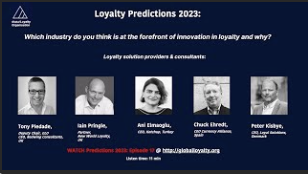
Video Interview featuring loyalty experts: Peter Kisbye, CEO, Loyal Solutions, Denmark / Chuck Ehredt, CEO Currency Alliance, Spain / Ani Elmaoglu, CEO, Ketchup, Turkey / Tony Piedade, Deputy Chair, GLO / CEO, Redwing Consultants, UK / Iain Pringle, Partner, New World Loyalty, UK
 GLO
GLOTony Piedade, CEO Redwings Consultants (UK): From a maturity perspective, the USA, UK, and traditional geographies like Europe are safe bets for a lot of brands and loyalty programmes. I’m seeing some exciting things developing especially in Asia, particularly out of Singapore. I’m seeing some great stuff happening in Bali from a start-up perspective. I am also expecting China to be on that list because of the sheer rapid pace of expansion. But for me, that feels a bit like an inaccessible market as I think getting there and taking part in that loyalty play requires a huge effort. So, I think Asia is certainly for me a big market. Australia, although a small market by size in terms of population, is quite exciting too. There are some interesting refinements of loyalty programmes going on there too, which are worth looking at. So overall, stability in the current markets of the USA, UK and Europe and don’t forget to look out for Asia as something a bit more inspiring, I would say.
Iain Pringle, Partner, New World Loyalty (UK): The issue is within the places like frequent flyer programmes, although it’s been very profitable, it’s been under-invested. So I don’t see massive innovation coming out of the frequent flyer space. Where I think the innovation is going to be next year is in the more forward-thinking retailers starting to apply new technologies and new techniques to loyalty in order to break out of the pack. And by that, you see things like Starbucks and Odyssey and web three. Starbucks is investing in NFTs and looking at how NFTs can help them do things better. Programmes like Joe and the Juice have really pushed out gamification and have an understanding that if you’re going to be in the mobile space, you’re really in the entertainment industry, not the loyalty industry. You need to make sure that your programme is entertaining and not just functional. I think where the innovations are going to come from is from retailers who really understand technology and loyalty and how it interacts with customers.
Ani Emanoglu, Ketchup Loyalty (Turkey): Actually, there are already many industries in Turkey where loyalty solutions have been established for a long time, such as energy, fuel and gas, airlines, banking and retail. But I think e-commerce companies are much more at the forefront of innovation, of campaign execution supported with personalisation and analytic tools. The difference or challenge is that until this time, they were using these technologies to acquire new customers or cross-sell and were less focused on retention. It should be easy for them to focus on their existing customers and put their loyalty mechanics into action.In Turkey, we don’t have a data issue because GDPR law is quite different from the European Union. So we have the data of the consumer. We know the consumer; we have the data system built already. And until now, we were always doing analysis on customer data or customer purchase behaviour, customer engagement behaviour etc. We are very used to that. For three, or four years, all the companies have had data analytics tools (very well-known tools like Click View, SQL etc) that they are using extensively. But until now they did not predict customer behaviour. They were using data analysis to plan their next step. But prediction is very different. Prediction based on machine learning is the next step. In 2023, we are trying to build a customised, personalised life cycle for each consumer and each loyalty member. Our challenge is to predict the next purchase step or the next engagement with the brand.
Chuck Ehredt, CEO Currency Alliance (Spain): Virtually every industry is involved in loyalty marketing in one way or another. Over the last four to five years, we’ve seen massive growth in B2B Loyalty programmes as well. So not only spanning telecommunications companies, utility companies, retail companies, travel companies, banks, and virtually every other sector that is involved in loyalty marketing. I can’t say that any particular industry is ahead of the others, or at least not achieving the optimal level of customer engagement. I think a lot of the bigger programmes that have been around for eight or ten or even 20 years are still playing catch up. And in many cases, it’s their existing technology stack that’s holding them back. An IT system that was deployed eight or ten years ago arguably was built on legacy architecture and probably has very significant maintenance costs from the vendors. And is inherently inflexible because of the monolithic structure of the different modules that operate a loyalty programme. I think we’re going to find that companies do start adding more microservice-based loyalty technology, typically, in front of their existing legacy system. If they can add cloud-based modern technology in front of the legacy system, the new technology can breathe new life into an ageing system, which sort of delays the need to replace a large loyalty system. Replacing loyalty systems can be a very complicated and expensive project that often takes 18 to 24 months. During an economic recession, brands are not going to want to embrace that level of expenditure or disruption to their business. And therefore, I think we’re going to find companies are delaying the replacement of legacy systems, but they will proactively start putting new cloud-based technology in front of their legacy system to breathe new life and extend the useful life of that technology.
Peter Kisbye, CEO Loyal Solutions (Denmark): I would say there are two industries driving innovation. One is airlines. Some airlines are really visionary. There’s a joke which is that many airlines should rework their whole business model and not be an airline offering a loyalty programme but a loyalty programme that has an airline. Some of the airlines are getting this right and winning. The other industry which is innovative is the financial services sector. Companies like Visa are seeing that loyalty is an important part of the offering and are building out their proposition in very innovative ways.
