


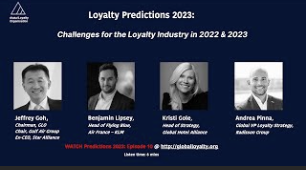
Featuring: Jeffrey Goh, CEO Gulf Air Group / Benjamin Lipsey, Head of Flying Blue Air France-KLM / Kristi Gole, Head of Strategy, Global Hotel Alliance / Andrea Pinna, Global SVP Loyalty Strategy, Radisson Hotel Group
 GLO
GLO
Jeffrey Goh, CEO of Gulf Air Group, ex-CEO Star Alliance: I think it is fair to say that many airlines and in fact many in the travel and hospitality industry are still adjusting themselves to the world after two or three years of very deep crisis. Some are still looking for ways to survive, some are preserving liquidity, and some are building better and stronger balance sheets. Investments in loyalty programmes have been mixed – some companies have continued to invest in enhancing their own programmes and enhancing their loyalty platforms and some have perhaps not been as forthcoming because of their concerns about liquidity and capital investments. We’re probably going to see some of that continuing into 2023 as I don’t think we’re entirely yet out of the COVID crisis, at least for the air travel industry. But I remain positive, and I think those of us who are familiar with the loyalty world, know the powerful proposition that all programmes provide to engage with customers. I am positive that many companies and many loyalty programmes will continue to invest forward in enhancing their loyalty propositions.
Kristi Gole, Head of Startegy, Global Hotel Alliance: Our biggest challenge which has been coming up more and more is trying to reach your customer. It used to be for marketing pretty straightforward: If you wanted to do direct marketing, which we did mostly because it’s no cost to send an email to people you could send it out to 2 million people and 20 million people. And email was a very low-cost way of getting in front of your customer and used to be really strong open rates and click rates. It was the key channel that we’ve leveraged in recent years.
But now, there’s email fatigue, as everyone is doing it. Consumers’ mailboxes are full of promotional emails. As a consequence, it has been harder to get our message in front of people the same way we used to. Now you have to do it across multiple channels. In different markets you have different channels entirely – like in China we’ve got WeChat for which we have an entirely different strategy that’s separate from our social media strategy in western cultures. Then we have we still have email, and digital ads and you have to kind of stretch it further. And so, for us, the hardest part is making sure that we’re being efficient and cost-effective and giving our message to this broad mix of channels and try to still do it personalised on where they are. If you got the app, do you want a push notification or do you still want that email or trying to figure out the messaging and the channel mix and trying to get the same results or better. It used to be easy. It was very direct. You said something, you want to get a message out, and you sent it. Now it’s: ‘okay, here is 15 different ways in 15 different things we did and here’s a follow-up. And by the way, I think we got the same amount of exposure we used to do with one try. I think that it’s a complicated aspect of it and this happens every decade. New channels come out and you have to figure it out. And that’s what this past year we’re still trying to do and next year, I think we’ll continue to try and figure that out.
Andrea Pinna, Global VP Loyalty Strategy, Radisson Hotels: In 2022, we dealt with the internal challenge to launch a new programme in such a short period of time, whilst at the same time keeping high standards of quality related to the member experience in a very unstable political international scenario, whilst also facing cost increase. But for 2023 we see challenges once again more related to external dynamics. We are very positive for 2023 as we expect travel to increase. This is also shown by the latest research. The challenges will be mostly geopolitical and also the impact of inflation on the overall economy.
Ben Lipsey, Head of Flying Blue, Air France – KLM: I think inflation was a big one. Cash inflation around the world is certainly in the double digits in many developed countries. I think we’ve also seen the spillover effects in the points world as well. I think a lot of programmes have devalued their currency because you have inflation at points. I think that’s much more pronounced in the US where I think credit cards have really contributed to more points in circulation. There’s a whole ecosystem that has evolved and you can build from that: Starting from the travel bloggers to the credit card companies to the airline to the hotel chains. And I think as a result, you’ve seen a lot of inflation in the points world as well and a lot of airlines and hotel chains have been forced to devalue or change the reward charts and the pricing mechanisms to accommodate for that. And I think for us in Flying Blue, we have members that earn the majority of their miles through flying, the old-fashioned way as it were. Credit cards in Europe are much less pronounced much less common, and much less generous for a number of reasons. So it means that European members don’t have the same access to earning miles as quickly as Americans, for example. And as a result, we have to make sure that our rewards are priced accordingly.
We are present in the US. We have relationships with a lot of the big banks that allow for miles conversion, which is for us, it’s a very important aspect. We have co-branded cards in 12 different markets. Again, it’s a very big component of our loyalty programme value proposition and we believe in trying to develop it further. In America, we do get to transfer members’ miles /points into Flying Blue, but we are still a programme that is based in Europe and has a majority of European members. And so we’re trying to combat the pressure of keeping inflation in our words under control while at the same time trying to manage surge and travel demand. And like many other programmes, we have a dynamic pricing mechanism. So the price of the reward ticket is a function of the price of the ticket and the inventory currently available. And when travel demand is surging reward tickets are naturally more expensive. So given that we have a lot of members with fewer miles than in the US and tickets that are becoming more expensive because travel is back up – it makes the value proposition of a loyalty programme kind of difficult and that’s what we’re trying to manage, while at the same time maintaining profitability.
