


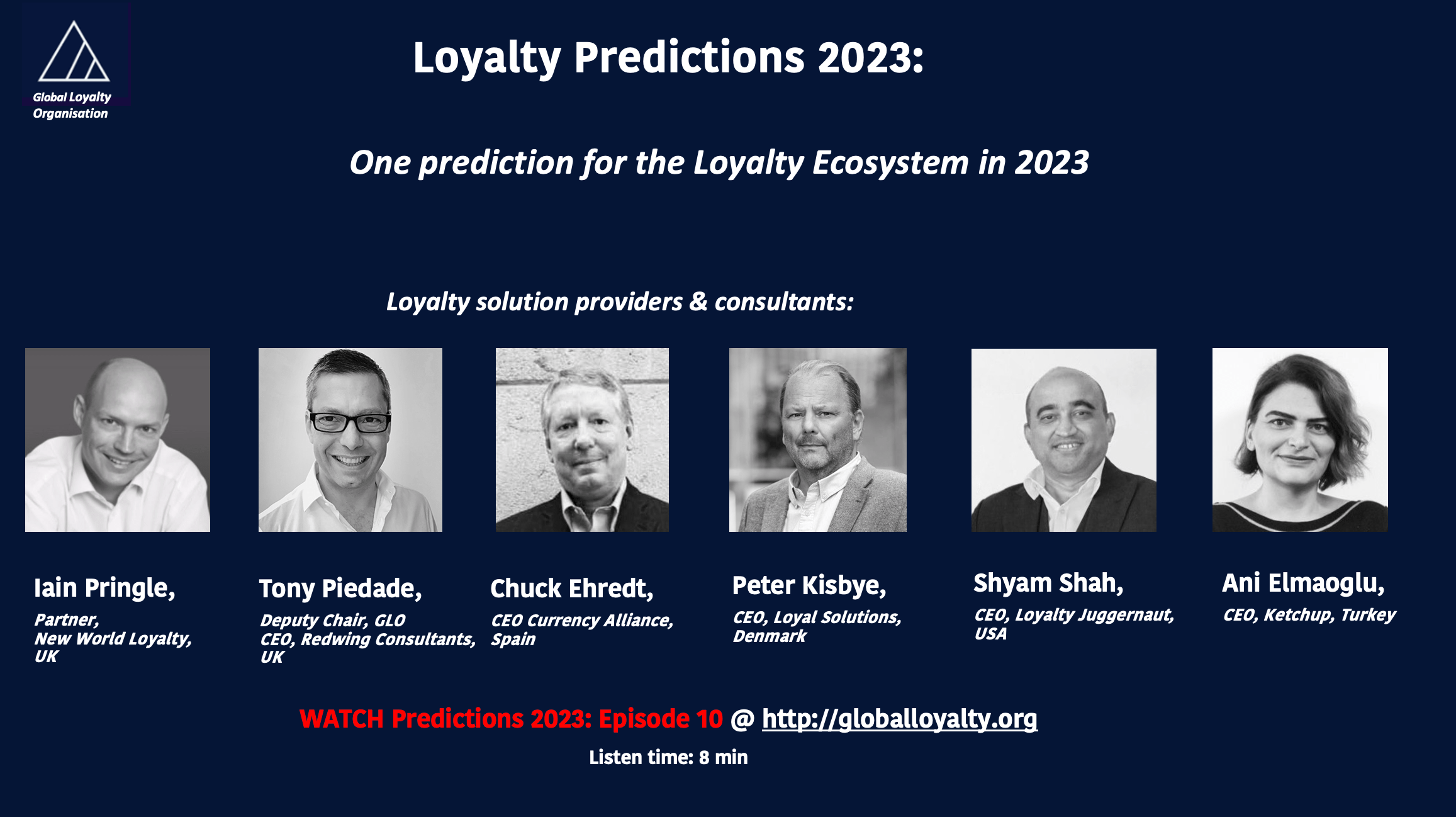
Video Interview featuring loyalty experts: Shyam Shah, CEO, Loyalty Juggernaut, USA/ Peter Kisbye, CEO, Loyal Solutions, Denmark / Chuck Ehredt, CEO Currency Alliance, Spain / Ani Elmaoglu, CEO, Ketchup, Turkey / Tony Piedade, Deputy Chair, GLO / CEO, Redwing Consultants, UK / Iain Pringle, Partner, New World Loyalty, UK
 GLO
GLO
Tony Piedade, CEO Redwings Consultants (UK): Well, I think this is an easy prediction as we are seeing signs of this already. I think loyalty programmes that were previously well entrenched in our own brands to open their arms to be much more inclusive. We talked about partnerships earlier. If you look at the British Airways Avios programme for example – they are actively going out and getting partners way outside of areas they would have looked at before. This is probably because this loyalty programme wants to be broader than just the airline but also because the partners became much more receptive to the fact that being part of a greater, more valuable ecosystem has more value than investing in their own programme. Some of that might be short-term thinking. But for some brands that makes absolute sense because there are synergies both from the brand and currency perspective that just makes that a no-brainer. Hence, my prediction is going to be that you’re going to see a lot of the well-known brands and loyalty programmes embrace environments, partnerships and other brands that they wouldn’t have otherwise two or three years ago.
Iain Pringle, Partner, New World Loyalty (UK): I think the big focus for next year will be review and redesign. So we’re facing a global recession facing a cost of living crisis with the airlines facing a status cliff where they’ve extended status and extended status, but business travel hasn’t recovered the way they were expecting. We talked about falling membership. We’ve also seen the success of programmes like Built in the US, which has been valued at $1.5 billion with only half a million members. So people are going to say “right I need to really redesign my programme. I need to look at the fundamentals of my programme and the value and ease of interacting with it, are they right? And also are things I could do to revamp that and look to the future?”. So you’ve seen the likes of Starbucks with web three, where they’re looking at using NF T’s to reward customers, and how that’s all going to develop? Who knows, but I think 2023 is going to be the year of the redesign to say “how can I make my programme fit for 2023 and fit for the future?”
Ani Emanoglu, Ketchup Loyalty (Turkey): Personalisation, because we have to step outside of only focusing on typical goods and mechanics and provide a personalised and consistent experience across all touchpoints to the consumers.
Chuck Ehredt, CEO Currency Alliance (Spain): I think the major trend over the course of this entire decade, the most impactful and important trend over the entire decade, will be brands setting up more open loyalty networks, where they’re able to collaborate with complementary brands as partners. And the reason for that is most brands don’t have that many frequent customers that are spending a lot with them. But those frequent customers are whom they’ve allocated most of their resources to over the last 20 years. And in order to engage with the mid-tail or the longer-tail customer, the less frequent customer, customers need to be able to earn the points that they really want from almost everywhere they shop. If I really want to collect the Avios, I should be able to get those at the convenience store or the pharmacy when I renew my insurance contract, or for most other categories of monthly discretionary spending and I think the retailers, especially the medium and smaller retailers also recognise that if they have their own standalone loyalty currency, it’s only going to be relevant to only a subset of customers. And if they want to be relevant to the majority of customers, they need to offer 1-2-3 or 5 popular loyalty currencies that the customers are most interested in collecting. And that requires that these brands connect with each other, establish commercial agreements and allow customers to be able to earn, redeem or exchange loyalty points. So that might almost sound like a self-serving proclamation but that’s exactly what currency Alliance enables. That’s exactly why we created the company. We believe that in order for brands to go from 20 or 25%, customer engagement to 50/60 or even 70% customer engagement they’re going to have to start offering the points that the customer really wants to collect, or they’re going to have to enable their loyalty currency to be exchangeable. So customers can shop for value between programmes and then accumulate enough value in one programme where they can reach interesting rewards.
Peter Kisbye, CEO Loyal Solutions (Denmark): Technology that enables people to be able to redeem the rewards in an easy way will be the one that takes off. We can see it in a lot of programmes now that when a programme introduces an easy way for consumers to use their rewards, it just takes off. I think that there is pressure from the consumer. Especially during COVID a lot of members in airline loyalty programmes had a large number of points accumulating which just sat there as there were no aeroplanes to fly on. This has led to immense pressure on airlines to offer other redemption possibilities. And that has, I think, caught people’s attention thinking:” Hey, if I can use this reward for something else, then travelling, then it’s really cool.” So, I think that is a key trend that will take off.
Shyam Shah, CEO Loyalty Juggernaut (USA): If you look at the predecessor of the loyalty ecosystem, we call it coalition programmes. And if you do a survey globally with loyalty professionals, there’ll be mixed sentiments about coalition programmes’ effectiveness and success. I think one of the things that coalition programmes did not really deliver on is the next-gen loyalty ecosystem. The coalition programme largely remains centralised. And that problem is largely solved through technology. So one of the improvements or one of the major departures in terms of how those ecosystems were delivered in the past, versus how they will shape up in the future is the whole ecosystem empowerment which benefits everyone – the partners as well as the members. And I think that’s the ultimate success of a loyalty ecosystem.
