


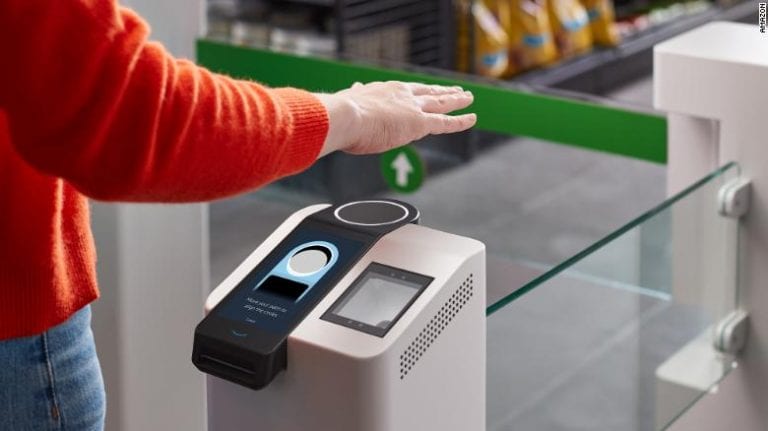
Amazon's expanded introduction of its palm-based payment technology, Amazon One, a month after its initial announcement, might not be the pioneer of this kind of technology, but its unparalleled deployment across numerous stores simultaneously could position it as the most ambitious venture of its kind.
 GLO
GLOAmazon’s expanded introduction of its palm-based payment technology, Amazon One, a month after its initial announcement, might not be the pioneer of this kind of technology, but its unparalleled deployment across numerous stores simultaneously could position it as the most ambitious venture of its kind.
This ambitious move is a direct response to consumer demand, as highlighted by the report “Consumer Authentication Preferences for Online Banking and Transactions,” a collaboration between PYMNTS and Entersekt. The study revealed that more than half of consumers who have employed biometrics for authentication purposes favor this technology.
In addition to being the preferred choice for consumers, biometrics technology also presents supplementary advantages for businesses and retailers. It allows them to integrate eCommerce-like data capabilities into physical stores, fostering a more integrated cross-channel approach. For instance, following a biometric scan, employees could greet customers by name and reference their previous order history, aligning with the trend in the restaurant industry to enhance personalized customer experiences.
Interesting research from PYMNTS, showing that biometrics as their preferred payment method:

In an interview with PYMNTS, George Hanson, the Senior Vice President and Chief Digital Officer at Panera Bread, elaborated on the motivations behind the chain’s adoption of Amazon One palm payment technology, starting in March. The initial rollout encompassed two stores, and Panera’s strategy extended to optimizing engagement with customers’ preferred accessory: their mobile devices.
Hanson explained, “Our approach involves bringing these digital capabilities into the café and into domains that have conventionally been analog.” He further mentioned, “For instance, we integrated Amazon One with the point of sale (POS), and in the previous year, we introduced contactless dine-in, which empowered customers to control their in-café dining experience using their smartphones.”
He emphasized, “We’re capitalizing on what customers have communicated to us and what their actions consistently demonstrate – an increasing adoption of digital practices. They expect their smartphones to be involved in every interaction and access point. We’re targeting areas that have historically been offline and enhancing the experience by leveraging our digital capabilities. The response from customers has been overwhelmingly positive.”
The trend of FinTech companies and other enterprises, like Amazon, introducing biometric authentication methods continues to gain momentum, and consumers exhibit a preference for these methods over passwords and PINs. While it remains uncertain if Amazon’s platform will emerge as the dominant choice, its swift market entry and potential for scalability position it as a formidable contender.
