

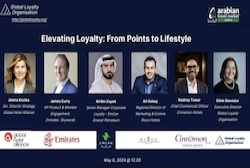
Featuring: Jelena Kezika, Sn. Director Strategy, GHA; James Curry, VP Product & Member Engagement, Emirates; Ali bin Zayed, Senior Manager, Corporate Loyalty, Emarat Petroleum; Ali Ozbay, Regional Director of Marketing and Communications, Rixos Hotels; and Radhey Tawar, CCO, Cinnamon Hotels.
 GLO
GLO00:00 – GLO introduction: Evolution from point-based rewards to experiential rewards
03:50 – How have members’ expectations changed over the last 12 months?
20:00 – Strategies to create emotional loyalty
36:18 – How to create emotional loyalty with GenZ and Gen Alpha
48:25 – One piece of advice for building successful brand loyalty
Dilek Glenister, GLO: Today’s loyalty panel is about experiences. It is called “Elevating Loyalty: from Points to Lifestyle”, and we will be discussing how brands can engage with customers and their guests to create long-lasting emotional loyalty.
Before we go into the panel discussion, I would like to lay the groundwork for how loyalty programs have evolved over the last few years. The first statement I would like to make is points based loyalty is transactional, while true loyalty is emotional. It has never sounded this true because, in a world of increasing competition and changing customer demands and behavior it has become more and more important for brands to differentiate themselves, offer loyalty and offer experiences.
Point-based rewards are still at the heart of every loyalty program; however, customers are demanding extra benefits and a seamless experience. Research, for example, done by Cap Gemini, showed that 82% of consumers surveyed said if they had an emotional connection to a brand, they would stay loyal to that brand over any other brand. Nearly 90% of all consumers surveyed said if they had an emotional connection to a brand, they would act as brand ambassadors – they would recommend the brand to friends and family. Loyalty programs and brands are recognizing this.
A survey done by Open Loyalty at the end of December last year surveyed over 100 (500 check) brands as well as loyalty specialists. The 3 main topics which loyalty programs have identified as key trends for the future are: experiences, personalization and gamification. In fact, we can put this altogether under one umbrella called “experiences” because without personalization you can’t offer the experiences, you can’t tailor experiences to your guests. Gamification is, in fact, just another form of experience. It’s a great tool for programs to engage with the members and guests even when they’re not staying at the hotel, flying with the airline or shopping at the petrol station.
The last chart I would like to leave with you is a recent study published by McKinsey, which uses data going back over 60 years and looks at consumer spending behaviour. It’s a clear trend that experiences or spending on experiences has been increasing over the past 60 years, whereas spending on items on things has been decreasing.
With that, I would like to open up to the panel. Jelena, I would like to start with you. GHA Discovery just published the latest annual members survey and asked the members what they want? Could you share your insights, please?
Jelena Kezika, Sn. Director Strategy, GHA: Two years ago, we relaunched GHA Discovery – our multi-brand loyalty program that we have together with 14 unique and beautiful hotel brands in Global Hotel Alliance. We deliver it to 26 million members. After the relaunch, we decided that every year, we will conduct customer research to understand what our program members want to see in GHA Discovery today, and also what they want to see in the program in the future.
For today’s conversation, I brought with me three interesting insights from our latest research, which we conducted in Q1 of this year:
Firstly, we asked our program members what they expect from the hotel loyalty programs, not just GHA Discovery, but programs overall. Here are their top three answers: Number one is all about perks or benefits to add to their stay that elevate the stay and make it more memorable. Number two is a new one this year and it’s all about scale. Members today are ready to travel with one loyalty program if this program gives them the scale – the scale of destination and the scale of the product that customers want. Number three, of course, is all about the loyalty currency. Members want a simple way to understand their rewards, the earn & spend in Discovery dollars, our innovative currency.
Insight number two, we asked our program members, “What defines the property when they want to book a hotel – what determines that?” The top three answers of our members Included: 1) the quality of the hotel (luxury), 2) the convenience of the destination and again 3) the benefits that the loyalty program provides.
This brings me to insight number three – the top benefits of GHA Discovery, our loyalty program. This year, members said that the number one benefit for them is room upgrades. Of course, who does not want to stay in a beautiful hotel room? Number two – it’s a complimentary breakfast, something our program members have been asking us for years and we finally launched this benefit just last month for participating brands for our top customers, Titanium members. Number three is late checkout.
So, how are these insights on benefits different from what our program members told us 12 months ago? They’re very different. 2022 was the last year of the pandemic, and everyone wanted to travel, of course, but it became very expensive. We’ve seen inflation and an increase in the cost of living everywhere. So 12 months ago, our program members were telling us that they wanted financial benefits of GHA Discovery – discounts, special offers, and promotions. 12 months later, as we can see, it’s all about “surprise and delight”, special experiences, and memories.
James Curry, VP Product & Member Engagement, Emirates: It’s really interesting to see congruence between what Jelena said and the focus area and our understanding (of loyalty) in the airline industry. I think the key to driving engagement and emotional engagement in our loyalty is delivering on the promise. That is absolutely fundamental: you must deliver, you must say what you’re going to do, and you must align with the values of the brand in doing that.
When I think about the evolution from traditional loyalty to emotional loyalty, it’s not a linear continuum. It’s actually a horseshoe shape, and I say that because 40 years ago, when airline frequent flier programs started, they were positioned as almost marketing programs. In some cases, they were maybe a little bit gimmicky, even a little bit of a sort of “test-and-learn”, but they’ve grown into business powerhouses in themselves, and they’ve become very transactional. The reporting has gravitated towards aspects such as revenue, top line and bottom line profitability. I think in that process, particularly when you get to a point with some businesses where they are beholden to shareholders, you can actually lose the focus, the genesis of everything we’re trying to do.
So, I think now in airlines, there was a full circle coming back, and people are recognising the importance of the emotional connection. Obviously, that’s around the rewards. Interestingly, the number one benefit is upgrades – 100% the same for us – everyone sees the most value in an economy-to-business or business-to-first-class upgrade. But also all the other stuff that you can do for customers in the lifestyle and expanding all that portfolio, that’s really important for us. If I look at all of our members that are engaged in the program, that have had one earn or redemption transaction with the Skywards program in the 12 months. If I can get 1% of those people in that cohort to buy one additional Emirates ticket, there’s about 100 million dollars in incremental revenue that comes from that. So it’s hugely beneficial when you get it right.
The reward piece is really important as well here. So there’s a lot of engagement for customers in terms of earning every single day and there’s a little piece of the brand that customers experience every single day – when they’re spending on their card, or in the coffee shop, or all the other places where we have a presence. But what you must do is to enable the ability for those miles to be redeemed. The first redemption is absolutely critical. One of the things we found which is really interesting in recent times post pandemic is that about 1 in 5 customers post their first redemption will earn those miles back more than 50% faster. That stands as well when you think about the revenue associated with the earn – it is worth about 100 million annually. So very, very powerful when you understand these metrics, understand the importance of completing that virtuous cycle and delivering on the promise.
Dilek Glenister, GLO: Emcan has just turned one year old. Congratulations! What have your observations been over the past 12 months?
Ali bin Zayed, Senior Manager, Corporate Loyalty, Emarat Petroleum: I think everyone or most of the people here own a car, and they know how critical it is to fuel. With the current market prices surging in the market fuel is a necessity. So when we looked at launching a loyalty program, we always wanted to compare the differences between emotional loyalty and transactional loyalty. But the most important things is actually understanding the customer. At the beginning of the project, before we launched, we took almost eight months just putting ourselves in the shoes of the customers. We went to the convenience store; we fuelled our car and we always asked ourselves what would make me loyal to that brand? Fuel is fuel, convenience stores are convenience stores. So, it all came down to experience: how emotional loyalty caters to customer needs, how emotional loyalty understands what the customer wants. Combining it with something very beneficial which is the value. We wanted it to become the most generous loyalty program when it comes to the fuel industry. That’s why we created a unique currency called mcoins. With mcoins, you can have generous cashback when you fuel – you can expect around 10% of cashback. On top of that, we created specific campaigns that cater to their needs. We put on a million dirham campaign, for example. We wanted to be part of the community. We pay for school tuitions; we pay for things that actually add value. So when you go to fuel with us, we want to cater to your needs rather than adding products and services. We want to be part of your life, we want to keep you for life with us. At this moment in time, we don’t consider commercial value to be as important as the customer. We put customer first. That is our main target: to actually be part of the community and add value to the community.
Dilek Glenister, GLO: Ali over to you. How do you create emotional loyalty with your guests at Rixos Hotels?
Ali Ozbay, Regional Director of Marketing and Communications, Rixos Hotels: It’s a very big ask but our short answer is: shared values and deep connections. Maslow’s hierarchy is an excellent tool to explain how to create emotional loyalty. If you look at that pyramid, right at the bottom, you see the fundamentals for human survival: food, water and shelter. These are the fundamental needs. The principles that lead up to the top – which are the shared values and deep connections – have to be triggered on each level. If you apply this to hospitality or loyalty basics, you will understand, for example, your physiological needs in terms of quality F&B, providing comfy rooms, or providing quality sleep. These are the fundamentals that you will have to deliver to achieve a certain level of trust and reliability. Without achieving the fundamentals, we won’t be able to proceed to the next levels. So, if you talk about safety, for example, it is the importance that we put on transparency of cancellation policies, or contact with guest points, or ease of booking on our website – these are the levels that actually need to be triggered subconsciously on your guests before you move one level up to the social level which is your first interaction with the guest (which is basically about recognition, personalization and customization that we put in place for the guests). The next level is about respect, which is about purpose which shows the human side of your company or human side of your brand. Do you actually care about the values that your guests have are you actually environmentally putting initiative that they care. The next level up is the level where the magic happens, especially for hospitality brands. This place is all about creativity and experiences that you put in place. I think once hospitality companies, whether they are restaurants or hotels, if they, actually align their loyalty strategies with Maslow’s hierarchy of needs, they’re going to put in place a strong bond and strong feeling of belonging with their guests. I think the short answer is shared values and emotional ties, and the long answer is Maslow’s hierarchy of needs pyramid.
Radhey Tawar, CCO, Cinnamon Hotels: First and foremost, I would like to share that I’m really surprised by the fact that Emarat, as a petroleum company, would have a loyalty program like this. It shows real outside-the-box thinking, and I would like to congratulate you for coming up with that. I never thought this was something that that could exist.
At Cinnamon Hotels and Resorts we’ve been bringing the best of Sri Lanka to the world for the last 18 years. We do not have a loyalty program yet. This is for the fact that we believe that loyalty should be for the guests, for the customers, and by the customers. We really took our time to understand. Destinations like Sri Lanka and Maldives are very unique, they offer very unique experiences. You have couples, family travelers, solo travelers etc. By the way, Sri Lanka has been rated the top destination for female solo travelers. This is something you don’t expect Sri Lanka to come up on top when you talk about female solo travel. I think that is remarkable.
So these are our main customer segments, and when you really think about what they need, we wanted to offer something really special to them, tailored to them. Last year we launched our direct booking campaign which is called “you select when you book direct”. So you offer a suite of experiences that you can choose from when you’re booking with us directly: if you are a family traveler, you have kids entertainment program, if you are a solo traveler then there is a snorkling experience, and if you’re a couple then there is a romantic dinner for two. This is what is available to you based on who you are and we believe that we are just starting to do our work on that and to take it to the next level.
Now, with the recent announcement of Cinemon Life at City of Dreams, Sri Lanka, which is going to be opening later this year (which is the biggest opening South Asia is going to see in this year) it’s a fun and entertainment complex. So, we have this on board, we believe that now is the opportunity for us to take whatever we have been doing to the next level and embark on a journey to have the right loyalty partner for us and I’m sure that we’ll be able to share some news shortly on that.
Dilek Glenister, GLO: Next, I would like to look at the tools you use to create emotional loyalty between your customers and your guests. Jelena, can I start with you?
Jelena Kezika, Sn. Director Strategy, GHA: At Global Hotel Alliance our recipe is very simple: we ask our program members what they expect to see in GHA Discovery and we work very hard on implementing their needs and preferences.
I mentioned already that two years ago we decided to relaunch GHA Discovery to give it a new boost. To do that, we went on a road trip to Asia, to the US, and to Europe. It was six months on the road for us (my CEO, four young colleagues and myself), sitting for days and weeks at the table with our program members, asking them what they wanted GHA Discovery to become. So, when we relaunched GHA Discovery in December 2021, its new value proposition including Discovery dollars, our innovative currency, is something that our program members co-created.
You also heard from me today that now, every year, we conduct customer research to understand what our program members want to see in the program in the future. Pretty much every aspect of GHA Discovery today, any benefit, any perk, any initiative, is something that is based on the preferences of our program members. I picked for this slide a couple of projects that we launched in the past 24 months. Our 1,000 experiences curated by GHA Discovery Hotels are something that our program members told us they want to see in the program. So, our sustainable project, Green Collection, is something our program members asked us to create so they can identify sustainable accommodation choices in our portfolio. Donate Discovery dollars is our way to offer our program members to support charities that our hotel Brands work with. 16 charities give our program members a choice to support something that is very close to their hearts. And lastly, of course, a free breakfast which we just launched. Partner benefits are something which is also very close to my heart because partner benefits allow our program members to think of GHA Discovery not only when they travel and stay with us but also when they book a car, when they want to book an airline, etc.
In the past 12 months, we launched two exciting projects: one with Regis 7 Seas Cruises and another one with Plum Guide Vacation Homes. We know that when our customers see that we listen to them, they know their needs and preferences matter to us, they trust us and this trust builds loyalty.
James Curry, VP Product & Member Engagement, Emirates: Emirates’ Skywards program has evolved in alignment with customer research through the years and the focus has always been on technology, becoming far more personal and more relevant. The program has grown over the years to a point where you literally have thousands of partners. Through the customer life cycle and personalized communication and tailored statements and other other coms that are presented to customers, you have to give them the snippet of the program that is most relevant to them. And that program is becoming more and more almost compartmentalized based on the types of customers.
When you’re a global business and you’re touching members in well over 100 countries, one aspect of this which has been important and actually very valuable for us is bringing our customers who fly with us and our Skywards members closer to some of the truly aspirational assets associated with the brand, and that’s our sponsorship. So, when you think about the likes of Arsenal and Real Madrid and AC Milan and Rolland Garrot and new partnerships to come with the NBA – the Skywards platform has enabled us to give the ability for members to use their miles to access that. On top of that we’ve also built in money can’t buy experiences. And on top of that going a little bit more broadly with some of our service delivery partners with the likes of LVMH Group or Moet Hennesy and other luxury brands we’re actually enabling behind the scenes experiences for our customers as well. And then through auctions to actually bid miles becomes a very engaging almost gamified experience and something which has been, as I mentioned, very popular – we burn about 100 million miles annually, which is perfect. That’s really more for the mass segment.
When we start looking more at the premium segments and business class travelers and our most valuable platinum and gold members and very high echelons of Skywards members and their engagement, we look to provide special access.
Can I ask the audience: Is anyone who experienced the EM A380 business class Lounge here today with us, or is anyone aware of the business class? Brilliant, a few people have experienced that. Those that have have seen that will know it’s a very convivial atmosphere. Strangers come together in the most intimate environment, and they engage with each other. There are amazing stories where friendships are made, forged for life, and business deals are done – almost lifechanging moments. What we try to do with our events and our partnerships with luxury brands is we try to bring this cohort together to meet – all enabled by Emirates and to build on that. That becomes a very valuable part of that emotional connection and bringing that relevance back to the customer what they’re interested in, what they aspire to and what helps them tell their story, what’s aspirational and what drives status and then also obviously adding value in everyday life. Then, on a more everyday level and automated level to some degree, an aspect which has driven really nice emotional connection amongst our platinum cohort is the ability for people, when they qualify for the tier, to have their card and their special presentation box and have almost a ceremony on our aircraft with our crew. Whereas before, those boxes were couriered out. So, previously, it was very impersonal, as it is difficult to do at scale. We have 50,000 platinum members globally, but it’s something that we’ve been able to do within a week when customers are flying. We have a great ceremony on for the aircraft. If that customer happens to be business class or economy, the crew presents them with a cake or perhaps even champagne from first class, and we make a great ceremony. That has really great appeal. All of these aspects – some of them are built into the mechanics of the program and some a little bit more ad hoc and surprise and delight all aspects – drive that emotional connection.
Dilek Glenister, GLO: Ali you’re in retail, and what you provide is a daily necessity. What do you do to engage with your customers and create loyalty?
Ali bin Zayed, Senior Manager, Corporate Loyalty, Emarat Petroleum: We look at different aspects. We always want to be part of their journey, and we always want to be part of their daily life. So, when we look at it from Emarat’s perspective and from a business perspective, we try to understand their behaviour. We turned 1 year old on April 26th. The data we collected over the last 12 months helped us to understand our customers’ behaviour – what they like to have, what they like to eat, different segments of the country, different age groups… From there we started catering to specific segments only for them. We’re personalising our communication with them so that they feel that we are with them and always engage with them. We know when their birthday is – they can just drive in and get a nice cup of coffee or ice cream without doing anything. That’s how we understand our business. Now, from the promotional aspect, we try to engage with them on their necessities. As I mentioned, we gave out a million dirhams to one lucky member, and it changed her life. Actually, she was shocked. She just used our app where within seconds, you get your points. After the campaign ended, we gave her a call and said, “You won a million dirham.” She couldn’t believe it. The next raffle was focused on tuition. When schools opened last year, we ran a specific promotion to pay for school or university fees for one lucky winner. If the winner didn’t have children, they could transfer it to someone else within their family. But it is more than just giving money. We listen to our members, understanding them without necessarily asking them. We do have a 24/7 WhatsApp channel where they can get in touch with us. We have a very quick turnaround time, but the goal is to see their behaviour and create something specifically for them without having to ask them.
Ali Ozbay, Regional Director of Marketing and Communications, Rixos Hotels: We do a lot of community building and experience mapping. When I say community building, we focus on activities that are really relevant for our guests. It’s driven by the guests’ needs – it’s not actually designed or executed by our team, but we really listen to and understand what these communities are asking for. If spinning classes are a part of your daily life, daily routine there should be no reason to stop doing it when you’re on holiday, for example. So, we want to focus on out-of-the-box sports activities, spa wellness rituals or even kids activities. I think Jelena mentioned about 1,000 activities and experiences – that’s that’s very impressive. I’m a big fan of GHA Discovery. When you think about these experiences, as long as you’re creative, if you think outside the box – I think you can come up with very simple things. For us, the floating breakfast was the most featured or posted experience after the pandemic era. It wasn’t a new thing. It’s been around for years, but during COVID, it took off massively, and it was the simplest idea of a floating breakfast that was served on Bali. So, you can actually map out thousands of these experiences for hotels and restaurants within hospitality. If you want to actually create emotional loyalty, you really need to be relevant, you really need to make sense, and you really need to tie up that emotional bond with the guests. And the simplest type of experience can actually achieve this.
Radhey Tawar, CCO, Cinnamon Hotels: I would like to start with our purpose statement: as Cinnamon Hotels and Resorts brand, we believe in curating emotional experiences to inspire stories that connect. Emotional loyalty has been the core foundation of our brand for years. In destinations like Maldives, we have resorts where we have guests staying for the 60th time, 50th time, and we think it’s remarkable. And it’s really important to understand that you focus on continuing to build a fan base rather than a database of guests. There is a Facebook page that we have at Cinnamon Hakuraa Huraa in Maldives which is called ‘Friends of Hakuraa’. Now, this is an organic page, which is used to respond to the queries of our future guests. Most of the queries are responded to by past guests who have actually stayed- questions as basic as, is there an ATM at the hotel or how’s the weather looking like I’m going to arrive there tomorrow or can somebody share their experience from your water villas because we want to know how to best make use of our time when we we are going to go there in 2 weeks time… All these queries are responded to by actual guests not by us, not by an AI. That, for us, is real, authentic organic loyalty. Nobody is is is getting paid to advocate our brand or to talk about our brand. It’s our guests who share real experiences from staying at our places. Another thing which I think is important is to also emphasize our focus on retention of our people (employees). The wellbeing of our employees is extremely important to us. We have a colleague assistance programme which we are very proud of. It is the very first programme where the employees have access to counselling. Another experience I would like to mention is that we invite our guests to plant a tree upon departure. So that can be done in somebody’s name or for any question or thing or person that is close to you. And once you do that, you are connected to the resort forever. This is how we create emotional experiences and connections as a resort for our guests.
Dilek Glenister, GLO: I would like to look at Gen Z next. It’s a generation which is social media savvy, has a very short attention span and has very high demands when it comes to experiences. They want a room that doesn’t exist. They want the experiences they’ve never experienced before. I would like to ask the panel what is your approach to building emotional bonds with the next generation. James. I’d like to start with you.
James Curry, VP Product & Member Engagement, Emirates: Very important topic for Emirates Skywards. You talked about that attention span aspect and the need for instant gratification. There’s a really low tolerance for receiving any type of communication that is not relevant among these segments and cohorts. So, again, when you look at the compartmentalized nature of the program and those very segmented coms and relevant parts being highlighted, that’s incredibly important. If we do not get that right, we will see a spike in unsubscribes. And when we have a spike in unsubscribes, it’s almost like operating with one hand tied behind your back because you can’t get that message out as easily to those customers to drive engagement. So very important: aspects around relevance and swift gratification. Hence, for these groups, we focus very heavily on the velocity to reward, and we track metrics very closely around how quickly people are able to reach their reward and aspects such as cash plus miles and things which will enable people to be able to redeem from one transaction or essentially fly once then redeem and get on the next flight have been very important for this cohort in particular. When I look at Gen Alpha – so gen Alpha is people that were born between 2010 and today – this is going to be the largest segment ever in the history of humanity. This is going to be about 2 billion individuals, and this is coming up really quickly over the horizon. So even beyond Gen Z we’re now having to start to think about from a program standpoint what different nuances are there for Gen Alpha in terms of engagement. One of the things which is really interesting – a lot of my friends who’ve got teenagers tell me that it’s incredible the power that their teenagers have of the choice of their life. And then, more specifically, narrowing into the loyalty proposition, the understanding that those teenagers have on the status of their mother or their father, whether it be gold or platinum or silver in the program and the importance that they fly more to earn that status so they don’t have to perhaps downgrade and maybe miss the opportunity to be in the lounges or even earn fewer miles and miss out on the upgrades. So, this generation, although young, is incredibly engaged, and they see the value. One other thing that we do is to build this into the life cycle of communication itself. So, for young people now who are under the age of 18, their miles will not expire, or their expiry process will not commence until they turn 18. That gives you a foundation where you can then talk about flying Emirates through that transition phase for being a student, a high school student to get into university and beyond into young adulthood. So that becomes actually a very important part of our life cycle and our strategy, and in this case, all built from that downstream engagement from the program. This is an interesting one. I even thought about this quite recently in my own experience. It’s quite sensory and in terms of what you remember growing up. Even in the car park of our headquarters, I get a whiff of aviation fuel over from the airport if it’s a westerly wind. It takes me back 40-odd years to growing up in New Zealand and the excitement around travel. And I think what we try to do with Emirates – the program being just a small part of that – is we try to light that fire early on.
Radhey Tawar, CCO, Cinnamon Hotels: We, as Cinnamon Hotels, are a brand with hotel guests as young as 3 years old to 25-30 years old. So, this actually means that we don’t only appeal to the generations of
Gen X and Gen Y but also Gen Z and Gen Alpha. Most of our current guest profiles are 40 and 50+, but we understand the importance of building the future now and understanding what we need to do to take the new generations beyond the social channels into our own channels. We build these connections by ensuring that they are engaged with us in a true sense when they think about and know about how we tell their stories about engaging with our communities and how we give back to our communities. So, at our resorts, we engage them, we invite them to engage with our, for example, the rainforest restoration project in Sri Lanka or reef project in Maldives etc. So, we do understand that it is really important for these young audiences how we work with the communities and beyond those social pages and channels and how we tactically engage with them. So, the way we try understand these audiences is that we don’t see them as customers or guests; we see them as our partners who work with us in supporting and working with those communities.
Jelena Kezika, Sn. Director Strategy, GHA: We know that our younger generations are very tech-savvy, of course. We also know that they have strong social values, and we know that they want to own their choice, they want to be in charge. In terms of social values, we all know that environmental sustainability and climate change are extremely important for the younger generation. Our recently launched project, Green Collection, donated
Discovery dollars community aspect. All of this is our response to their needs. When it comes to choice, we experiment a lot with our currency, Discovery dollars. So, our program members earn Discovery dollars up to 7% back in cash every time they stay at one of 800 hotels in the Alliance. So, we give our members the choice to spend these Discovery dollars. In the past 12 months we gave many options to our program members to cash in even without the stay. So, we were running sweepstakes with our partners and on our own – we gave our members the choice to earn double and triple Discovery dollars. We just surprised them with Discovery dollars so they could wake up and see Discovery dollars in their wallets. And then they have a choice on how to spend them. They can explore the world, stay at our properties, or spend Discovery dollars on 1,000-plus experiences. They can also transfer these Discovery dollars to their friends and family to give them a gift, give them a choice to explore the world with GHA Discovery, and, of course, they can also donate to charity.
Ali bin Zayed, Senior Manager, Corporate Loyalty, Emarat Petroleum: So, one of the things we like to focus on is how we speak to our customers. There are different ways how we engage with every generation. In terms of marketing, as they’re (GenZ) always on social media. We try to cater to them with specific campaigns. We choose content that they would like from, let’s say, convenience stores. Things that might appeal to them. We ran a couple of case studies to test their response. We said, okay if we push that product, are we going to see an increase in the purchases? We checked through EmCan to make sure what actually makes sense. We ensure that the experience is seamless for them. We don’t put an age limit on downloading the application. We want them to actually pull their families in. One of our staff members told me that his keeps pulling his Dad into Emarat Station. He calls me and says, Ali, I just spent 1,000 dirhams because of you because my son wants to become a gold tier member at EmCan so he can win tuition. I thought, okay, then we’re doing a good job. We focus on tuition, plus we’re focusing now on partnerships that cater to all segments. We don’t want to forget the older people, but we also want to focus on the young generation. That way, we don’t only focus on one segment we cater to all our family.
Ali Ozbay, Regional Director of Marketing and Communications, Rixos Hotels: For us, I think if you really want to stay relevant for both these generations you really need to do good listening. You really need to understand what drives these two generations. I’ve got a very practical case study which I would like to share: We noticed in one of our hotels all these pictures which had been actually geotagged. What’s interesting about these pictures is that we don’t actually have these sorts of rooms where you have beds by the window. People taking pictures of themselves with Dubai Eye in the background was fascinating because they are actually asking housekeeping staff to pull these beds to the window and going through great effort to take these pictures. These rooms don’t exist. What we realized is we actually don’t design our rooms like this. We design our rooms the way that the designer designs or the way the architecture designs these rooms. If you can address this in a more practical manner because this is what this new generation is basically asking from all of us – whether you’re a restaurant or hotel that’s actually how you create that emotional loyalty.
Dilek Glenister, GLO: Thank you. We have run out of time, but I would like to ask one last question. Can you share with our audience one piece of advice for building successful brand loyalty?
Radhey Tawar, CCO, Cinnamon Hotels: To keep it really short, I would like to say: Listen to your guests. They are always telling you what they need, and whenever you are looking at tailoring or making anything, ensure that you are giving them what they want, not what you want. As long as you are able to manage their expectations and then exceed them you can be sure that they will keep coming back for more.
Ali Ozbay, Regional Director of Marketing and Communications, Rixos Hotels: Emotional loyalty happens on a subconscious level, and if you actually want to achieve that top bit in that pyramid where shared values and deep emotions take place, you really need to do a very good listing of these audiences that we talked about.
Ali bin Zayed, Senior Manager, Corporate Loyalty, Emarat Petroleum: I would say be the customer, experience the journey and then give the customer what you want to give yourself.
James Curry, VP Product & Member Engagement, Emirates: I would say that from a product management standpoint, you must know your product absolutely backwards because your most engaged customers invariably know it. Always be available, be the advocate for the customer, be visible, listen to the customer, and acknowledge where there are opportunities to grow. Take it on board and continue with that improvement going forward.
Jelena Kezika, Sn. Director Strategy, GHA: I will join our panelists in saying that today’s consumer is very demanding. But this is the consumer who is pushing us to deliver the best products and services. We should not hesitate and keep asking our program members, our customers in any industry what they want and deliver based on their needs and preferences.
Disclaimer: Press release
© Press Release 2025
Send us your press releases to news@globalloyalty.org
Press releases originate from external third-party providers. This website does not have responsibility or control over its content, which is presented as is, without any alterations. Neither this website nor its affiliates guarantee the accuracy of the views or opinions expressed in the press release.
The press release is intended solely for informational purposes and does not offer tax, legal, or investment advice, nor does it express any opinion regarding the suitability, value, or profitability of specific securities, portfolios, or investment strategies. Neither this website nor its affiliates are liable for any errors or inaccuracies in the content, nor for any actions taken based on it. By using the information provided in this article, you agree to do so at your own risk.
To the maximum extent permitted by applicable law, this website, its parent company, subsidiaries, affiliates, shareholders, directors, officers, employees, agents, advertisers, content providers, and licensors shall not be liable to you for any direct, indirect, consequential, special, incidental, punitive, or exemplary damages, including but not limited to lost profits, savings, and revenues, whether in negligence, tort, contract, or any other theory of liability, even if the possibility of such damages was known or foreseeable.
The images used in press releases and articles provided by 3rd party sources belong to the respective source provider and are used for illustrative purposes in accordance with the original press releases and publications.
Disclaimer: Content
While we strive to maintain accurate and up-to-date content, Global Loyalty Organisation Ltd. makes no representations or warranties of any kind, express or implied, about the correctness accuracy, completeness, adequacy, or reliability of the information or the results derived from its use, not that the content will meet your requirements or expectations. The content is provided “as is” and “as available”. You agree that your use of the content is at your own risk. Global Loyalty Organisation Ltd. disclaims all warranties related to the content, including implied warranties of merchantability, fitness for a particular purpose, non-infringement, and title, and is not liable for a particular purpose, non-infringement, and title, and is not liable for any interruptions. Some jurisdictions do not allow the exclusion of certain warranties, so these jurisdictions may not apply to you. Global Loyalty Organisation Ltd. Reserves the right to modify, interrupt, or discontinue the content without notice and is not liable for doing so.
Global Loyalty Organisation Ltd. shall not be liable for any damages, including special, indirect, consequential, or incidental damages, or damages for lost profits, revenue, or use, arising out of or related to the content, whether in contract, negligence, tort, statute, equity, law, or otherwise, even if advised of such damages. Some jurisdictions do not allow limitations on liability for incidental or consequential damages, so this limitation may not apply to you. These disclaimers and limitations apply to Global Loyalty Organisation Ltd. and its parent, affiliates, related companies, contractors, sponsors, and their respective directors, officers, members, employees, agents, content providers, licensors, and advisors.
The content and its compilation, created by Global Loyalty Organisation Ltd, are the property of Global Loyalty Organisation Ltd. and cannot be reproduced without prior written permission.
