

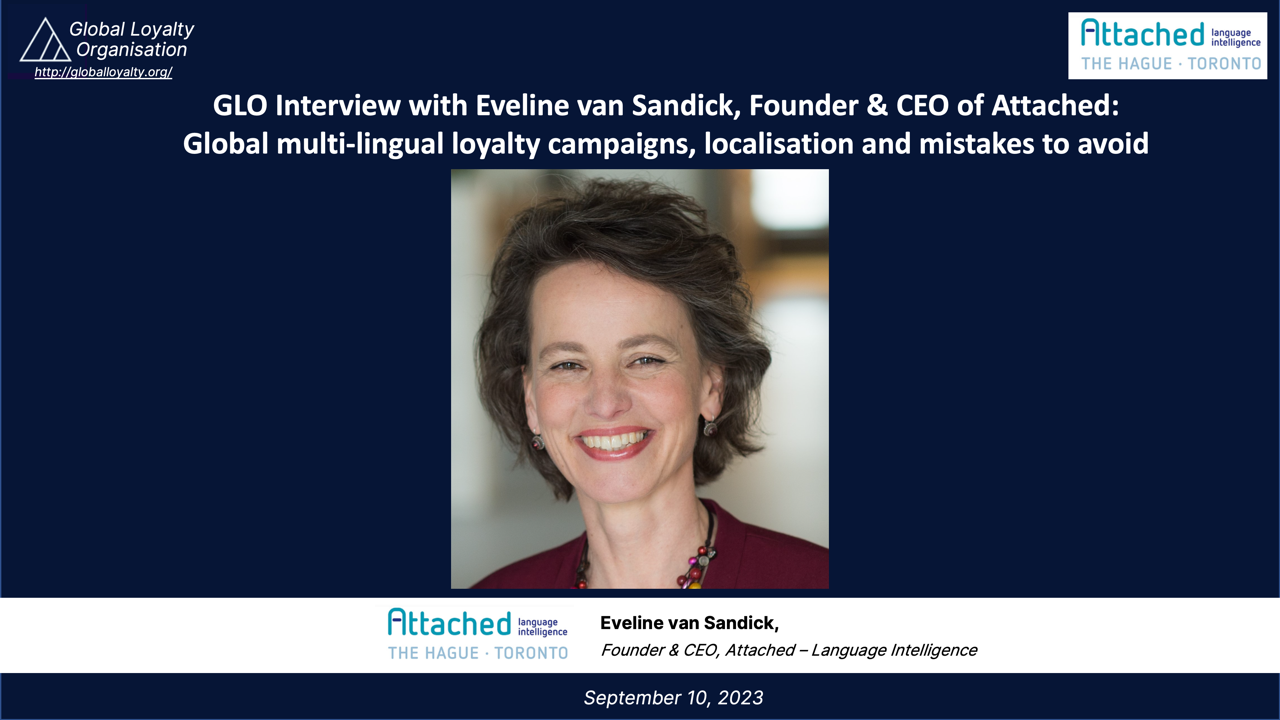
Eveline shares insights on: How important is language in delivering the best possible CX? For which countries or cultures would you say local language campaigns are commercially important? Do you see any loyalty-specific features or trends in lingual support? How to integrate AI and machine learning into your language intelligence services? What would be your advice for large global players from a commercial point of view of language support, etc.
 Attached - global communications
0:00: Attached introduction
1:40: How important is language in delivering the best possible CX?
3:09: For which countries or cultures would you say local language campaigns are commercially important?
4:39: In which markets translating English content is not commercially viable?
6:55: How do different marketing channels determine and differentiate themselves in multilanguage support aspects? How did you see this evolve in the past years?
9:10: Do you see any loyalty-specific features or trends in lingual support?
10:09: Do you integrate AI and machine learning into your language intelligence services?
10:58: Can you discuss any future plans for new service offerings or expansion into new segments?
12:35: What are unique opportunities or advantages your company offers to potential clients looking for language solutions?
13:22: What do you advise companies embarking on international advertising and loyalty campaigns?
14:29: What would be your advice for large global players from a commercial point of view of language support?
14:55: Can you mention any campaigns that stood out?
15:44: If you had 1’000’000 loyalty points, how would you spend them?
16:23: Advice to your yonger self?
Read full transcript:
GLO 0:05
Eveline, it’s a pleasure to have you with Global Loyalty Organisation this morning. Could you please introduce yourself to our members and tell us a little bit about your work at Attached?
Eveline: 0:18
My name is Eveline van Sandick and I’m the CEO and Founder of Attached Global and for nearly 25 years now I’ve been in the business of helping our clients move and grow internationally by supporting them with their global communications. We have offices in Europe and North America, from where we cover over 40 languages for all of our clients.
The key industries that we operate in include aviation and loyalty programmes, hospitality, but also legal and finance, marketing, HR and e-learning.
Five of our clients that are definitely worth mentioning here include Air France KLM and their loyalty program Flying Blue, Plusgrade, Norwegian Air, Goldman Sachs and Avis.
The typical types of content that we support these clients with include a variety of channels, including websites, and campaigns, apps, but also their terms and conditions and programme ruling and a lot of search engine optimization and beta testing. Basically, anything and everything that’s needed to communicate on a global scale.
Thank you so much for having me here with GLO and I look forward to this interview.
GLO: 1:40
You’re one of the best specialists in language insights across global campaigns. How important would you say is language in delivering the best possible customer experience and supporting large global loyalty programmes and campaigns spanning multiple continents and multiple languages?
Eveline: 2:04
Well, good question How important is language in delivering your message to an audience? Actually, I would say it’s key. After all, loyalty is all about emotion and commitment and establishing a personal relationship. And we think besides your name, language is actually one of the most personal things that you have. We also see that indeed that truly properly localised messages so local content and local language messages are really the best enablers to make genuine emotional connection with your target group.
Fortunately, we also see that more and more of our clients really understand that they need to make that shift from seeing translations just as a tool to breach a language barrier to actually using localised content as a true revenue driver.
We believe that loyalty programmes and of course any other types of businesses here at GLO network, can really use language and carefully chosen tones of voice to stand out and distinguish themselves from the rest.
GLO: 03:09
Eveline, this is very insightful. What would be interesting to know is in what languages, in what cultures it would be commercially sensible or commercially viable to run localised language campaigns. We’re lucky to have two reports, one by Harvard Business Review and another one by Common Sense Advisory, both indicating actually very similar figures that around 72% of the customers will definitely buy the product or will be significantly more inclined to buy a product if it’s represented in the local language. What’s your view on that and what’s your experience in this market?
Eveline: 03:48
I would say that local language campaigns are important for quite a few countries. After all, like you said, the numbers speak for themselves. Just look at a map of Europe, for example, where in so many countries still a high percentage of people, don’t speak any other language than their own. And globally, roughly 20% of the world’s population speaks English at a level that makes them feel at ease with basic communication flows. But that means 80% of your potential market doesn’t. So together with our clients, we for sure, target large markets where people are used to being addressed in their own language thing. For example, Japan, Germany, Italy, Latin America, China, Middle East.
GLO 4:39
As you say, using local language for campaigns is really important and studies have shown this to us. Looking at your client base, where would you say, does it not make commercial sense, to translate English content into your local language for your campaigns?
Eveline: 5:10
Actually, that’s not a very easy question. First of all, we distinguish of course between the traditional big English markets like the USA, or Hong Kong. Companies are just not used to being multilingual because for them the necessity has never been there. Still in the USA, embracing the Hispanic segments in your communication often proves to be a smart commercial move too. Secondly, there are of course relatively small markets where English is widely available as a second language such as the Scandinavian countries and the Netherlands. But even in these markets if offered the choice consumers indicate very clearly that they’re more comfortable doing business in their own language.
And thirdly, and maybe most importantly, it’s also important to keep in mind the cost of not translating. Our clients often look at the cost of their translations. But it’s important also to know that not translating also comes with a cost. First of all, you get more calls to your customer care centre, because your customers don’t understand the content that you present to them. So that’s a huge factor to take into account.
Second, there are also higher unit costs because your international sales just don’t help cover the existing fixed cost. Without a local language, you also have more limited country insights, and maybe even more importantly, without local language content, it’s way harder to really rank high in the local search engines.
GLO: 06:55
How would you say that different marketing channels differentiate themselves in customer support? And how did you see that evolve in the past few years?
Eveline: 07:14
I would like to mention the developments for two channels. First of all, if you look at our customers’ websites, a past development that comes to mind is that it is no longer needed to translate everything at the same quality level. To choose the right level, the first step in your content strategy should be to clearly determine the goal of your different website blocks. For example, is the content just there for information purposes? Then use can be made of AI and machine translation. But if the content is intended really to inspire or incite a certain action from your readers, then we see a deep dive into more and more organised content. And often there’s even been some move away from translation transcreation or even local content creation. What we do at Attached is to service our clients across this entire service board, and also help them make that decision by auditing their websites.
Secondly, very important also is when you look at apps. We see that it is more and more important to really make sure that the app is built with a multilingual implementation in mind from the very, very beginning. This can be ensured by what is called internationalisation. And that basically covers the principles of how to write your code, so that it makes the app suitable for localization down the line. As a very basic example, if the app doesn’t support different currencies or different date formats, then it’s probably not going to be suitable for a smooth user experience in all the markets in which you’re launching it. We advise and support our clients in this very often forgotten phase of the development, avoiding translation issues later on in the process.
GLO: 09:10
If we zoom in straight into large global loyalty campaigns, do you see any trends or loyalty-specific features in the lingual support of those programmes? What is dominating now?
Eveline: 09:24
Here we see that it is becoming increasingly important to adapt your content not only linguistically based on the master language but also on the local variants such as French for Belgium, and Spanish for Mexico. This is not only to make sure that those audiences really feel connected and understood it’s also good for your local search engine performance.
Secondly, and maybe even more importantly, and current at the moment, is the need to make sure that your content is truly inclusive. Here we see that each country and each language group is in the middle of finding out what would be the best approach in their language to communicate in a truly inclusive and gender neutral way.
GLO: 10:09
You already mentioned AI earlier. Can you tell us if you use artificial intelligence and machine learning in your language intelligence services?
Eveline:
Yes. In fact, I may have become a hot topic to the rest of the world with the launch of chat GPT almost a year ago, but in our industry, it has been around for quite some time already. After all, text prediction and machine translation are also just loose forms of AI.
Our expertise really comes in by knowing when and also when not to use AI. Knowing how to use it, for example, by advising our clients to choose the best engine for their particular language sets. And also by being able to verify the output and making sure that it is really fit for purpose.
GLO: 10:58
Undoubtedly new technology will open new opportunities and potentially lead to expansion into new sectors. Can you tell us if there are any plans for new offerings in the lingual support or new features? Are you looking to expand into new industries based on that?
Eveline: 11:16
Yes, I’m happy to say that we’re actually constantly rolling out new services into new industries. Currently, for example, we’re expanding more and more into the financial industry by onboarding banks and insurance companies among our clients.
On the surface level, what we see is that our clients’ international communication is getting so complex by having to offer hyper-personalised content through an incredible number of communication distribution channels. Because of this, what we call our holistic approach is often very much appreciated. This means that we support our clients across the entire board of communication needs with services ranging from raw machine translation to human translation, all the way up to local language content creation. To make sure of course it all just runs as smoothly as possible our content strategists consult our clients on their best available global communication opportunities. Our localization engineering team is there to audit and build the most efficient workflows and integrations.
GLO: 12:35
If I’m a client looking for language intelligence solutions, what opportunities and advantages does Attached offer to new customers?
Eveline: 12:46
Thank you for asking. What we often hear back from our clients is that they really appreciate our accessibility and flexibility, combined with technical professionalism still with a very human approach. All those elements are of course also closely linked to our core values, which are Solid, Smart, Skilled and Supportive.
We actually offered the best of both worlds: Attached is large enough to cater to large, often very complex organisations yet small enough to remain very personal and flexible.
GLO: 13:22
You have 25 years of experience supporting global companies in international campaigns. What would be your advice on embarking on such a marketing or loyalty campaign globally?
Eveline: 13:35
There are two I’d like to mention here. First of all, don’t think that your clients will take in your message exactly the same way that you do. They come from many different cultural backgrounds and so may have very different feelings or understandings with visuals, colours, or even taste. So this may mean sometimes, to reach in other markets with the same message of product field as you have in your home market, you may actually have to adapt that message for products first. A good example is how McDonald’s for instance, applied to this localization principle.
Secondly, my recommendation is to not take language as an afterthought. After all, it is based on the language version that you present to your customer. The date decides whether or not they want to do business with you.
GLO: 14:29
What would you advise large companies with large programs from a commercial point of view of language support?
Eveline: 14:36
An advice that comes to mind is to really make sure that you measure the things that you do and also to share the results with your localization provider. Because in the end, it’s based on these data that informed decisions can be made about your language options and opportunities going forward.
GLO: 14:55
Do you have an example of any of the campaigns that really stood out – made an impact and is worth mentioning?
Eveline: 15:06
Looking at our clients’ successes, two projects immediately come to mind. The first one is a travel guide that we helped optimise and localise for different search engines and fortunately boosted traffic to our client’s website.
The second success relates not so much to the language aspect of what we do but more to the process behind it. For one of our clients, we helped build a connector between their content management system and our translation environment saving them dozens of hours of manually handling the different language versions for their website.
GLO: 15:44
If you had 1 million points or miles, you could spend anywhere you wish, whatever you want to do. What would it be?
Eveline: 16:04
For sure travelling with my family to many, many interesting places and make my kids see even more of the world. Secondly, also donate a portion to charity – preferably a cause that helps children develop their language and IT skills.
GLO: 16:23
If you were able to give your younger self starting out in the industry nearly 25 years ago a piece of advice. What would it be?
Eveline: 16:44
It would probably be: enjoy the journey that you’re on and every piece of it. Also how the journey helps you to grow and develop skills, how it enables you to work with and for others, and how to provide a living and do the other things that you love so much.
Souce: GLO
