


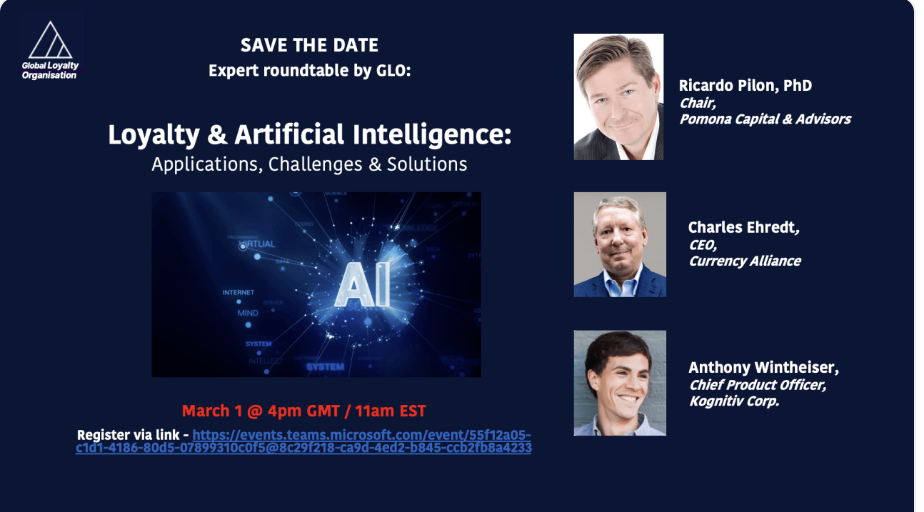
Read the summary of our Loyalty and AI webinar held on 01. March 2023. Fittingly, this summary was generated using Chat GPT.
 GLO
GLOGlobal Loyalty Organisation Expert Roundtable – Loyalty & Artificial Intelligence: Applications, Challenges & Solutions
Audio link to webinar
- AI in Loyalty and across commercial airlines business cycle: challenges & benefits of implementation
- AI evolution and implementation in loyalty: case analysis
- AI use in loyalty marketing
- Right data” input and AI algorithms: accuracy of data and implementation of results
- Organisational & system framework required to successfully operate AI
Speakers:
Chuck Ehredt, CEO Currency Alliance; Anthony Wintheiser, Chief Product OfficerKognitiv; Ricardo Pilon, ChairPamona Capital & Advisors
Session Summary:
Charles Ehredt: Ricardo, your new book about artificial intelligence in commercial aviation is coming out in a few months. There’s one chapter on loyalty marketing in particular, but then 25 or 30 other chapters on other aspects of airline operations. What are the common themes Ricardo in terms of AI applications in the commercial aviation space?
Ricardo Pilon: There are three common drivers of AI: obtaining deeper insights, automating repetitive actions, and solving complex problems in real time. Deeper insights involve using electronic information to predict outcomes, while automation streamlines tasks and frees up time for more value-added work. There are two categories of AI application opportunities: local and enterprise level. Local applications involve using predictive analytics within a specific function, while enterprise applications involve using predictive insights to improve other related functions. Opportunities for AI exist anywhere there is paper, information handovers, repetition, and routine tasks, as well as where something complex needs to be solved in real-time, such as in kiosks.
Charles Ehredt: Ricardo, in the newspapers, there are typically these stories about how AI is going to replace human workers. I like the way that you describe these opportunities. Because it basically is getting rid of boring work or work that maybe humans don’t have the capacity to do the analysis, but humans would have the capacity to make decisions based on accurate and valid data. It looks like there are lots of applications across the board. Anthony, in your case you’ve been working in this area of data science for more than 15 years. And it appears that AI has evolved much more in the last year than during the previous 15 or 20 years. But from your experience, what has changed in the last year that’s making it more accessible for loyalty use cases?
Anthony Wintheiser: Generative AI is a set of algorithms that can create new content, such as chatbots and deep learning models that create visual content based on text descriptors. Chat GPT, a pre-trained transformer chatbot, is an example of generative AI in customer service. It has gained popularity because it can generate answers in real time, no matter how simple or complex the question is. The chatbot has over 100 million active monthly users, demonstrating the value of making AI accessible and providing value to a large group of users.
The potential of AI in customer service lies in its ability to increase efficiency, effectiveness, and responsiveness. An intelligent chatbot can help customers with product discovery, evaluation, purchase, and post-purchase support. It can also provide customers with the information they need, increasing their satisfaction with their experience. The use of AI in customer service has the potential to drive more efficiency and effectiveness in organizations.
Generative AI can also be used for marketing personalization. Applications such as Jarvis or AdCreative use AI to create content for marketing and engagement purposes. By leveraging AI techniques, companies can reduce cycle time and expense by over 90%. The use of AI in marketing personalization provides marketers with the ability to create content, respond, and engage with customers in real-time, with personalization in terms of colour, tonality, product, character content, and offer inclusion.
In conclusion, generative AI has the potential to revolutionize customer service and marketing personalization. The ability to generate content in real-time and personalize it to customer needs provides companies with the opportunity to increase efficiency, effectiveness, and responsiveness. However, it is important to note that there is still value in older types of AI and machine learning. Companies should leverage all available AI techniques to drive customer loyalty engagement and personalization.
Charles Ehredt: ChatGPT is accessible and popular among the audience as many people have tried it in one way or another. I asked ChatGPT earlier today about loyalty marketing use cases for artificial intelligence, and the answer I received was articulate and covered the important topics. ChatGPT even offered an option to regenerate the response if the answer wasn’t satisfactory.
The main use cases of AI in loyalty include pricing and promotions, customer insight and personalization, and streamlined operations. AI can help optimize pricing and promotions by filling distressed inventory or targeting offers to specific subsets of customers. Additionally, AI can personalize each touchpoint or marketing communication with customers on a large scale. Lastly, AI can monitor business operations and detect potential problems such as fraud or system failures, allowing companies to be more proactive in addressing them before they create a bad experience for customers.
Ricardo, the AI obviously requires a lot of data to feed into the model. How do we go about identifying which data is the right data to feed into the algorithms and then how do we make sure that that type of data remains available in an operational phase, so not just training the algorithms upfront, but also executing on the data in a day-to-day environment?
Ricardo Pilon: In summary, when it comes to the excitement and hype around generative AI, it’s important not to lose touch with the traditional, conventional applications of AI that still have a lot of value, such as in the airline industry where adoption is still low. However, the challenge with AI projects is often around data, with over 80% of projects failing in the execution around data and electronic information. The complexity today is much higher than it was even a year ago or 10 years ago, with exponential volumes of data in different formats coming from more channels, including mobile and computer. People often get excited about collecting data without necessarily having a clear purpose or goal in mind, and it’s important to break it down into more manageable pieces. It’s also important to not confuse causality with correlation and to recognize that people are the biggest challenge when it comes to data, as we need access to it and new relationships with it that we’re not used to. Data can be used to drive specific agendas and become political, so governance in AI is important. Cleansing data is essential but challenging for most organizations. Overall, the opportunities for working with data are enormous, and it’s important to ask the right questions, such as what we are trying to solve, what information we need to solve it, and who needs access to this information.
Charles Ehredt: Yes, the organisation needs a framework in order to, first of all, ask good questions, and then set up the systems to provide the necessary support. Anthony that reminds me of a previous conversation you and I had where you were describing a framework related to AI that helped organisations interpret the data and predict and come up with predictive outcomes. Could you describe that framework for the audience?
Anthony Wintheiser: Ricardo highlighted that 80% of projects fail due to data-related issues, and he elaborated on the five V’s of big data: volume, veracity, variety, value, and velocity. The reality of data science is that 50% of it is just data cleansing, which means getting the data in a place where it can be made sense of. We work with a five-step framework to overcome these challenges.
The first two steps of the framework focus on data integration and transformation. Step one involves data integration and harmonisation, where data from multiple sources is cleansed and formatted similarly. Step two involves transforming the cleansed data into feature engineering to create new synthetic datasets that will sit alongside the raw data. These new features give the algorithm something new to work with. Step three is where the fun stuff begins, and it involves prediction. There will be different algorithms that run to try and predict customer behaviour based on all the information available on the customer and similar customers. Step four involves simulation, predicting the full effect of a customer’s purchase. Finally, step five is all about optimisation. A business will leverage a whole new set of algorithms to optimise how they engage with their customer base based on the data insights they have gathered from previous steps.
In conclusion, the five-step framework proposed is a roadmap for businesses to effectively leverage big data for artificial intelligence and machine learning. The focus on data integration, transformation, prediction, simulation, and optimisation ensures that businesses can make the most of the data insights they gather, engage with their customers effectively, and ultimately achieve their business goals.
Charles Ehredt: In my opinion, implementing a framework can help organizations come to a shared understanding and agreement on how to achieve their goals. I have noticed that in loyalty programs, there has been a long-standing conflict between the loyalty team and revenue management team due to their different objectives. However, both teams aim to drive customer loyalty, satisfaction, and revenue optimization. AI can be utilized to remove internal disputes and help organizations maximize their return on investment by finding the best course of action.
Anthony, back to you. You work for Kognitiv, which is a loyalty technology company that is helping brands build closer and deeper, more meaningful relationships with their customers. Can you get share any insights about what Kognitiv is doing today with AI to drive results?
Anthony Wintheiser: Kognitiv is a global loyalty technology and services provider that works with enterprise clients across the world. The company manages hundreds of millions of customer IDs across several different programs, with privacy and security being of paramount importance. Kognitiv’s focus is on expanding its capabilities to lead on prescriptive and predictive analytics within the loyalty construct, moving from loyalty as a program management capability to loyalty as an outcome across all channels. We are building two key capabilities, the data hub and the cognition engine, to help us achieve this goal. These foundational capabilities will power a suite of new products that we plan to launch later this year including Pulse, Ignite, and Amplify, which are focused on providing more real-time, granular, and one-to-one personalization at scale. Our approach involves breaking down AI/ML adoption journey into defined milestones within defined timelines to avoid wasting resources and time. We have successfully deployed an experience intelligence decision engine for a retail brand, which established a loyalty program with tens of millions of members. Kognitiv helped the brand by engaging customers on an always-on basis to optimize promotional and offer budgets to drive specific business outcomes. We were able to increase redemption rates by over 160% and decrease discounts by nearly 40% using our model. We identified with the client that the size of the total opportunity for them was over $300 million which at this time was somewhere between eight to 10% in terms of top-line growth. And when you have a multi-billion-dollar business, a global business, and a relatively stable industry, and you have the ability to turn on a technology that can drive that much incrementality with very little investment, it’s a very powerful story.
Charles Ehredt: Before I ask Anthony about the costs involved, I’d like to ask Ricardo about a really important point he touched on earlier related to organisational change that needs to take place in order for an organisation to embrace these types of advanced technologies. Ricardo, can you elaborate a little bit more on the organisational requirements involved in implementing AI?
Ricardo Pilon: AI has a significant impact on organization and organization design. Organizational design can have a significant impact on the effectiveness of AI. AI can build bridges and automate tasks across silos or departments and align divisions within an enterprise. However, this can create friction as people supporting conventional processes may not easily find a new role unless they upskill and evolve. AI can be used in organization design to allow upskilling of people along a line of new workflows using new technology that underpins it being enterprise AI. AI organization design necessitates different approaches with people and requires more help from applied behavioural and organizational psychologists.
Charles Ehredt: Anthony, back to you. I guess a lot of people in the audience might be thinking, how much did this cost? Can you reveal the cost involved to that company so that they could realise another $300 million in sales?
Anthony Wintheiser: So in the context of $300m, it probably doesn’t sound like a lot. However, from a zero-based budgeting context, it probably does sound like more. At the end of the day, if you’re going to try and do this in-house, or if you’re going to work with a partner, you’re going to need to hire data scientists, data engineers, ML ops engineers, and project managers. You’re going to need to put together a cross-functional team and I think Ricardo can probably speak to that better than I can. And so the investment is not insignificant. I would say it’s probably over a million dollars.
Charles Ehredt: I asked chat GPT this morning, how much it would cost to implement AI. And the answer was somewhere between $2000 and several $100,000. Now, maybe that’s the technology trying to sell itself in a clever way. But I do think that AI is certainly on a maturity curve, where costs will likely decrease over time as vendors make it easier to implement and manage. Organizations may want to experiment with AI in the short term to gain knowledge but may not want to allocate significant budgets until costs have decreased. As AI technology matures, smaller companies may be able to embrace AI for more tactical initiatives, and eventually, bring it in-house without being dependent on vendors. The decision to invest in AI should be based on the potential return on investment, with larger returns making it an easier decision for businesses to invest.
Ricardo Pilon: So, when chat GPT comes up with a cost as low as $2000, you won’t get a data scientist for that, as we all know. But in some cases, some airlines have a small team of let’s say, 10 data scientists that are dedicated to the entire organisation and not to a specific unit or business unit. So, there are different approaches that are taken. But the majority of the cost is in working with data management tools and AI platforms. And those costs can be significant, particularly because the intention is to use it at scale. But a lot of vendors are available to work on a small project basis and are very flexible to start somewhere. But if you’re looking at adding value with data scientists, I also find that vendors can help structure some of the initial projects because let’s be honest, the very starting point is to learn how to deal with data, and to start playing with that. And so that doesn’t have to be that expensive. There’s always an inexpensive way of kickstarting and you need to build your cases anyway. I would say you can start today and it doesn’t have to cost an arm and a leg.
