

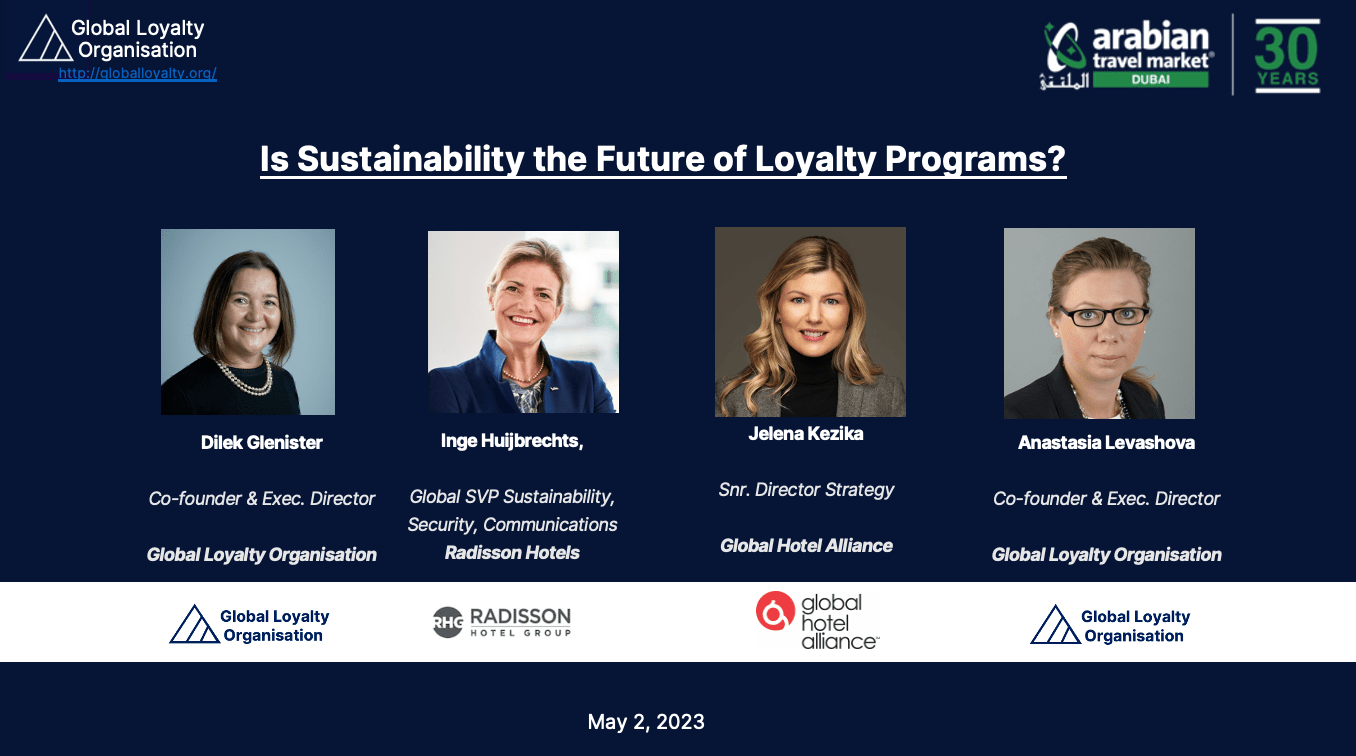
Participants: Inge Huijbrechts, Global SVP for Sustainability, Security and Corporate Communications at Radisson Hotel Group; Jelena Kezika Senior Director of Strategy at Global Hotel Alliance; Dilek Glenister, Co-founder & Exec Director, GLO; Anastasia Levashova, Co-founder & Exec Director, GLO.
 GLO
GLOGLO Panel discussion at Arabian Travel Market Dubai, 2 May 2023 – Is Sustainability the Future of Loyalty Programmes?
May 2, 2023 – Arabian Travel Market 2023, Dubai, UAE
Participants:
- Inge Huijbrechts, Global SVP for Sustainability, Security and Corporate Communications at Radisson Hotel Group,
- Jelena Kezika Senior Director of Strategy at Global Hotel Alliance,
- Dilek Glenister, Co-founder & Exec Director, Global Loyalty Organisation
- Anastasia Levashova,Co-founder & Exec Director, Global Loyalty Organisation
GLO: Hello and good afternoon. Welcome to today’s panel: Is Sustainability the Future of Loyalty Programmes? I’m Dilek Glenister, the co-founder of Global Loyalty Organisation, based out of London, we are a global professional network for customer loyalty rewards and engagement professionals and also solution providers, and payment providers technology consultancy. Our vision is to bring everybody together onto one platform to enhance communication, deepen discussion, and cooperation, find new partnerships and bring innovation. Though we are a very young company, we are very lucky to have very enthusiastic supporters and founding members such as global hotel Alliance, Star Alliance, Air France KLM and Accor, just to name a few. One of the reasons why we have such support I believe is because loyalty has evolved over the last couple of years. It’s no longer just about collecting points, collecting miles or just getting that discount. Loyalty has evolved and is driving businesses, driving revenue growth and has become an important factor for corporations. Also throughout COVID customers’ expectations have changed. Customers no longer just want to collect points with any loyalty programme. They want to engage. There’s the emotional loyalty side. They want to feel that the loyalty programme is actually aligned with what they stand for. And sustainability is a big part of this. And this brings us to the panel. I’m very pleased to introduce you to our panellists Inge Huijbrechts, Global SVP for Sustainability, Security and Corporate Communications at Radisson Hotel Group and Jelena Kezika Senior Director of Strategy at Global Hotel Alliance. Inge, could you introduce yourself and tell our audience about Radisson’s Sustainability efforts?
Inge Huijbrechts: I’m with the Radisson Hotel Group. We’re one of the large hotel companies in the world. We have 1100 hotels in 90 countries and nine exciting brands. In the UAE, we have 16 hotels, and in the Middle East, we have almost 80. We are planning to double that in the next five years. My role is as the Global Head of Sustainability, Safety and Security and Corporate Communications. So, in terms of sustainability, we have been practising sustainability for a very, very long time. Our roots are Scandinavian. As you can imagine in the Nordics, people were working with sustainability already a long time ago, we had our first policy on the environment in 1989. We’re happy to be talking about sustainability and loyalty. Sustainability demands have evolved. We see it coming back in our loyalty programmes, and we can talk about how that’s happening in a few minutes.
Jelena Kezika: Jelena Kezika, Global Hotel Alliance. In my role, I help plan and execute projects and initiatives that help us stay in growth for Global Hotel Alliance. And it’s called Discovery Loyalty Programme. So, if you ask yourselves, what type of projects do I work on? In the context of today’s conversation, Green Collection is one of the concepts I had the pleasure to lead with the support of a very talented team at Global Hotel Alliance. For those who are not aware of Global Hotel Alliance: We are the world’s largest alliance of independent hotel brands, bringing together 40 Beautiful individual brands with 800 hotels in 100 countries. GHA Discovery is our core product, we introduced it to 24 million GHA Discovery members. The programme is delivered to them and other hotel guests by our 40 brands in the alliance so we recognise all of our customers across the globe in the same way.
GLO: My name is Anastasia Levashova. I am the co-founder of Global Loyalty Organisation and am grateful to be here at this event to co-organise this panel with ATM. Just to mention that some of the largest Middle Eastern companies like Emirates are already members of the Global Loyalty Organisation and we invite all of the other UAE or Middle Eastern companies to join. Let me quickly set the stage for our discussion on sustainability and highlight that the hospitality industry made tremendous progress in the last 10 years on sustainability efforts. Sustainability is no longer a decision of the hotels or airlines but it’s rather a duty imposed both by shareholders and stakeholders of the companies, and also the customers.
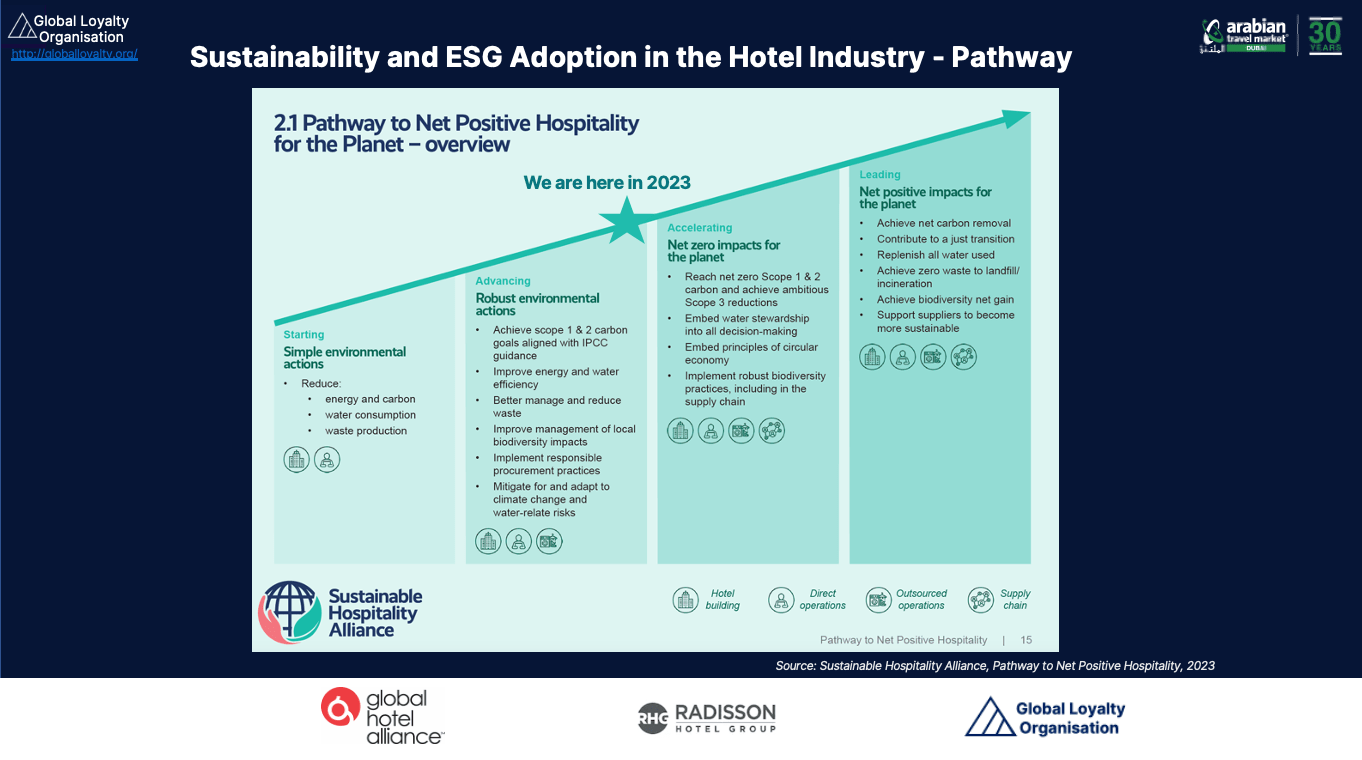
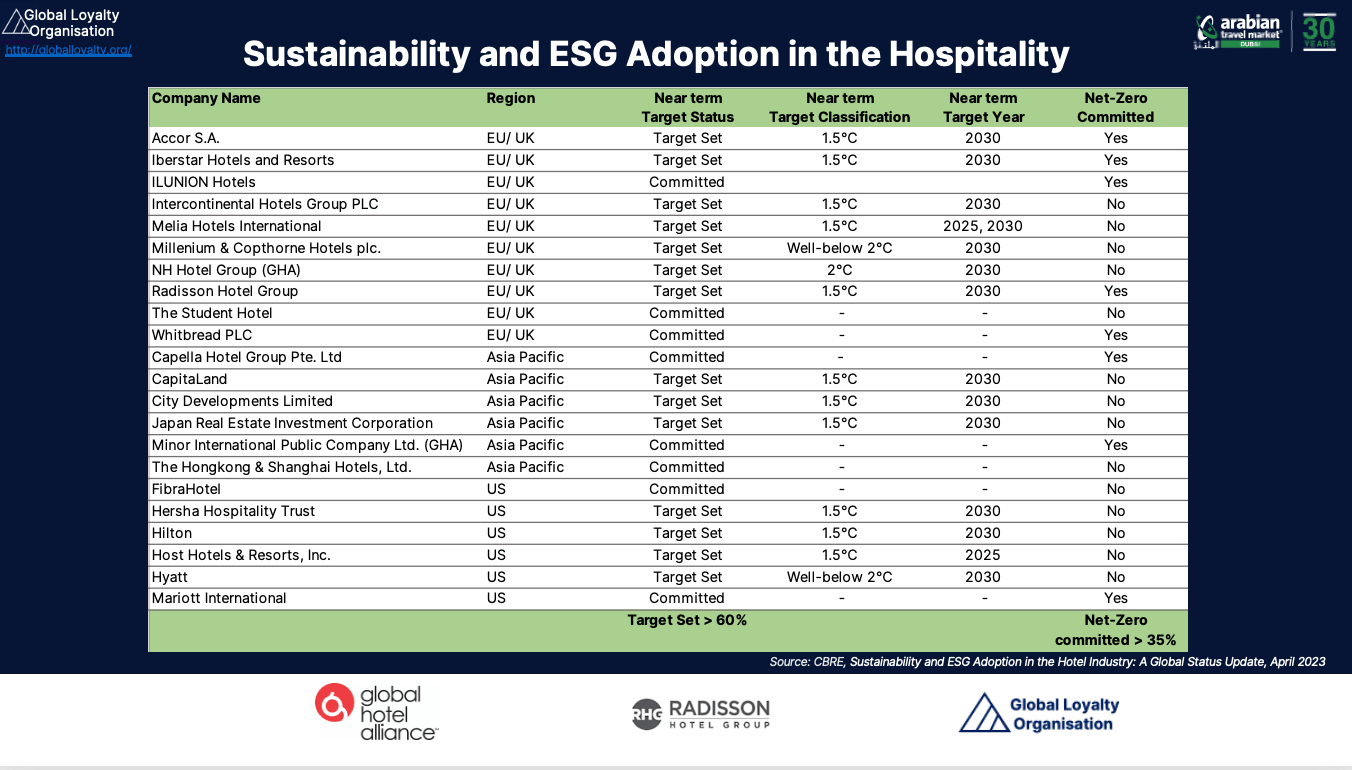
There was some research in the early 2000s, which quoted that hospitality is just awakening to sustainability. I think that actually refers to Inge’s point that the first programme or the first steps were taken in 1989 by Radisson, but now hospitality is firmly actively pursuing sustainability. And I would say that we are probably halfway to reaching the goal of setting up net zero hospitality. The customers are no longer asking to do no harm. They rather ask you to do good. And that’s the opportunity for the panel to highlight how the hotel groups are taking active steps. If we quickly look at where the largest global hotel groups are: Currently, over 60% of the global hotels already have set the target of the Paris Accord 1.5 degrees achievement. And that’s quite a near-term target from a business perspective. With regards to net zero commitment, which is a much harder target for businesses to achieve over 35% of hotels already committed. And you can see that our panellists Radisson and GHA, are definitely among the leaders. With that, let’s pass on to the first question.
GLO: Before we start talking and delving more into your sustainability efforts and your loyalty programmes, can you tell us a little bit more about what kind of challenges you have been facing and you’re still facing to operate sustainably in the hospitality sector? Inge, I would like to start with you.
Inge Huijbrechts: I’ve been working on sustainability at Radisson for 14 years. And I must say I’ve seen a big evolution. One of the evolutions we see is that sustainability has become a very much professionalised subject. It’s very technical. You were talking about the net zero commitment. Radisson has committed to become net zero by 2050. Which means we need to half our emissions by 2030. Now that’s a very big step compared to 2019. Making a company net zero is a big transformation. It’s a strategic transformation. So, our work and what we do is part of our company’s strategic plan. It has to be because it’s simply so much more technical than what it was when I started. Acceleration I would say is the first challenge. We need to accelerate. So, we’re working on greening our buildings, on integrating more renewable energy, on greening our operations. And we’re making good progress which I can talk about later. But the speed at which this needs to happen is really very high. And so, we need to accelerate with other partners in the industry. And I would say the second I wouldn’t call it a challenge but certainly something we are seeing is the customer demand for sustainability. Customers are serious about sustainability. There are some interesting stats about this. We see it in the leisure space, and we see it in the b2b space. And it’s not just a tick the box of ‘Do you do sustainability?’, but they want you to be serious and to offer verified solutions. Business clients even want you to tell them, what is the carbon footprint of my stay, what is the carbon footprint of my meeting and events etc. So, the level of inquiry has definitely increased. And then I think, but that’s something that everybody knows, is that we have quite a complex value chain. The way we talk to the customers is on different platforms. We talk on our direct bookings, we have our wholesalers, you have all these platforms, but also on the ownership side. For example, Radisson Hotel Group, we are asset light, so we do not own the buildings we operate. And for a net zero transformation, it’s essential to bring these owners along. So that’s not really a challenge. It’s a reality. But given the speed and the customer demand, it’s very important that we work across the value chain, with the platforms and with the owners.
GLO: Jelena, could you tell us a little bit about GHA’s challenges regarding sustainability in the hospitality sector?
Jelena Kezika: I think at Global Hotel Alliance we are in a slightly different position. We don’t manage hotels; we don’t own hotels. We are in the tech and marketing loyalty space. However, as I mentioned, we work with 40 hotel brands. They are regional mostly and we learned from them that the challenges are quite complex, and these challenges come from external factors as well as internal factors. Talking of external factors, I agree with Inge. The key driver of sustainability is the customer and we have to be thankful to the customers that they kept driving our sustainability efforts. This is why we are able to talk about progress in sustainability today. But in addition to that, we also know that a lot of pressure comes from investors who want to invest in sustainable companies. There are also regulators who are now catching up on new policies which we have to implement in every destination and every hotel company. Plus every hotel or hotel brand faces challenges when it comes to internal environments. So the financial investment is complex and needs a commitment. Of course, we know that getting out of the pandemic many hotels and hotel brands still experience challenges in staff shortages. We know that building the strategies is difficult, committing to it is also difficult and then implementing and improving is a challenge on its own. On top of it all everyone expects hotels to deliver excellent day-to-day operations. So the challenge is big. And I think it’s great that we have a platform like this to talk about them. However, I would like to emphasise that many hotel brands and hotels see these challenges as opportunities. And this is what we have to celebrate. Many hotels already understood that a financial investment today will bring them a saving tomorrow. And shortages of staff are difficult to overcome. But let me give you an example from the Global Hotel Alliance, our shareholder and manager of several brands in the alliance recently launched a new Asian Institute of hospitality management, where they contribute to new talent that will be leading hospitality efforts in the future. So there are many examples like that in the Alliance, but also in the industry. And talking of challenges and opportunities – we really have to celebrate the efforts of hotels that got started and lead us by example.
GLO: Going back to the customer – the epicentre, the core of the hospitality industry. How would you say the customers’ demands or customers’ desires changed in the last five years? I do understand that COP21 and COP28 which will be setting new sustainability targets which will put pressure by regulators. But do you see customers being active in their desires for more sustainable services by the hotel or are they more passive? How do you segregate your customer base?
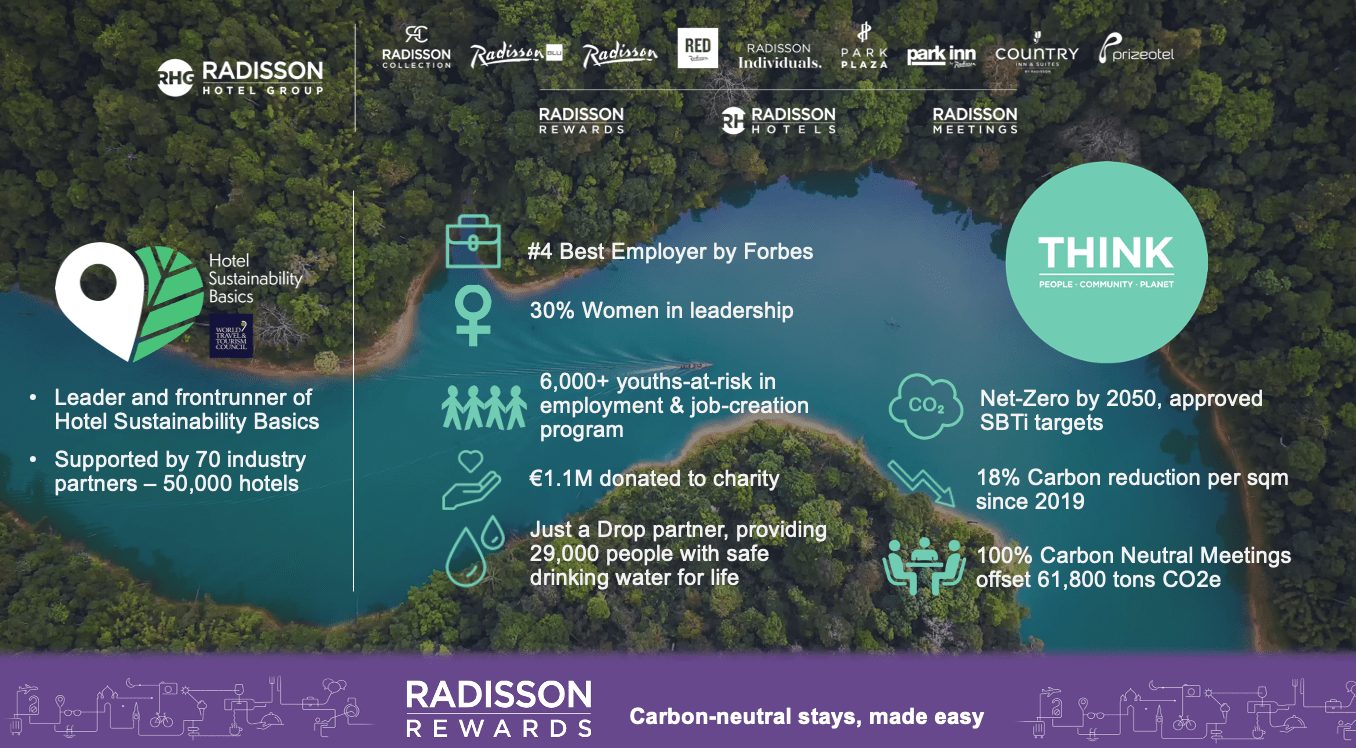
Inge Huijbrechts: I think we’ve definitely seen an increase in customer demand for sustainability. And I must say that even during the COVID pandemic, so I was busy with the team, managing the safety and health crisis obviously. And we had a lot of hotels closed. But the guests that were there, they were even commenting. Why do you wrap everything in plastic? Which we were doing obviously for single-use portions in the breakfast and everything we could offer given the regulations. So even during the worst crisis that we have seen recently, guests were concerned about sustainability. And that level of interest has remained. So, year after year you see in the booking.com and Expedia surveys that the percentage of guests who want to book sustainably increases. I think I have it here on my iPad: I think 73% say that they would be likely to choose an accommodation if it has implemented sustainable practices. But at the same time also 72% say that they don’t know what these sustainable practices are. So it’s a willingness, but also I think customers are a bit overwhelmed. And that’s why we came together with the industry – Radisson Hotel Group with a WTTC and 70 other partners representing 50,000 hotels. We came together to say ‘Let’s define what essential hotel sustainability is’. We defined a new label, a stamp, a standard if you wish of 12 actions called Global Hotel Sustainability Basics. And that is the stamp that is verified. So, we make it easier for customers to recognise this is a trusted label for essential hotel sustainability. I think on the customer side if you look at the corporate clients, there was a recent GBTA study published last year (the Global Business Travel Association). 88% of the Business Travel Association members said that climate change is the number one challenge on their agenda. So, the pressure is on: The customers want to know and at Radisson, we actually give our corporate clients a login to a platform where they can get transparency about the carbon footprint of the usage of our hotels and where we tell them how much footprint we have offset for meeting and events etc. So that is also something we see increasing.
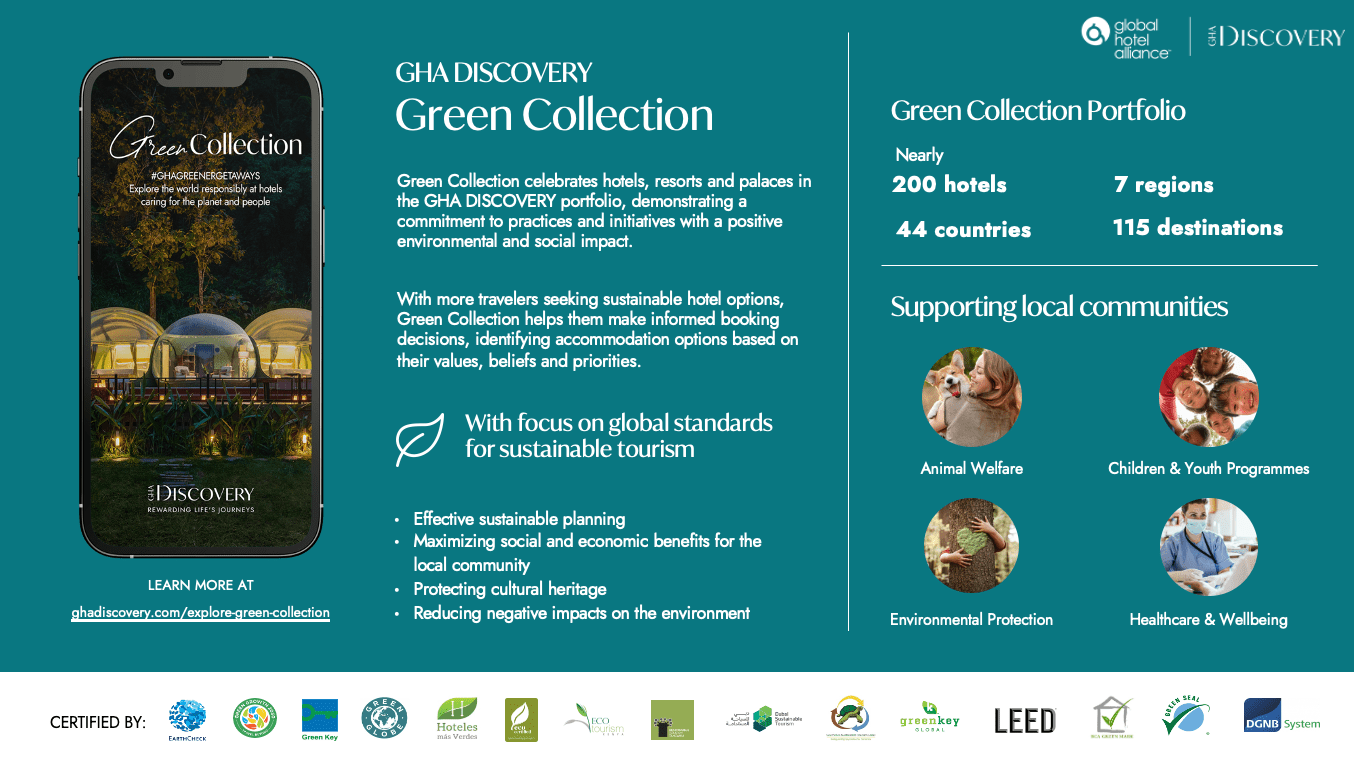
Jelena Kezika: I think everyone agrees that during the pandemic we’ve seen a significant shift in the customer mindset for sustainability. But at Global Hotel Alliance we’ve seen it significantly earlier. GHA Discovery Programme as we know it today has been co-created together with our members. In 2019, we worked on revising the value proposition for the programme and we asked our members and hotel guests in different regions, in different countries, what they expect from the programme. And among other things, we heard a lot that members wanted us to take a step towards more sustainable tourism. And the way we addressed it is with the launch of a new concept in the GHA Discovery Programme, which is called Live Local. So Live Local allows our members to travel more sustainably meaning that members can connect with their favourite brands and hotels in their destinations. So Live Local is helping our members to reduce their carbon footprint because, by definition, they don’t travel that far away. We also bring the local communities together because, we are all social creatures and we want to see each other. So, our members are meeting each other to discuss sustainability or other topics during events and meetups which we at Global Hotel Alliance organise together with our hotels. Live Local also has a number of staycations or events that have a sustainability focus, helping members to understand themselves and the world around them better. So what I’m trying to say is that as a loyalty programme, we have the ability to ask our members what they expect, and introduce these elements in all aspects of the programme. So of course, we didn’t stop our research in 2019. We keep surveying our customers. And our recent 2023 Travel Trends report has shown that our customers want to have a choice of sustainable accommodation, and especially when they’re travelling for leisure. So this led us to the launch of the Green Collection concept.
GLO: You both mentioned that customer expectations and demands have changed and customers are asking hotels to operate more sustainably. Inge, can you talk a little bit more in detail about the initiative to set sustainability standards for hotels? And Jelena, what are the main topics of discussion during those member meetings?
Inge Huijbrechts: Yes, with pleasure. I just want to clarify, what I was talking about with hotels’ sustainability basics is not a Radisson initiative. It’s something that the hotel industry did. So we united the big players, many were mentioned today already. We united destinations, we united the Hotel Associations of India, and groups in China and Thailand and everywhere to be part of this. And we set ourselves the difficult task to say ‘what are the essential points that any hotel should start with?’ And of course, I think there is a saying, “Give me time to write a short letter. It will take me longer.” So, I don’t know how it goes exactly, but the point is, if you try to reduce criteria to the essentials, it’s going to be quite an exercise. We came together with these hotels. We had 12 founding companies who were part of it to say what are these basics. We have them around three key topics, efficiency, planet and people. We aligned these definitions with the United Nations Sustainable Development Goals. And we aligned them also with the GSTC criteria for eco labels. So in that sense, it’s a starting point that can lead to much more. So in efficiency, it’s the typical ones of reducing your energy measuring and reducing energy, measuring and reducing water, measuring and reducing your carbon footprint and identifying and reducing waste. On the planet side. It’s the things that the guests want to see in the guest experience. When you travel to hotels, you don’t want to see single-use plastic straws. You don’t want to see the mini toiletry bottles. Maybe you want to see vegetarian meals in the food and beverage offerings. So those kinds of things are included. And then on the social side, it’s everything about reducing inequality, promoting responsible tourism in the destination and making community contributions. So those together make 12 of the essential criteria. But I just want to add that I’m very happy that you’re showing the pathway to net-positive hospitality. Because there you can see there are four clear steps for any hotel that wants to advance on sustainability. And the first one is hotel sustainability basics. The next level is for example a full eco label. The next level is net zero hotels, and we all want to aspire to be net positive – to give back more than we take. And that journey is a collective journey that the hotel industry is on so many companies like Radisson Hotel Group. We actually have hotels that are on each part of the journey, I would say. But we want to get everybody along and operate within our commitment of achieving net zero.
GLO: How about GHAs members, what are their demands? What are you seeing in those discussion groups?
Jelena Kezika: So, at Global Hotel Alliance, we are focusing on three key areas. One area is Live Local concept which I already described. Secondly, we do a lot of work in philanthropy, working with charities on a corporate level, but also with 12 charities that are either supported or founded by hotel brands in their lines. The third area is our Green Collection concept which we just launched on the 27th of March. And we’ve seen a great response to that. In fact, not only did our members and hotel guests ask us to help them identify sustainable hotels to make informed choices, but also we wanted to set up a stage for other hotels in airlines to follow the example and perhaps not only the lines but also in the industry. Because when it comes to sustainability, we believe that there is no space for competition. It’s all about collaboration, showing examples and sharing practices because we all are in it together and only together we can succeed. Talking of the Green Collection, it was very important for us to create a concept that our members and hotel guests can trust. Because greenwashing has been so big in recent years, and this is what we wanted to avoid. We looked at what sustainability efforts are performed by hotels and airlines. Because as I said, we are not in sustainability, expertise space. We are in the loyalty business. And we wanted to rely on experts. So what we’ve done is that we collaborated with hotels in Global Hotel Alliance, but also with recognised international, national or regional certifications such as Green Growth, Green Key, Earth Check, Green Globe and so many others. So 15 of these certifications helped us launch Green Collection. It is a collection of sustainable hotels that pioneer sustainability practices, a great example of a variety of projects and programmes that help improve the lives of local communities, but at the same time, protect the natural environment. About 200 Hotels are already part of Green Collection: very diverse properties, in seven regions, 44 countries 150 destinations. In Dubai, we have 10 hotels, and they are very different. It’s wrong to think that sustainable hotels are always new builds and only beach resorts. We have so many city destinations. We have many eco-lodges for instance with our hotel brand elewana, and we also have Safari camps. Because our members are travelling for different reasons, we want to always offer them a sustainable option to stay at. And just to conclude what I was saying about Green Collection. I said transparency was important to us. We made sure that our members and hotel guests know how we build it and that they have enough information to validate what Green Collection stands for. The 15 certifications we collaborated with they, of course, pay great attention to sustainability development goals, but also specifically to four GSTC pillars: Managing for sustainability, improving lives of local communities, reducing the negative impact on the natural environment and protecting cultural heritage. So it’s all important to the Alliance to our hotels and to our members.
GLO: Let’s dive a little bit more into loyalty programmes and marketing. Both Radisson and GHA have very large loyalty programmes. Customers approach loyalty programmes usually with some emotional aspects: they are with your loyalty programmes because they like it, and they want to be part of it. How can loyalty programmes help customers contribute to sustainability efforts? Do you see some of the customers being rewarded for their low carbon footprint? Or are you thinking along the lines of maybe gamification, and putting some of the marketing elements to improve customer experience? Passing on to Inge.
Inge Huijbrechts: Yes, if we can have a slide back from Radisson that will be great. So, I’m wearing purple today as a colour because it’s the colour of our Radisson rewards programme. And we say ‘it’s so much easy, so much more’. And so actually we have been integrating sustainability in the loyalty programme from the beginning. But the thing we have been focusing on when we did our rethink of the loyalty programme – which by the way has 11 million members – is to make it easy for guests to be sustainable when they are loyal. Your loyal guests are the ones that are the repeat guests. Those are the ones that spend most and more time in your hotel. Those are the ones which you can really connect with and we do that in a couple of ways. One of the things is of course, to say you can redeem your points for the charities we work with. For example, we work with SOS Children’s Villages International; we work with the International Red Cross and Red Crescent. In that sense for any disaster where we provide relief, or if people want to redeem their points for these charities, they can and actually we see that the loyal members are doing that. So just in Q1, we’ve had 12 million points donated to various initiatives. So we see that there’s an uptake there. The other thing is, as you can see on the slide, we have a carbon-neutral space made easy, because it’s part of your profile, you can actually indicate whether you are interested in having carbon-neutral stays, which we do by reducing our footprint and then offsetting the remainder of the footprint with trusted gold standard offsetting projects. So we have for the first time really integrated this into the profile of the client, which is a new thing for us. This is something we launched a couple of months ago. So for just a few points, which is relatively low, guests can actually indicate that they want carbon-neutral stays every time they stay. We’ll see what the uptake is, we’ll see if it goes faster than the classical redemption. But I would say that’s one of the things we tried to do across the board is really integrate sustainability in our value proposition. So that is what we’re doing in general and that’s what we have been doing with rewards.
GLO: Carbon-neutral meetings probably is a big hit with corporates and business travel.
Inge Huijbrechts: Yes, thank you for highlighting that. All the Radisson meetings and events worldwide have been carbon-neutral since 2019. We know and we calculate the carbon footprint of any meeting or event that takes place at our hotels. And the portion of the meeting and events is offset again with these trusted projects. And all these projects have a social dimension so it’s carbon offsetting and contributing to more equality, better water quality, better air quality, etc. All that together has already contributed to offsetting more than 61,000 tonnes of carbon.
GLO: Jelena, I can imagine multiple opportunities to use reward points on local communities and to involve local communities to benefit and achieve sustainability targets.
Jelena Kezika: Well, I think I will take a step back and remind ourselves what purpose loyalty programmes have. Loyalty programmes and I think we often forget it, are there to reward customers for their continuous interaction with a brand. For a brand that gives them products and services or a loyalty programme. And in order to support this collaboration, we as loyalty programmes or brands have to understand what values our customers have, what worries they have and address all of that in our product and service offering. So let me refer again to our 2023 Trends survey where our members said that in 2023 there will be three things that will impact their decision when it comes to travel. And one of them is a loyalty programme next to location and destination and price. So this means that for members of loyalty programmes, the programme is there to tell them, to educate them so it’s a power and we know that sustainability is the at the very top of our customer agenda. So this is why we implement different sustainability programmes and initiatives pretty much in any aspect of our programme. So Live Local, as I said, is one of the programme’s pillars. We recognise customers, whenever they travel with stay benefits specific to their status in the programme. But we also launched in 2021 our own innovative rewards currency which is called Discovery Dollars. Discovery Dollars is something new in the industry and we are pleased that our members found them useful because every time they stay at one of 800 hotels in the programme, they are earning Discovery Dollars up to 7% back in cash. And on the next stay, they’re able to use these Discovery Dollars to reduce their bill. Discovery Dollars is a great component to play with in the loyalty space because we are using it now to introduce a new concept. Inge already mentioned donations are very powerful in the hospitality industry. This month in May we introduce a new concept called Donate Discovery Dollars. Our members will be able to donate and participate in the lives of local communities by contributing to programmes and initiatives close to our hearts, to the hearts of our hotels and hotel brands, but also meaningful for them. And just to add to that, charities we are supporting together with our hotel brands fall into four categories. There is animal welfare, environmental protection, and also support for health. Family Health in local communities, as well as something that’s probably even closer to our hearts, is educational programmes for children and youth because we believe in the future of our generations. And what we can give them today is education.
GLO: Every company has a slightly different approach to sustainability and also to loyalty but there are also a lot of similarities. And you both talked about, for example, giving back to the local communities and also giving the members and the customers the opportunity to choose to offset carbon and contribute themselves as well. So having told us about what you’ve been doing so far, maybe as your closing remarks, you could tell us a little bit more about what you plan to implement in your sustainability journey. And that is for the company but also for the loyalty programmes.
Inge Huijbrechts: Well, I would dream of many things we could do in loyalty. We have our manager for loyalty sitting right here, there are quite some things we could do in our loyalty programme, but I think the main focus we have is to make it easy for guests to do good by booking right in a way so they are a loyalty member and making it easy to make the right choices. For example, we have in recent months, globally rolled out green housekeeping programme which means that long-stay guests can actually choose to forego housekeeping if they wish to do so. And to our surprise, we’ve seen that this has actually been picked up quite well. We connected to loyalty because we also give some loyalty points and we donate to charity every time that the choice gets made. So in that sense, I think it’s making it easy for the guests to do the right thing and we continue to focus on that. One big other thing that we are focusing on also in collaboration with our loyalty team is to focus on green mobility. You will see that in Europe I mean regulation is coming on electrical vehicles, but we see it in many markets, actually that electrical vehicles are definitely on the rise. So today in Radisson hotels we have over 700 charging points already. But we’re rolling out electric vehicle charging points across the board in Europe and in India and then some on the other markets so that every hotel is equipped with the green mobility option and that is also something we will be linking to our loyalty programme. And then in general, what we will do is continue accelerating on our journey towards net zero. As I said, it’s all about having more green buildings, using more renewable energy and greening our operations. So that is really where our focus is in the future.
Jelena Kezika: I think I already introduced the core concepts which we launched and we want to enhance them this year. Live Local, Green Collection, Donate Discovery Dollars and philanthropy work with charities – we want to continue that. But what we also want to do we want to stay authentic and transparent with our hotel guests and members of the programme going forward. So we want to tell them about great initiatives that the alliance supports and our hotels and their brands are doing to support local communities and reduce the negative impact on the environment. Because in addition to all these concepts and programmes, there is so much that individual hotels are also doing. Let me give you one of my favourite examples. Capella Ubud, a hotel in the alliance and also a Green Collection hotel by the way, a few years ago launched a programme to support children in the local community with English language courses. Because they understand that in the hospitality business, English is so important and the local community does not necessarily have access to it. What they decided to do is they organised classes for children, and to secure the spots in the class children have to bring plastic bottles. I think it’s so simple and absolutely amazing. And there are so many similar initiatives that hotels do or can introduce to show what they stand for. And everything that we’ve done so far and want to do in Global Hotel Alliance is to create the platform. We want our members and hotel guests to be proud of us, of their favourite brands and proud of the programme. But we also want to have a platform to share knowledge and for our hotels to share their knowledge and expertise and experience with each other. And also stay the leader in the hospitality industry to show the way.
GLO: Thank you for sharing insights about the loyalty programmes. I really loved the last example you gave about this emotional loop and actually making customers part of the programme sustainability efforts. I do think that the hospitality industry has taken tremendous steps in the last 10 years and I hope next year when we meet again on this stage, we will be further down the upward line. And I think that probably one of the next frontiers that the hospitality sector can explore is actually feeding back the information to the customer. The positive loop of how much they’ve added to the efforts of the hotels for saving water or contributed to local community. We are actually on the tech stage. So with the help of big data, with the help of mobile and digital technology, it should be possible in the near future to actually give customers positive information that you’ve contributed this in the last 12 months. That’s your positive impact and that’s your new opportunities. Thank you for your efforts, first and foremost. And we wish you all the best with the loyalty programmes and sustainability efforts. And we hope to see you next year.
