

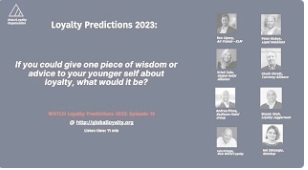
Video Interview featuring loyalty experts: Kristi Gole, Head of Strategy, Global Hotel Alliance / Ben Lipsey, Head of Flying Blue Air France-KLM / Andrea Pinna, Global SVP Loyalty Strategy, Radisson Hotel Group / Iain Pringle, Partner, New World Loyalty, UK / Ani Elmaoglu, CEO, Ketchup Loyalty, Turkey / Chuck Ehredt, CEO Currency Alliance, Spain / Peter Kisbye, CEO, Loyal Solutions, Denmark / Shyam Shah, CEO, Loyalty Juggernaut, USA
 GLO
GLO
Kristi Gole, Head of Startegy, Global Hotel Alliance: I don’t know how wise it is but first of all: loyalty is a lot of fun. I think the thing that you learn as you get more experienced is that you try and fail, and you have to try lots of stuff and if you don’t – you see the same stuff and the same results and you’re doing the same campaigns- and a lot of businesses require that because you have to hit the monthly targets and then the quarterly. You know how to hit them because of historical campaigns. But that’s so boring and it’s so incremental. So I feel like what I’ve learned in our organisation – because we were a start-up looking to start a programme and still act like a start-up, even though we’re about 15 years old. I think is really cool and what you learn if you’ve had the chance to try and fail and try and try, is you have to do really weird different stuff to get much bigger results. So anything that’s kind of the same, or anything that’s small, you get the small, you get incremental results, you get small gains. But if you really want big gains, you really want to do cool stuff, you want to win the awards, you want to have huge year-over-year growth, you want to get into new audiences: you have to do huge risks and take big leaps. And that’s the only way to do it. I think I didn’t realise that before. I think everyone likes to be safe and the safe is really boring. It’s good to try new things. And certain organisations embrace that and others don’t have the ability. So I think to my younger self, it’d be “Hey, make sure you jump into the start-up stuff much earlier because it’s much more fun.”
Ben Lipsey, Head of Flying Blue, Air France – KLM: Benchmark, benchmark, benchmark. I think there are a lot of programmes that operate in isolation, they operate with blinders on, and they don’t know their consumer. They think that what they put out there is simple. They think that their reward charts are fair. They don’t understand the consumer’s choice. I look at this from an airline perspective. We view ourselves as having to earn the business of our customers every time they buy a ticket. We cannot take the customers for granted and if we don’t know what the consumer wants, what the competition is offering, either on board or in the airport or from a loyalty perspective, we won’t be able to speak to customers and we won’t be able to understand. Being close to your customers is to really understand what their wants and needs are sometimes better than they do themselves. But if you don’t know what your competition is offering and you don’t know what your consumers want, you’ll never be able to deliver on the loyalty value proposition.
Andrea Pinna, Global VP Loyalty Strategy, Radisson Hotels: I would have three recommendations. One, no matter the generation recognition always matters. Today there are many articles about Millennials and Generation Z etc. but no matter the generation, recognition always matters. Two, memorable experiences are in large part emotional. The connection with the loyalty programme will be more and more important. Last but not least, never give up on excellence but keep things simple. We can change the programme many times adding benefits etc. But keep it simple. And that’s why our main strategy for the new Radisson rewards is: ‘So easy, so much more.’
Iain Pringle, Partner, New World Loyalty (UK): It’s a really good question because I have now worked for many, many programmes including four that I have worked with for many years. And I think my biggest advice to me then and anyone listening is to be honest with yourself because I’ve spent too much of my career justifying programmes that don’t work. I know now, the programmes do work that loyalty can change behaviour and loyalty can provide vast and big benefits to the lead brand, but only if it works and only if it if the proposition is right. And so, I would urge everyone to understand what impact their loyalty programme has on their lead brand and if they don’t know then I would urge them to find is how much loyalty is actually driving their business. How much additional sales is the programme actually driving, how much cross sales, and how much acquisition? Because when you know those questions, you can be much more confident in what you do and how you do it. Whereas to hide behind programmes that aren’t working or make excuses or to find ways of justifying a programme to a board is not great. It’s not great for you and it’s not great for the industry.
Ani Emanoglu, Ketchup Loyalty (Turkey): Be a developer. Because everyone who knows a little bit about marketing can have an idea about consumer trends and consumer needs. But the right execution of loyalty mechanics is through loyalty solutions. So that’s why if I was giving advice to my younger self I would probably tell myself to get an education in information technologies and backend development.
Chuck Ehredt, CEO Currency Alliance (Spain): I’ve had sort of two phases of my life related to loyalty programmes. The first phase was 25 years of travelling very frequently as a business person. And I focused most of my travel on United Airlines and Star Alliance airlines. I have a lifetime gold status with United Airlines. But I also accumulated 300,000 or 600,000 points with many other airlines. And I probably wouldn’t change that because I wouldn’t have gone out of my way to fly on United Airlines in order to earn more points. I was often more interested in getting to my destination as quickly as possible or saving money on the flight when necessary. But I was a member of many loyalty programmes for 25 years and I could have done a better job if I understood the industry better in accumulating value faster, I probably would have used co-branded credit cards much more than I did. I would have been a more sophisticated consumer if you will. And then the second phase has been in the last seven years when I’ve been working in the loyalty industry. My behaviour as a consumer has changed a little bit because I understand how loyalty programmes operate better. But as an industry insider now, I think if I knew what I know today, seven years ago when I started Currency Alliance I would have focused on two or three really strategic anchor partners for our business in the first year or two. That would have given us the network effects to grow our platform and our marketplace for brand collaboration much faster. I guess because I was naive in the way that the industry works it sort of took until the third or fourth year when we started to see network effects where one partner was inviting another partner and then that partner would bring in three more partners and now, we’re growing really fast because of the network effects.
Peter Kisbye, CEO Loyal Solutions (Denmark): It would be to always multiply the cost budgets by three, divide the revenue budgets by five and extend the timeline by ten. Even though I have been at a very large company before, things take more time, cost more money and take more effort than you have ever imagined. No matter how smart you think you are. We were very, very seasoned people and thought this was a five-year project and it has taken eleven years. So patience; patience and perseverance. If I started from scratch today, I would ensure that I did not have shareholders with a three-to-five-year horizon. Because if you start from scratch, especially in a high-tech business, you make so many mistakes along the way. You need a longer horizon. We were lucky to have long-term shareholders but if I were starting today I would make this by design and not luck.
Shyam Shah, CEO Loyalty Juggernaut (USA): I remember a very famous line from a book I read. It says (I’m paraphrasing it): Loyalty is not bribery for your transaction. It is empathy. It is all about empathy for the customers. I think that is something that we lose sight of. We believe that loyalty programmes are all about rewards. Of course, rewards matter. But what really matters is empathy. I think brands do a more effective job of conveying the sentiment that we understand who you are: We recognise you, and we also know what you value and thereby when you engage with us when you give when you trust us with your loyalty, we, in turn, make sure that we deliver you what you really value. I think that the empathy aspect is sometimes missing. And it’s not an easy thing to solve. But that will be my advice to my younger self: focus on the empathy element of the loyalty programme. Rewards are important and rewards can also be aligned with the empathy aspect of the loyalty strategy. But that’s something that often gets lost in translation. So, I would advise focusing on that. There’s a lot that is spoken about emotional loyalty, but the word “emotional loyalty” for me is an oxymoron; loyalty is always emotional. So there is nothing like non-emotional loyalty or unemotional loyalty. I think it’s an analyst-created word that doesn’t have much meaning. I think loyalty is always emotional. Loyalty is about expression of empathy of the brand towards the customer. I think that’s what I would advise my younger self.
