

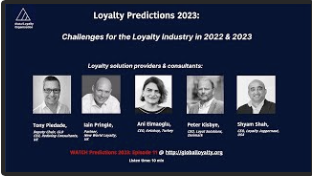
Video Interview featuring loyalty experts: Shyam Shah, CEO, Loyalty Juggernaut, USA/ Peter Kisbye, CEO, Loyal Solutions, Denmark / Ani Elmaoglu, CEO, Ketchup, Turkey / Tony Piedade, Deputy Chair, GLO / CEO, Redwing Consultants, UK / Iain Pringle, Partner, New World Loyalty, UK
 GLO
GLO
Tony Piedade, CEO Redwings Consultants (UK): I think operationally they’ve (Loyalty Programmes) got a lot of worries. I think many have probably got loyalty commitments and promises that they’ve made both as a brand and as part of their loyalty programme of which they’re probably thinking: “How do we now make sure we still fulfil those promises?” Whether that’s redemption capacity, product redemptions, or offers that encouraged footfall, while physical infrastructure is being shut down. As retail continues to shut down stores, how do you balance it against the proposition saying, “Come into our stores more often, then you can earn a reward”? I think some of the businesses that are grappling with that. Ultimately it is also understanding where to jump. Do you invest in loyalty for the short and long term? Do you invest in discounting because in a cost-of-living crisis discounting is what really people want? I say that reluctantly because maybe what consumers want and what they need are two different things. But that’s an academic debate. So, it really depends on who’s at the helm. I wouldn’t be surprised if there are very tough conversations going on right now in organisations’ boardrooms that talk about price discounting, ensuring that they’re still alive and trading in 18 to 24 months’ time and they will make these big decisions only then at that point. It is an unenviable position to be in right now.
Iain Pringle, Partner, New World Loyalty (UK): I think given where we are in 2023 and the global recession we’re expecting, the first thing is to keep the lights on, the first thing is survival. And by that, I mean that the loyalty companies and the loyalty strategy have to reflect that to some degree if it’s going to be a tough, tough year, then the loyalty company will have to roll their sleeves up and really help their lead brand to do that. And if that means cutting costs, or if that means engaging more customers your first priority is to make sure that the business works best and you’re reflecting that. The second priority I’d then say is to move more towards a spenders mentality than a savers mentality of saying “how can I give my customers that little bit of luxury?”. It’s this lipsticks or sofas debate. The sale of luxury lipsticks generally tends to go up during a recession because people are looking for those small returns, those small luxuries that make a big difference. And so that’s why I’d say reflect your lead brand, what’s happening there and make sure you’re honest to that. And the second thing is to focus on customers and give those little bits of luxuries that can make a big difference.
Ani Emanoglu, Ketchup Loyalty (Turkey): Actually, the biggest challenge in 2022 was sustaining the growth of the loyalty programmes, despite the market shrinkage in many industries as a result of the decrease in purchasing power of the consumers. In 2023 we expect purchasing power to decrease further, due to the recession. It will be necessary to find more effective and personalised offers to retain customers.
Peter Kisbye, CEO Loyal Solutions (Denmark): The biggest challenge for our industry I think is the lack of speed in decision-making with a lot of potential clients. Everything takes a long, long time. Then there are other challenges. If you have old technology, data privacy can become a real challenge. We have global clients and operate in many markets. We are very lucky that we have a technology that can adapt easily to these different privacy rules. For example, we have a client that operates across Australia, the US and Europe. And that means that data has to be stored in different servers in Australia, US, and Europe. This is how we can turn a challenge into an opportunity for our clients. India is another example. Currently, it’s almost impossible to do card linking in India, because the schemes have not adapted to the new data privacy rules. Being a Danish company works to our advantage. Denmark is one of the first countries to implement GDPR and apart from Germany, I think we are the strictest. We are used to operating in this environment. Then there are regulations within payments to deal with. There are challenges that some of the schemes face as cannot operate fluidly in all countries and have issues with cross-border transactions. Inflation is another challenge. If inflation stays at these high levels, a lot of companies will be forced to go out of business. The biggest challenge for us however is getting qualified IT staff. Having these systems require very talented people at least in the Nordics. Getting talented IT staff is a challenge will and remains challenging for 2023.
Shyam Shah, CEO Loyalty Juggernaut (USA): I think one of the major challenges that the existing loyalty programmes faced or have been facing for some time now is that the programmes are designed and run as transactional loyalty programmes. Driven by the shift in consumer expectations programmes had to re-think and transition to a more contemporary loyalty programme that is more vibrant, a lot more dynamic, a lot more personalised, a lot more engagement-driven and more experience focused. I think that transition has been hard for several loyalty programmes. It’s not so much a lack of intent or willingness to make that transition. It’s the enabling technology and the organisational readiness. I think those have been the major challenges for the loyalty programmes trying to make that swift transition, having realised that the transition is inevitable. I think that I would highlight it as the single most critical challenge, and I would continue to see that challenge going into 2023. As the technologies evolve, the loyalty markets and regions evolve we are on a very solid track to get to a place where the loyalty programmes will see the next generation of the evolution of loyalty rewards 3.0 so to speak.
I believe COVID did have an impact on the economy and impacted everything from all walks of life. However, what I would like to highlight is the silver lining. Loyalty programmes actually were quite effective. Especially the brands that knew how to use loyalty programmes to continue to stay in touch with their customers and continue to engage with the customer. I could name several brands that I felt did a brilliant job in keeping in touch with the customers making sure that the customers realise that the brands continue to care about them, delivering them benefits that were not necessarily the benefits that they were traditionally used to be delivering but benefits that were more aligned to what customers’ expectations were. So they used loyalty programmes very effectively as a tool to stay connected with their customers. And I think that actually underlines the power of a well-run loyalty programme to provide that kind of a bridge with your customers even when they are not doing business with you. So, I think COVID was challenging, but at the same time, those who had invested in a well-established loyalty programme were able to harness the power of loyalty programmes to stay in touch with the customers and they benefited very well on the rebound. Because customers always felt that this brand cared about them as they communicated with the customers. They extended, for example, their points expiration, extended their vouchers and privileges, and made sure that the customers were continuously engaging through that period of breakdown in terms of business.
