


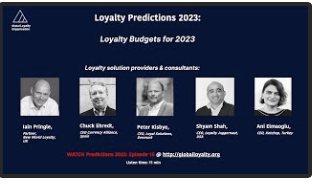
Video Interview featuring loyalty experts: Shyam Shah, CEO, Loyalty Juggernaut, USA/ Peter Kisbye, CEO, Loyal Solutions, Denmark / Chuck Ehredt, CEO Currency Alliance, Spain / Ani Elmaoglu, CEO, Ketchup, Turkey/ Iain Pringle, Partner, New World Loyalty, UK
 GLO
GLOIain Pringle, Partner, New World Loyalty (UK): When we talk about budget, I don’t think people should be thinking “I should be spending more on loyalty?”. The question is “How much can I spend and how can I make that spending most effective?” Because what we’ve seen a lot in the industry is that if you take the cost of rewards that is what you can afford. The cost of technology in all sectors is coming down and in the loyalty sector, it has come down significantly over the last few years. So it’s really about saying “How can I use my budget most effectively?” As we talked about before, I’m not necessarily certain there’s going to be an increase in spending on customer rewards. The budget has to be a reflection of all factors. So I’d be saying “How can I make the money that I’m spending on loyalty go furthest by wringing as much value as possible?” And that’s by looking at the customer journey and customer proposition. I think in 2023 there is going to be a focus on customer retention because of the challenges we face. So I’d be considering how to retain my customers and how to make the most of the customers I already have access to.
Ani Emanoglu, Ketchup Loyalty (Turkey): In Turkey investment has been in data systems and the development of mobile applications for years. Turkey has a high rate of technology adoption and integration. The economic crisis not only affects purchasing power it also negatively affects the marketing and technology budgets. In 2023 we expect the investment to focus on machine learning and data analytics to support predictive analytics and brands focusing on spending their limited budgets to retain existing customers. Retaining the loyalty members will be key in 2023. In the past years, many loyalty programmes reached certain saturation based on the acquisition of new customers and new members. However, with the decrease in purchasing power of the consumer, it will be important to retain the price-sensitive existing customer rather than gain new members.
Chuck Ehredt, CEO Currency Alliance (Spain): In any type of uncertain economic situation, you want to be focused on retaining customers and capturing a higher share of wallet from your existing customer base because as people have talked about, for 20 years, it’s seven times cheaper to retain a customer, than to acquire a new one. And I think people generally believe that and if it’s not seven times, it’s at least three or four times and therefore retaining customers and extracting more revenue from your existing customer base is what companies will focus on in a challenging economic situation. We’ll continue to see growth in loyalty programme participation. I think there will be recruitment drives, but instead of direct marketing through digital channels, I think we’re going to see a lot more new customer acquisition by partnerships. For example, if a large airline partners with a hotel group, then they’re trying to get some of the hotel group members that are not yet members of the airline loyalty programme to join the airline programme which is a relatively low-cost method for new customer acquisition, but the majority of the focus will be on maximising share wallet from existing customers.
Peter Kisbye, CEO Loyal Solutions (Denmark): We see budgets increasing almost everywhere. There’s a lot of talk about blockchain and AI. But I don’t see it happening on a big scale in the next year or two. I think that the short-term focus will be on personalisation and making the programmes more relevant. I would like to split the loyalty programmes into two categories. There are the ones who use the increased budget to upgrade their technology. These programmes have been running for 15 years and have a technology that’s not really up to par. They will search for partners who can help them to upgrade their technology. We have had clients like that. Then you have the programmes that already have the technology and they are thinking more down the road. They are thinking ‘How can we reduce the cost of redemption?” They are looking for partners to help them to fund their loyalty proposition and looking to cooperate with banks to try to enable a better reward proposition for the consumer but whilst having a sponsor behind because they can’t fund this out of their own profit margin. If we look at 24/25, I think people will want more proactive systems (whether you call it predictive or you call it AI) instead of systems that are reactive. So they would like the system to come out and say, “Peter is a prime candidate for a co-branded card, because he shows certain behaviours in the system.” I think that’s the next phase. But if we’re looking at the next 18 months I would say the budget focus is going to be more on generating ROI. This will take away from these more “exotic” investments. Companies will focus on customer retention. I think they have all learned the hard way during COVID that getting new customers is extremely expensive compared to retaining consumers. Companies are looking to build a better proposition to retain their customers whilst also looking to make better use of the data they have. We do have a few clients who are more aggressive on the acquisition side, but it’s rare. I think the focus is definitely on retention.
Shyam Shah, CEO Loyalty Juggernaut (USA): I do strongly believe that the investment in more modern, contemporary, future-proof loyalty technology will continue to be one of the top investment priorities for the brands going into 2023. I feel that there are three key constituencies of customers that would look to invest in loyalty technology with a sense of urgency. There are still many loyalty programmes in the world that run on legacy technologies, and these were highly customised over a period of time. These are expensive to maintain and not geared for rapid innovation. These technologies were built to support Terms and Conditions driven transactional loyalty programmes. And that whole concept is ready to embark on the newer technology to benefit from the new capabilities that the more modern technologies bring to deliver on their loyalty programme objectives. The second constituency is loyalty programmes that use technologies that you cannot technically call legacy but these are on-premise platforms that are pretty fat, so to say they require huge managed IT services, they are not quite adept in terms of speed to market in terms of greater programme innovation, in terms of delivering customer experiences, and I think those loyalty programmes will to embark on something that gives them that agility and competitive advantage. And the third constituency will be those loyalty programmes that are looking to evolve and transform their current proprietary brand-based loyalty model into a more modern lifestyle-oriented digital ecosystem. I think these three constituencies would definitely see an urgent need to invest in more modern technology. Which ones they will investin? I would say that some of personalisation capabilities or some of the modern AI based capabilities that that deliver one to one individualisation will be strong drivers to motivate that investment. Why this investment even though we are all talking about a possible slow down of economy or possible recession? I do still feel that these investments will have incremental ROI over time. So in effect, these investments will work out a lot more cost effective over a period of time if you take into account the return on investment that the new technology will enable them to achieve. Budgets may vary from client to client and industry to industry. But if I were to give a more generalised answer, I would say that most of the customers would maintain, if not increase their investment in their loyalty programmes. As the programmes mature, there is a need for them to continue to make sure that the programmes deliver all the consumers’ expectations. So I would definitely think that the investment of our clients will either stay flat or increase.
Again, whether the focus is on growth or customer retention depends on the stage of the life cycle the program is in. If the programme is a brand-new programme that started less than 12 months back, obviously one of the key KPIs or the objectives they will be chasing is to maximise the customer acquisition potential, because as they have more customers, their ability to learn about their customers, their ability to build a data foundation is directly proportional to the magnitude of customers they have. So those programmes will look to focus on acquisition. But all the programmes will look to make sure that more and more customers are retained. One of the major issues with the loyalty programmes has been that the percentage of active customers is always a worry. And depending on the industry it may vary from single-digit active customers to 30-35%. And I think there is a strong merit and a strong argument for loyalty programmes to look at maximising retention, maximising engagement and maximising the ability to leverage loyal customers so as to be able to reduce their marketing expenses and drive, word of mouth advocacy and drive low-cost acquisition. I think that will definitely be a priority across all the loyalty programmes, but those which are brand new loyalty programmes will also focus on acquisition.
