

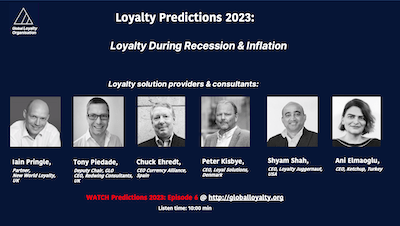
Video Interview featuring loyalty experts: Shyam Shah, CEO, Loyalty Juggernaut, USA/ Peter Kisbye, CEO, Loyal Solutions, Denmark / Chuck Ehredt, CEO Currency Alliance, Spain / Ani Elmaoglu, CEO, Ketchup, Turkey / Tony Piedade, Deputy Chair, GLO / CEO, Redwing Consultants, UK / Iain Pringle, Partner, New World Loyalty, UK
 GLO
GLO
Tony Piedade, CEO Redwings Consultants (UK):
Loyalty as a product or a service comes into its own in a number of environments – when the economy is going well and there is lots of spending and we are all upbeat, loyalty is great because everyone is fighting for that additional spend. When the economy is going down and it is harder and we have got less purchasing power out there, particularly with inflationary pressures and the cost-of-living crisis which are on us today, it has another role to play because it is now about retaining the customers you already have and you need to keep that loyalty with you. It isn’t an option to drop loyalty just because there is a cost-of-living crisis, in fact, quite the opposite – now is the time to invest in it. Those that had already investment plans in loyalty back two, or three years ago are probably reaping the greatest rewards because the program is in good health, loyalty propositions are in good health and it just so happens that it coincides now with the downturn and they are getting the maximum energy out of that loyalty program. None of us would have predicted this and now is the time to really double down on loyalty and make work a lot harder for you.
There are a number of things within a loyalty programme that make it work well. One is having the base proposition done, the other one is about segmenting your audience. And the third one is overlaying the data lens on that so you can really maximise your one-to-one relationship with your loyalty customers. Now, I think having a programme in place is a good start but making that work effectively and efficiently for you is the real key here. You got to know which audiences have the propensity to pay irrespective of the downfall, which of your customers are actually feeling less of pain right now and you can still maximise. How many are feeling the greatest amount of pain and how can you help them? And the ones that are in-between: how can you have some form of treatment for them that keeps them engaged with your business over the long term? So, the key here really is segmenting the members of your program and overlaying a treatment for those that you feel have the greatest propensity to still spend with you.
Iain Pringle, Partner, New World Loyalty (UK):
We saw similar experiences in 2009 when we had a similar recession or similar cost of living crisis. And what you generally tend to see those times is that loyalty is made up of four different customer types: 1. joiners, who join anything, 2. spenders who spend and look for instant gratification 3. savers who save up for reward over time and 4. people that just don’t care about loyalty. What you generally tend to see at times of recession is a focus on a move from savers to spenders. So you move from saving behaviours where you’re saving up a long time to saying ‘actually, I want instant gratification. I want money off ‘. You’re seeing that with the likes of Nectar in the UK, moving to the reduction of petrol. What I would urge loyalty programme managers is to consider how to make redemption easier and how to make it more associated with cash off because that is what customers want at a time of crisis.
I don’t think there’s any such thing as discounters anymore. I think there’s value and customers make that choice. You just have to look at the types of people that are shopping at Lidl these days. They’ve got everyone in there – not it’s not just the low demographics. Loyalty has to be viewed as part of the whole. When Tesco described loyalty years ago, they said it’s the chocolate on top of the cappuccino. And by that, they meant it’s not just a cup of coffee. You have to get the coffee right. It has to be the right temperature, has to be the right mug, it has to be the right environment. And then you’ve got to put the sprinkles on top. Loyalty can’t be seen as a means of discounting. In fact, if loyalty is seen as a means of discounting by finance, it will fail. You must get your pricing strategy right. And then loyalty is a means to make it stickier. You can’t do one or the other. And you certainly can’t use loyalty as a means to discount. What I have seen used very effectively, particularly in the petrol market is where loyalty is used as a means of keeping your price high and discounting for customers who are price conscious because they will join the loyalty programme. Hence your loyalty benefit can be seen as a means of discounting to the people who care about discounts. Whereas the people that are just going to fill up when they hit empty, they’ll still come into your store. So, you have to consider it as a whole and you can’t just consider it as a means of discounting.
Ani Emanoglu, Ketchup Loyalty (Turkey):
Loyalty should not be seen just as a cost centre. For the last five years, companies have switched to a performance-oriented loyalty approach. The effect of loyalty or incremental sales should also be considered when designing and managing loyalty programmes. We have to implement mechanics that go beyond the traditional sense of loyalty and support the business strategies of companies. On other hand, a loyalty offer shouldn’t necessarily be viewed as a monetary incentive such as discount campaigns or points. A unique experience can also be a reward, a form of loyalty. The brands must be focused on their own assets, and they should give their best support to improve the customer experience.
Chuck Ehredt, CEO Currency Alliance (Spain):
In 2023 whether regions will fall into recession is still unknown. A country can be in a technical recession if they’ve had two shrinking quarters. But in many cases, employment rates continue to go down. Interest rates have gone up and then now they’ve started to come back down a bit. There are a lot of conflicting indicators about whether the world economy will fall into recession in 2023. I think it’ll be more of a regional impact. Consumers have different income levels, spending levels, and different levels of discretionary spending across different regions. And families or individuals that are struggling to make ends meet on a monthly basis, are certainly going to have to cut expenses. But I think the majority of people are not in that situation and so, I would expect that again, travel in particular, will be strong in 2023. But loyalty programmes in particular can help customers at any economic level. For mid-income families, we are seeing them redeemed for more essential items, rather than experiential items. In Southeast Asia in particular, it used to be the gas station chains that were generating a lot of points because people were putting fuel in their cars, but then the value of those points would flow out into more aspirational tours and activity experiences or travel loyalty programmes, whereas, in the last two years, we’ve seen a lot more points getting redeemed for fuel. That’s also true in South Africa and a few other countries where the consumers are trying to use the loyalty value they’re accumulating for their monthly needs.
Peter Kisbye, CEO Loyal Solutions (Denmark):
I think that inflationary pressure will definitely impact brand loyalty. Consumers will maybe not go for the cheapest option, but cheaper options. It will be this split which you will see: The luxury segment will like not really be affected by inflation. Then there’s a big middle segment which I think will be really affected. If you look at grocery stores, for example, I think there will be high-end stores, and then there’ll be stores like Lidl at the very low end. And anybody in the middle I think is going to have a real problem with inflation, because consumers will have a problem if inflation rates keep hovering around 8- 10%, including all the energy issues we are facing right now. I think there’s a big pressure there. You can argue that a loyalty programme is a cost centre, but it is important to remember that it also generates ROI. I think that having more loyal customers in a situation where you are under price pressure is better situation than having fewer or not having any customers. In the end, I think everybody will be hit by inflation. But using a well-designed loyalty programme in an intelligent way during inflation could be a competitive advantage.
Shyam Shah, CEO Loyalty Juggernaut (USA):
The answer to this question lies in what happened when the recession happened last, and there’s lots of data and historical evidence that the loyalty programmes were even more effective when the recession hit last time round. It’s pretty obvious and natural that when in either recessionary times or inflationary times, customers expect to get better value for their investment and for their spending. The customers look for avenues to save and loyalty programmes provide a value proposition that is aligned with those objectives. We believe that loyalty programmes will continue to have the same prominence if not greater, should there be a recession. The brands that continue to invest in loyalty programmes, and the brands that continue to persist with their loyalty programmes will stand to gain both during the recession and after the recession. The other example when COVID happened was not a recession, but it was more the economy stalling because of COVID. And we saw that loyalty programmes were fabulous communication tools or engagement tools used by brands effectively to ensure that the customers remain engaged with them. So, we do feel pretty bullish about the future of loyalty programmes even heading into a possible recession.
