

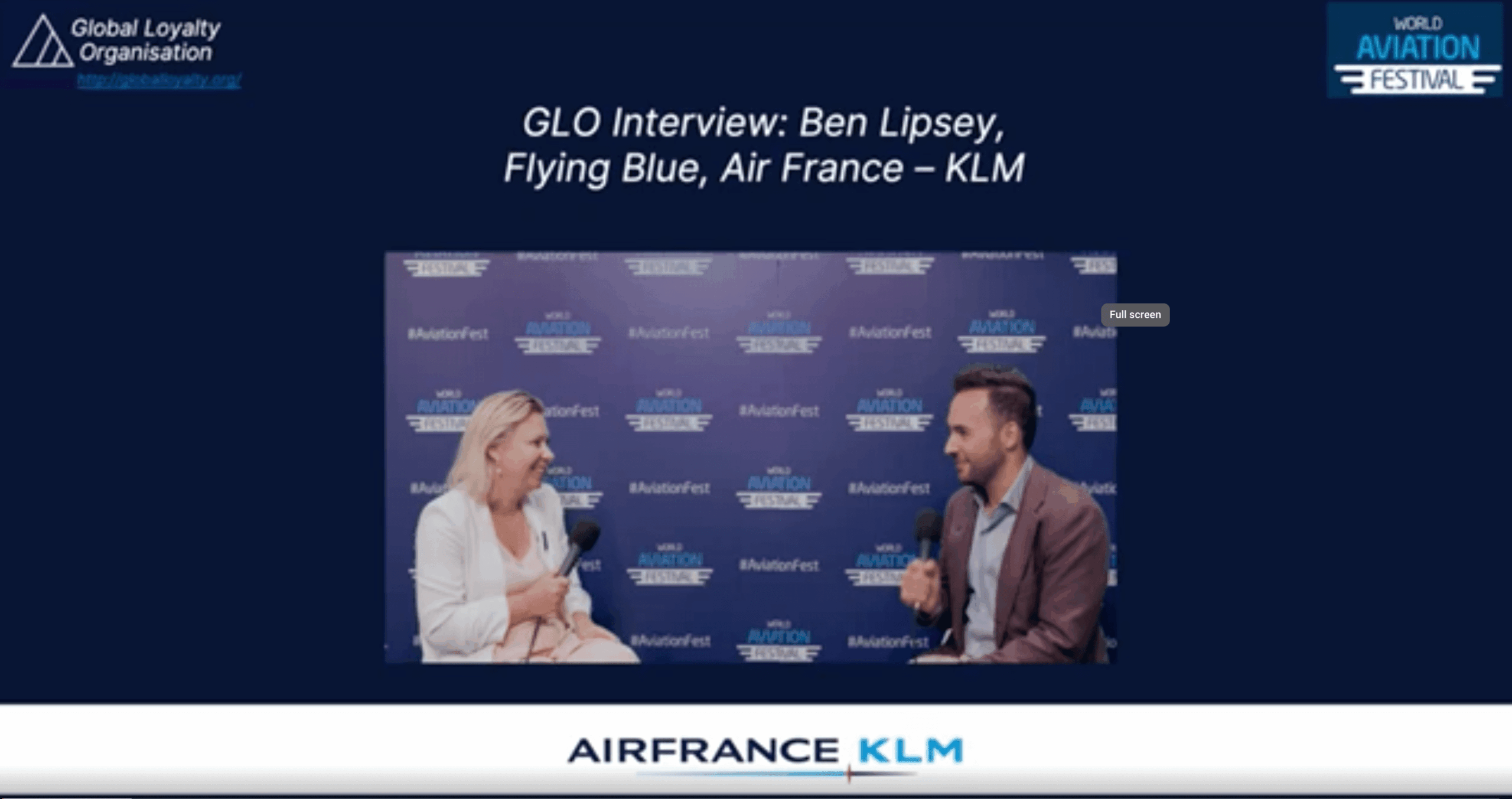
Ben Lipsey, Head of Flying Blue on: 0:00 - on Amazon customer centricity and customer data ecosystems • 4:55 - on Millennials, social media, experiential travel and sustainability • 10:34 - on partnership with Etihad
 Air France - KLM Group
0:00 – on Amazon customer centricity and customer data ecosystems
4:55 – on Millennials, social media, experiential travel and sustainability
10:34 – on partnership with Etihad
Read the transcript:
0:00
GLO: Dear Ben, it’s a pleasure to see the World Aviation Festival here in Lisbon and thank you so much for meeting us again at Global Loyalty Organization and sharing your insights. It is a big conference this year and we see some new participants such as AWS with key topics touched upon being definitely new technologies, big data, and the importance of auxiliary revenue. What were the key themes that you think are most important this year at the World Aviation Festival?
Ben Lipsey, Air France – KLM: A couple of things I guess just to mention – for example Amazon, since you brought them up. We’re a new partner of theirs actually and our members can earn Miles when they when they shop via Amazon. But interestingly enough, when we look at internally how we want to build our data models, our CRM system, and our customer suite, Amazon really does come to mind. They’ve done a really good job at putting the customer in the middle – whether you’re shopping via Amazon.com, your Kindle or Prime – they know who you and they leverage all that to have a better idea of who you are.
Taking that into our aviation world – we have so much data on our customers – we know where they fly, how far in advance they book, what travel cabin they tend to travel in, obviously, we know their loyalty number, etc. When you start plugging in the information from our partners, including our financial partners, we can do more to understand customers’ purchase patterns and our share of wallet. From our mobility partners – we have a partnership with Hertz, what kind of cars they book? Our hotel partners, we have a partnership with Accor, can say that they’ve booked a hotel in Singapore, but we don’t have a flight from Paris to Singapore – so how did they get there? Maybe we can send them an offer next time? I think we can do a better job at building and for me, it’s been really inspiring to see AWS is here but also more of the other partners that I’ve spoken to.
The elephant in the room for a lot of us now in the loyalty space is what’s happened recently in the USA with Delta of course, who is our JV partner, and how they followed American Airlines, which last year introduced the concept of loyalty points. In both cases a departure from the traditional system of how much you fly or engage with Delta by flying in terms of earning status and instead much more revenue focus, in terms of not only how much you fly with the airline but also how much you spend on their co-brand and credit cards, how much you rent from their rental car partners, how much you use their hotel portal or their shopping portal, e.g. total spend which goes into this the calculation in order to earn status.
It’s a bold move and I think it works well in the USA, given the proliferation of co-brand and credit cards. In Europe, for a variety of reasons we don’t have the same strength of credit cards or the same customer behavior, but I do think that we can start to learn from what we see in other markets and see how we can better incentivize engagement with our partners. For example, we can say: “We want you to rent a car via Herz, our partner, you earn miles as a customer, and we earn a commission, obviously, as the partner, Herz earns the rental. So it’s a win-win-win”. We’re going to find new ways to reward you for that. Then you tie into that the data model that we just described and that we want to do a better job building and we then start to be able to get a better behavior modeling possibility for our customers, which I think then allows us to better messaging at the right time, to the right customer, which then will hopefully boost conversion and engagement with our company.
4:55
GLO: A couple of sessions here focused on the Millennials, becoming one of the main customer categories and the use of social media. From my understanding it’s the third largest channel now for travel and one of the key takeaways from this conference is that selling flights alone is no longer an option and it’s not interesting for Millennials. It has to be an inspirational experience package with a hotel or with some experience trips. Do you think that will fundamentally change the nature of loyalty programs globally – and we will see much more the ecosystem of maybe one or two dominant players with the affiliated partners?
Ben Lipsey, Air France – KLM: I think it’s it’s a really interesting question. I can say a lot about the millennial segment being one myself. First and foremost, I think you know your point on social media – we think that it’s important to be present where our customers are. We are present on Twitter, Facebook, Instagram, and WhatsApp and it’s true we certainly find from a customer handling perspective that these channels are increasing.
We also see your point about aspirational travel with influencers. We don’t have any influencers ourselves that we use at least in Flying Blue but what we do see is that they can inspire people to book trips. There are a lot of partnerships that we can lead with there and what it means to me is that it really reinforces this idea that loyalty can work with the aspirational idea of travel, which can reinforce the power of loyalty programs. It’s this aspirational reward that makes people pursue what I call “irrational behavior”, which is not a negative, it just means that customer can take a more expensive or less convenient route when he can fly with somebody else, but doesn’t as he gets out miles and thinks that our miles are valuable because he can use than book a trip that he’s seen on Instagram. This is the idea of an aspirational award whether it’s a flight, which of course is our primary business. But as you say there is also the kind of “Halo” of the flight that then extends to the other travel aspects and travel partners in our ecosystem. I mentioned we have a partnership with Hertz, we have hotels with Accor, Booking.com, etc. I think all of those are going to become more important as people say: “I want to be able to use my miles for more things. I want to increase the utility, the relevance of my miles”, which makes the currency more valuable, which then makes it more interesting to earn miles with us, engage with us, creating that virtuous circle.
The other benefit to making the miles more valuable is then you get more people using them and you increase this level of aspirational redemption not only for flight, travel but also for experiences. You start to create more everyday relevance not only for partners like Amazon but also for what can we do to leverage the brand partnerships. We have, so you know, at Air France we have 17 Michelin-star chefs that sign our menus in business in first class. Being based in France of course we’re home to the French gastronomic culture and we can leverage that. You can use your miles to train with the pilots in the flight simulators because that’s a money-can’t-buy experience. We are looking to increase not only the ‘everyday use’ utilization but also ‘desire and aspirational value’ so that more people want to engage which then increases experiential utilization of the program.
Then lastly, I think with millennials the key thing that we have to keep in mind is sustainability. For us as a loyalty program for an airline of course this is a sensitive topic as there are some stakeholders who are saying we should be banning frequent flyer programs because that stimulates travel. And that’s another reason we’re looking to extend the number of ways you can actually use your miles is that is not necessarily focused on air. We do have studies that show that the actual incremental amount of travel stimulated by loyalty programs is negligible. But we can’t pretend that this challenge doesn’t exist, given the pressure particularly from the younger generations. So we were one of the first in the world to take a step back and say: “How do we encourage people to do the right thing?” So we actually introduced the ability to earn what we call ‘XP’, which is the status mile or the tier mile qualification, which you earn for buying SAF (sustainable aviation fuel). So for making a conscientious choice to contribute towards purchasing SAF, on which we don’t make any margin, you actually earn XP, which then helps you qualify for status. So you actually have to fly less if you purchase SAF in order to earn/maintain your status – which says a lot because we’re putting our money where our mouth is by saying we are willing to accept less money effectively for you to earn the same tier benefits if you are willing to make a contribution.
When we put this in place we noticed that there was an 800% increase in our Elite members who are purchasing SAF. Now that a lot it shows the power of loyalty to stimulate change, to influence people, to make the right choice. But it also helps us to respond to customers. We did a survey and one of the members said: “I’m a platinum member and I love the airline, I like flying with you, I like the benefits. But when I’m traveling with my friends or family and you recognize me as a platin member I’m embarrassed because it means that I fly a lot in order to achieve this status. So I don’t want you to recognize me now.” This is a new challenge for us because you have others like that. Certainly, the historical and traditional model of loyalty assumes that you should recognize your best customers and we still have many people that wish to be recognized. But how do we adapt to this new challenge of dealing with customers who don’t want to be recognized, because they’re embarrassed? For us the recognition piece is one aspect and when we can say to them: “You’ve earned the status because you’ve also contributed to buying SAF” this really helps as they can feel proud and we noticed that this has been very positively received, particularly by a younger generation. We hope to continue to find new ways to award members who are making the right choice.
10:34
GLO: It is interesting what you’re mentioning. We are seeing at Global Loyalty Organization in the hospitality segment, some of the hotels created a niche product – effectively the ‘green hotels’. For example one of our members, Global Hotel Alliance, has a Green Collection. If I look at the other industries food and beverages, for example, is quite normal now to have on the menu the vegan option so I wouldn’t be surprised if you know that in a couple of years, we will see green tier status as well as platinum, gold or silver tiers or a combination of those right. I definitely think there is a need and demand for this. Going back for a second to what you mentioned very interestingly about the partnership programs, about expanding into experiences, mobility, rental, and hires – we definitely can see the benefit for the non-airline partners to join such an ecosystem. How should we look at the co-brand or how should we look at the code sharing with other airlines? You recently announced several code-shares with airlines. If there are two airline partners in that relationship, each with a loyalty program, how can it be beneficial for both of them?
Ben Lipsey, Air France – KLM: It’s a great question. We recently announced an extensive partnership with Etihad. Air France recently announced that they’re launching a flight to Abu Dhabi and KLM is making the same analysis to see if it makes sense for them too. I think we have customers that are primarily based in Europe. In this case with our new partner Etihad has members primarily based in the UAE and in the Gulf region, and even as far south as Australia. So this allows us to offer more destinations to our customers. In a loyalty aspect, we aim to introduce reciprocal mileage earning and burning for our members on Etihad and reciprocal benefits for our top-tier members – lounge access, extra baggage, etc. In this case, you really are going to start to see the benefits. When you look at the way airline alliances were founded, this was the primary reason for customer benefit. Etihad is not in Sky Team but we still do see the value in partnering with airlines certainly in regions of the world that might not have Sky Team partners. Etihad is a great partners to work with and we hope to see successful growth from this.
GLO: Rise of partnership is definitely one of the key trends now and that’s the philosophy and DNA of Global Loyalty Organization we hope that through us you can also forge new partnerships in the future.
Ben Lipsey, Air France – KLM: Absolutely, thank you so much.
Source: GLO
