

Nearly six out of 10 Americans (59%) purchased a new consumer packaged goods product recently that improves health and well-being, and 27% because it's good for the environment. 42%t of Americans say their overall positive perception of the brand is enhanced when its marketing of healthy and sustainable products aligns with their values and preferences.
 GLO
GLO- Nearly six out of 10 Americans (59%) purchased a new consumer packaged goods product recently that improves health and well-being, and 27% because it’s good for the environment
- Forty-two percent of Americans say their overall positive perception of the brand is enhanced when its marketing of healthy and sustainable products aligns with their values and preferences
- Four out of 10 consumers always or often prioritize the environment when shopping for laundry or cleaning products, and 37% consider our earth when they shop for skin care products and food and beverages
More than half of Americans (55%) say they’re more likely to try a new product if it’s marketed as being aligned with a healthier and more sustainable lifestyle, according to a new consumer sentiment survey commissioned by NCSolutions (NCS), the leading company for improving advertising effectiveness for the consumer packaged goods (CPG) ecosystem.
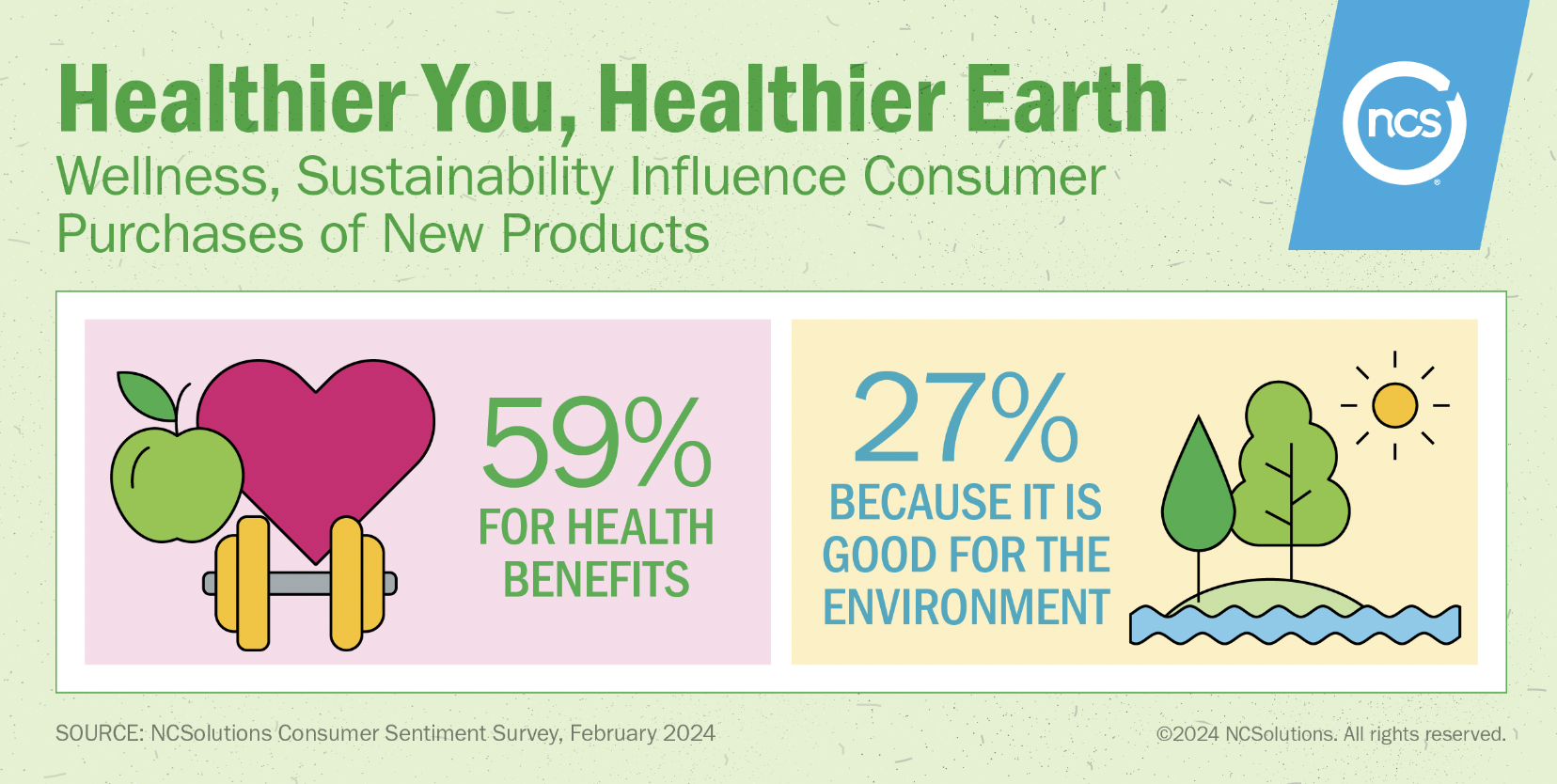
Six in 10 American consumers (59%) recently purchased a new product because of its health benefits. Nearly half (47%) of consumers say they’ve specifically purchased a food or beverage product in the last 30 days to get more vitamins or nutrients, while 33% buy to improve sleep and 29% to support gut health. More than one in four Americans (27%) purchased a new product because it is good for the environment.
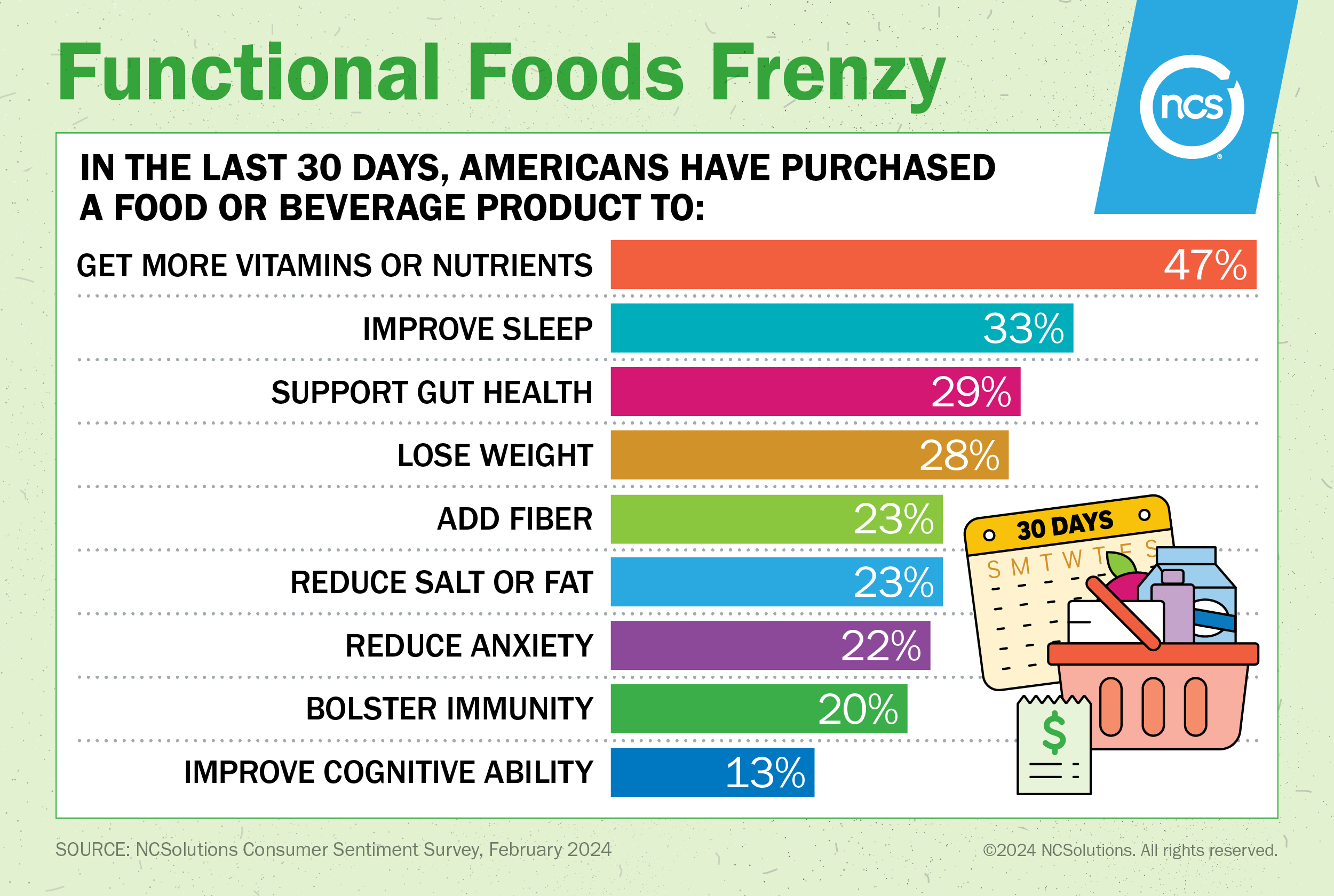
Since the first Earth Day in 1970, eco-friendly products, such as laundry detergent using sustainable packaging, have been designed and marketed to earth-conscious consumers. Functional (or fortified) foods, which involve modifying or enhancing the nutrients of conventional foods for added health benefits beyond basic nutrition, are also a growing trend. Examples of functional foods include vitamin-enriched water or low-carb bread.
Younger generations are more likely to consider the effect of their food or beverage product choices on the environment than older generations. Forty-eight percent of Gen Z and 44% of millennials consider this effect always or often, compared to 33% of Gen X and 29% of boomers. Likewise, younger consumers factor in the effect on the environment of their choice of laundry or cleaning products more often than older consumers. Fifty-one percent of Gen Z and 41% of millennials consider this effect always or often, compared to 33% of Gen X and 35% of boomers.
“The movement toward a ‘healthier you, healthier Earth’ has only accelerated over the last decade, driven by factors such as an aging population, consumers’ growing interest in convenience and advances in nutrition,” said Alan Miles, CEO, NCSolutions. “There’s greater awareness and concern, especially among younger consumers, about their own health and the planet’s health. As our findings show, consumers continue to factor well-being and sustainability into their purchase decisions, which is a powerful and positive message for CPG brands to hear on this Earth Day.”
A Sustainable Impact on Brand Loyalty
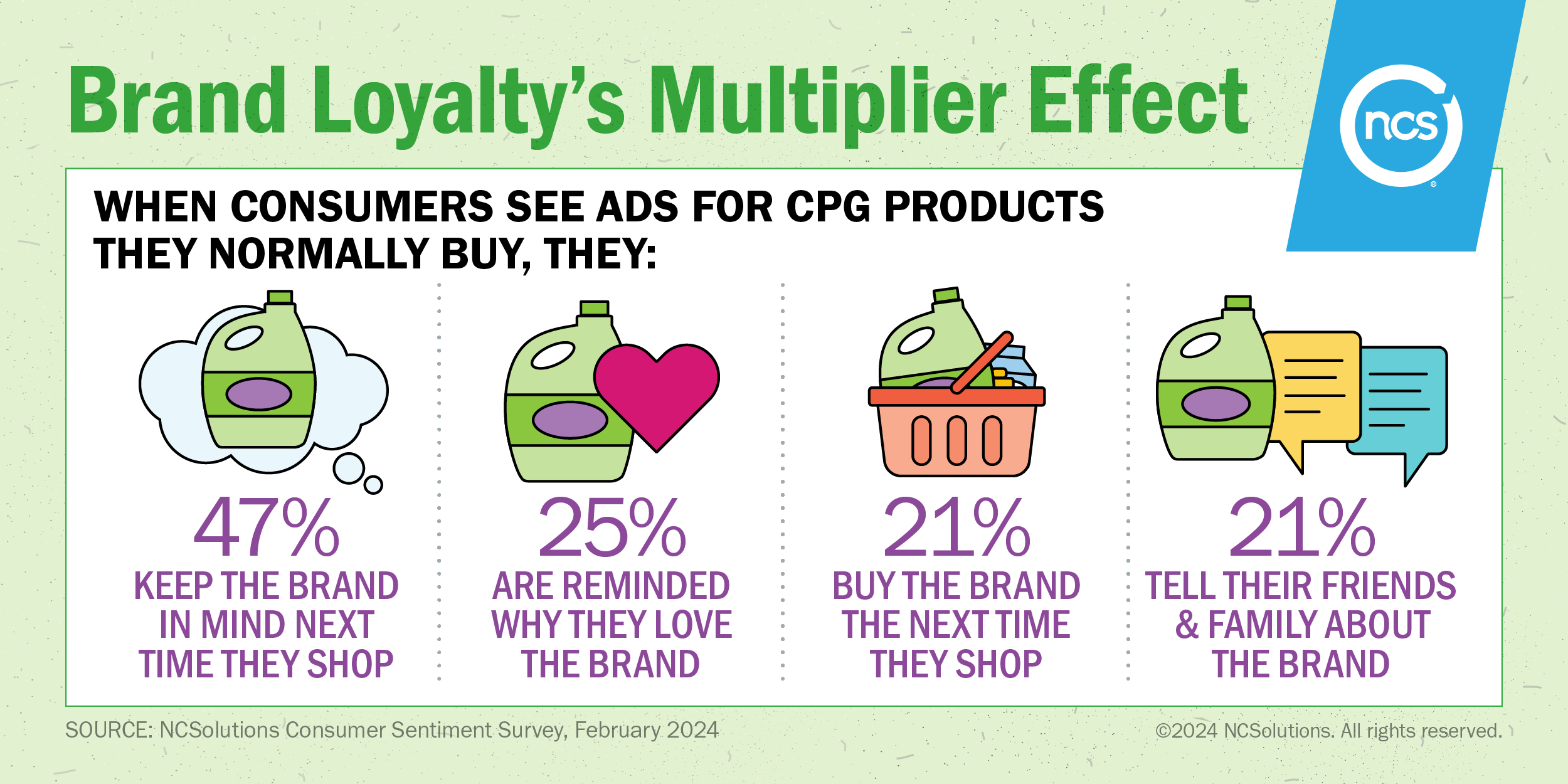
Almost half (47%) of consumers say that when they see a brand advertising products they typically buy, they’re more likely to keep that brand in mind the next time they shop.
Additionally, if a brand’s mission aligns with the consumer’s values, 58% say they’re very or completely likely to buy that brand’s product. When a CPG brand’s healthy and sustainable marketing message syncs with a consumer’s values and preferences, 42% say it enhances their overall positive brand perception.
However, controversial stands from a brand can also backfire: 28% of Americans prefer to keep controversies out of the shopping cart, while 19% only like it when the brand agrees with their own.
“As preferences evolve, health and sustainability have become non-negotiable social pillars for some consumers,” said Dan Malmed, chief revenue officer NCSolutions. “The NCS consumer sentiment survey results demonstrate that emphasizing healthy and sustainable values highly influences how consumers feel about a brand. By prioritizing these important product attributes, CPG brands can not only meet market demands, but they can also drive long-term growth and be more relevant in an increasingly conscious marketplace.”
Healthier for Earth: Brand Loyalty and Longer Purchase Cycles
When shopping for laundry or cleaning products, 40% of consumers say they always or often consider the effect of their product choice on the environment, and 37% say they consider these attributes when shopping for skin care products and food and beverages.
How often are consumers considering these healthy and sustainable purchase factors? In 2023, the average purchase cycle for household care products ranged between 75 – 93 days, according to NCS’ proprietary CPG purchase data. Laundry detergent was purchased every 75 days, on average, and bleach and bathroom cleaners had longer purchase cycles, 93 days and 91 days, respectively. In the skincare category, American households purchased facial cleanser and body lotion once every quarter, while they purchased sunscreen every 53 days.
“CPG brands that embrace sustainability and healthy living as an ongoing practice can expect to find and connect with like-minded consumers, according to the sentiment expressed in the latest survey,” said Deirdre McFarland, SVP, marketing and communications, NCSolutions. “By authentically aligning with consumer values, brands have the power to cultivate lasting brand loyalty, drive incremental sales as well as shape a brighter and more sustainable future––a win-win for all.”
A Roadmap to the Buying Journey of Conscious Consumers
Health- and eco-conscious consumers are most influenced to buy a wellness or sustainable product after seeing it advertised on TV and ad-supported streaming (44% of Americans), followed by social media (39%) and internet/website display ads (37%).
Celebrity and social media influencers can also hold sway over consumer purchase decisions. However, the impact of endorsements is split – 55% of consumers are at least somewhat likely to try a product that improves well-being or the environment when there is a celebrity or social media influencer involved. In comparison, almost a quarter of Americans (24%) are not influenced by a celebrity or social media influencer who endorses a healthier you or healthier for the environment product.
Consumers are most likely to purchase products that support a healthier you or healthier earth at the grocery store (67%), via a website (39%), or in a drug store (39%).
If you are interested in more data, check out our e-book for more insights.
About NCS Consumer Survey
NCSolutions commissioned the consumer sentiment survey of 1,104 Americans in February 2024. Results were weighted to be representative of the U.S. population by age, gender, region, ethnicity, marital status, education level, and household income.
About NCS Purchase Data
NCS provides purchase insights to brands to help them target, optimize, measure, and enable sales-based outcomes. NCS’s representative and balanced consumer CPG purchase data set consists of the industry’s preeminent and comprehensive sources. It is inclusive of actual purchase data (transaction information) from big-box retailers, supermarkets, drug stores, convenience stores and other retail channels at which American households buy CPG products spanning 340+ grocery categories. The NCSolutions purchase data was analyzed in March 2024.
About NCSolutions
NCSolutions (NCS) makes advertising work better. Our unrivaled data resources powered by leading providers combine with scientific rigor and leading-edge technology to empower the CPG ecosystem to create and deliver more effective advertising. With NCS’s proven approach, brands are achieving continuous optimization everywhere ads appear through purchase-based audience targeting and sales measurement solutions that have impacted over $25 billion in media spend for our customers. Visit us at ncsolutions.com to learn more.
Source: NC Solutions
Disclaimer: Press release
© Press Release 2025
Send us your press releases to news@globalloyalty.org
Press releases originate from external third-party providers. This website does not have responsibility or control over its content, which is presented as is, without any alterations. Neither this website nor its affiliates guarantee the accuracy of the views or opinions expressed in the press release.
The press release is intended solely for informational purposes and does not offer tax, legal, or investment advice, nor does it express any opinion regarding the suitability, value, or profitability of specific securities, portfolios, or investment strategies. Neither this website nor its affiliates are liable for any errors or inaccuracies in the content, nor for any actions taken based on it. By using the information provided in this article, you agree to do so at your own risk.
To the maximum extent permitted by applicable law, this website, its parent company, subsidiaries, affiliates, shareholders, directors, officers, employees, agents, advertisers, content providers, and licensors shall not be liable to you for any direct, indirect, consequential, special, incidental, punitive, or exemplary damages, including but not limited to lost profits, savings, and revenues, whether in negligence, tort, contract, or any other theory of liability, even if the possibility of such damages was known or foreseeable.
The images used in press releases and articles provided by 3rd party sources belong to the respective source provider and are used for illustrative purposes in accordance with the original press releases and publications.
Disclaimer: Content
While we strive to maintain accurate and up-to-date content, Global Loyalty Organisation Ltd. makes no representations or warranties of any kind, express or implied, about the correctness accuracy, completeness, adequacy, or reliability of the information or the results derived from its use, not that the content will meet your requirements or expectations. The content is provided “as is” and “as available”. You agree that your use of the content is at your own risk. Global Loyalty Organisation Ltd. disclaims all warranties related to the content, including implied warranties of merchantability, fitness for a particular purpose, non-infringement, and title, and is not liable for a particular purpose, non-infringement, and title, and is not liable for any interruptions. Some jurisdictions do not allow the exclusion of certain warranties, so these jurisdictions may not apply to you. Global Loyalty Organisation Ltd. Reserves the right to modify, interrupt, or discontinue the content without notice and is not liable for doing so.
Global Loyalty Organisation Ltd. shall not be liable for any damages, including special, indirect, consequential, or incidental damages, or damages for lost profits, revenue, or use, arising out of or related to the content, whether in contract, negligence, tort, statute, equity, law, or otherwise, even if advised of such damages. Some jurisdictions do not allow limitations on liability for incidental or consequential damages, so this limitation may not apply to you. These disclaimers and limitations apply to Global Loyalty Organisation Ltd. and its parent, affiliates, related companies, contractors, sponsors, and their respective directors, officers, members, employees, agents, content providers, licensors, and advisors.
The content and its compilation, created by Global Loyalty Organisation Ltd, are the property of Global Loyalty Organisation Ltd. and cannot be reproduced without prior written permission.
