

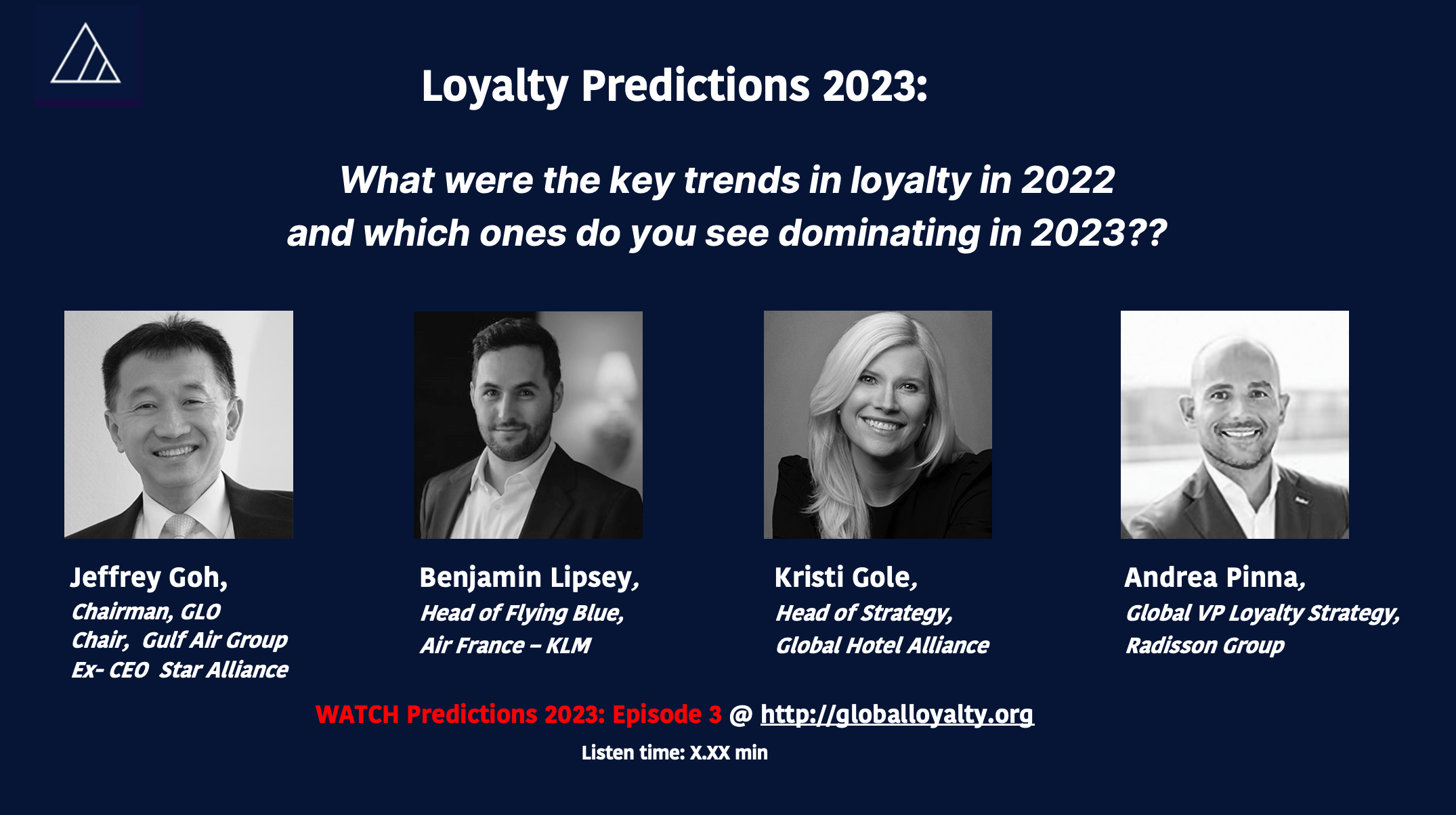
Featuring Heads of the largest global loyalty programs: Jeffrey Goh, Chair Gulf Air Group // Benjamin Lipsey, Head of Flying Blue Air France - KLM // Kristi Gole, Head of Strategy, Global Hotel Alliance // Andrea Pinna, Global SVP Loyalty Strategy, Radisson Hotel Group.
 GLO
GLO
Jeffrey Goh, CEO of Gulf Air Group, ex-CEO Star Alliance: I think it is fair to say that all these trends have been important and anchored the development of loyalty propositions across multiple sectors. But if I was pushed to choose one or two of these, I will want to say that rise of partnerships for me is the underlying trend of what we have seen in the loyalty proposition and loyalty world for the past year or so and certainly as we go forward. I believe that the world of loyalty is changing, and the world of customer engagement is changing. That is a new norm that we must recognise. The convergence of these partnerships will lead to what I call the ecosystem of partners in the loyalty universe. Whether we’re talking about retail, travel, and hospitality industries we’re beginning to see loyalty ecosystems emerging. That is a very exciting development. We will probably see multiple ecosystems emerging in different markets and different sectors. What is even more exciting is perhaps some of these ecosystems coming together in form of consolidation or mergers.
If we look back, during the last two or three years, the second trend is that we are probably going to see more emphasis on experiences. I think the emphasis on experiences had begun to take place prior to the COVID crisis. By having come out of the COVID crisis, society is probably going to appreciate more, at least in the world of air travel, the ability to travel, the ability to experience again, having been deprived of it in a lockdown environment for the last two or three years. So I think, same as in the food & beverage industry customers are looking for better cuisine experiences, the same way they will be looking out for better experiences in air travel, I believe. So these are probably the two most important trends that I see.
Ben Lipsey, Head of Flying Blue, Air France – KLM: In 2022 there was a big focus for us both on gamification as well as emotional loyalty. I see that continuing going forward. I expect a bigger focus across the industry on the emotional aspects of loyalty. I tend to view loyalty programmes as being a driver of “irrational behaviour”, encouraging customers to make decisions they might not have made otherwise if they were thinking purely about the cost of scheduling those kinds of things, and I think you’ve seen a lot of success of a lot of loyalty programmes and a lot of companies, hotel chains and airlines, for example, supermarket chains, beauty chains, because of the power of a loyalty programme, because of that emotional effect. There’s going to be a continued focus on control, after COVID especially given the realignment of people’s travel and shopping patterns, I think there’s going to be a focus on trying to go after consumers in different ways – in ways that cater to them, speak to them better. In ways to answer new demands and new questions.
For us in Europe, sustainability is a really big question, particularly in the airline industry. We’ve launched a couple of interesting features that are unique in the industry. For us, it is responding to a new need because this conversation didn’t exist before. I think as we move forward, we’re going to see more focus on sustainability.
In 2023, there’s probably a big focus on customer retention. As the COVID extension measures are coming to an end, customers might be looking to shop around. They might have had some miles expiring, and they won’t necessarily feel the same sense of emotional obligation to continue to fly with airlines as part of their loyalty programmes I think spending patterns have changed and travel patterns have changed. To keep up with a change in customer behaviour, we have to be adaptable, we have to be nimble, and we have to be willing and ready to adapt.
Sustainability is another major trend, particularly in Europe. In the Netherlands, for example, KLM is struggling to respond to government impetus to try to ban frequent flyer programmes, because some people view them as being inherently and intrinsically unsustainable. It is not certain that this bill is going to pass, but these are the kinds of conversations that are happening. I think there’s going to be a bigger focus on how to respond effectively to flight shaming for example, although it’s a little bit less pronounced than it was when that term was first coined there certainly is guilt that accompanies frequent travel. And so I think you’re going to see more companies in Europe trying to find ways to deal with that. There are links with the rail networks, and incentives for participating in sustainable aviation fuel, which is something we’ve done etc.
And lastly, I think there is going to be a continued focus on emotional loyalty through things like financial relationships, gamification etc. as companies try to keep consumers engaged in an increasingly busy world.
Kristi Gole, Head of Startegy, Global Hotel Alliance:
Kristi: For us, it was partnerships. It’s been something we’ve done for some time because it truly is a great channel – a zero cost channel of acquisition of highly qualified audiences. In the past year we were trying to get our partnerships more structured so that we can do it more at scale. We have had some learnings with that along the way: in certain markets where if you do a tier match, or if you do any currency promotions, some audiences find loopholes and take advantage. A lot of it was trial and error: trying it out, taking it back, cleaning it up, trying it out, and trying to close any gaps or loopholes. And again, we’ve had some good learnings.
I think we’ve put in a good foundation for partnerships this past year to do it more broadly. We’ll need about 10 really strong ones right now globally. We’re planning to focus our efforts on forging long-term partnerships. We know that’s going to be a great way to extend the value proposition to our members and to make sure that we’re attracting different audiences that we can’t get to through other means at such a low cost. Partnerships is a strong focus area within the sector in general as well. All programmes are focusing on growing their partnerships, and I feel it is a big win for everyone involved.
Personalisation has been on everyone’s radar for the past 5-10 years. Everyone wants to do it. Everyone does pieces of it, us included. There are so many versions and variations, and we try so hard, but I think we still have a long way to go to make it relevant, to make it truly what we want it to be. The issue we have here like everyone else is having the right tools. I think the issue that we have there which I feel like we’re not alone as the right tools. We need tools to help us do it. Again, the at-scale piece is the part that’s the hardest. We can do anything we want to but at-scale globally is difficult. And to have that done in an automated fashion is the tricky part. There’s a big challenge. So that’s a piece that we need to improve upon, and we’ll continue to work at that.
Emotional loyalty is something I think very much will continue. I feel that it’s going to continue to grow in its relevance and the perception of customers is truly not just ‘are you connected to a brand, but is that brand representing your value?’ So do they align with it? And it’s not just that it fits your lifestyle, it’s ‘do I like what that brand represents, what it stands for, and does that represent me?’ And that’s where I think some of the decisions are being made on that purpose as opposed to the usual ‘what is your price, what is your promo?’ It’s truly the brand. It’s not just ‘is it cool? Is it sexy?’ It’s truly saying ‘they stand for something that’s at my core, what I believe in.’ And are more and more that’s happening across all different industries like even CPG or like when you’re just buying a soda, you’re buying canned goods, or whatever it is. There’s something about if there was an emotional connection that resonates more at your core about values or principles that’s becoming more and more a focus and I think that that’s not going to go away.
Andrea Pinna, Global VP Loyalty Strategy, Radisson Hotels: For us, the key drivers in 2022 for launching a new programme have been personalisation and enhanced experiences. Personalisation in the new programme has been designed for allowing VIP tier members to decide how they want to personalise their benefits. For example, do they want a discount booster to increase their room discount for future reservations by reducing the number of points that they can earn? Radisson One Reward now provides a fully enhanced digital experience as well on-demand profile online or on their app. For 2023, global partnerships will play an important role in the member proposition offered by the new loyalty programme. Our current revamped programme is more flexible and dynamic, adapting to the rapid lifestyle changes of the traveller and their evolving expectations when they stay, work and meet in our hotels.
